Establishing secure connection…Loading editor…Preparing document…

Oregon Waiver and Consent to Change of Name of Minor Child

This template is fully customizable. Edit the text, fill out the fields, and send it for signature. Give it a try!
Oregon Waiver and Consent to Change of Name of Minor Child

What the Oregon Waiver and Consent to Change of Name of Minor Child Is

The Oregon Waiver and Consent to Change of Name of Minor Child is a legal document used when a minor’s name will be changed and a custodial or noncustodial parent (or other person with parental rights) must either give consent or waive objection. The form records identity details for the child and consenting adult, explains the reason for the name change, and documents whether a parent voluntarily waives the right to receive notice or explicitly consents. Courts review the signed waiver or consent as part of the juvenile or family court petition process before issuing an order changing the minor’s name.

Why this waiver and consent matter for a minor name change

A properly completed waiver or consent clarifies parental agreement and minimizes litigation risk by showing informed consent, which speeds court review and reduces the chance of contested hearings.

Why this waiver and consent matter for a minor name change

Who typically completes this Oregon waiver and consent

Common filers include the custodial parent, noncustodial parent, court-appointed guardian, or an attorney preparing the family court petition.

  • Custodial parent or guardian — Signs to approve the minor’s new legal name and confirms custody status.
  • Noncustodial parent — Provides consent or a formal waiver to avoid required notice or objection proceedings.
  • Attorney or court representative — Prepares documents, verifies signatures, and files the waiver with the court.

Step-by-step: completing the Oregon waiver and consent

Follow these sequential steps to complete and include the waiver in a name-change petition package.

  • 01
    Identify parties: Enter full legal names for child and consenting adult.
  • 02
    Provide details: Record current name, requested new name, and reason for change.
  • 03
    Sign and date: Sign in presence of required witness or notary as instructed.
  • 04
    File with court: Attach waiver to petition and submit to the family or juvenile court.

How to set up a digital workflow for the waiver and petition

Configure an online signing workflow to collect signatures, notarization, and a secure audit trail before filing.

Field Configuration
Signer order Define signing sequence for parent(s) and court representative.
Authentication Use email plus SMS code or knowledge-based ID verification.
Notary integration Enable remote online notarization where permitted.
Retention policy Set storage and export for PDF with audit trail.

Typical online signing and filing flow

Use a simple, secure sequence so consent and related documents are complete and court-ready.

  • Upload documents: Add the waiver, petition, and ID copies.
  • Assign signers: Enter signer emails and set authentication.
  • Collect signatures: Signers receive link and complete fields.
  • Export package: Download full PDF with audit history for filing.

Digital signing and notarization considerations

Store the signed, notarized PDF with a verifiable audit trail and provide the court the original electronic document per local filing rules.

  • Authentication strength: Use multi-factor authentication where possible.
  • Audit trail: Capture IP, timestamps, and signer events.
  • RON availability: Use remote notarization only where state law permits.

Typical timelines and processing expectations

Timelines vary by county and case complexity; plan for court scheduling and required notice windows.

Preparation time:

Allow 1–3 business days to gather IDs and complete forms.

Notarization or witness:

Schedule concurrent signing and notarization within 1–7 days.

Court filing:

Most courts process filings in 1–6 weeks depending on backlog.

Hearing notice:

If required, expect a 2–8 week window for a hearing date.

Final order:

A signed court order may be issued the day of hearing or within a few weeks.

Penalties and risks of incorrect or incomplete waivers

Document rejection: Missing notarization can cause the court to reject the filing.
Delay in proceedings: Incorrect party names or dates will delay hearings and rulings.
Custody disputes: Improper consent may be contested, creating custody implications.
Identity mismatch: Mismatched IDs can require supplemental affidavits or amended filings.
Notary invalidation: Improper notarization or RON performed outside allowed jurisdiction may be void.
Financial consequences: Court-ordered corrections may produce additional filing or attorney fees.

Security and compliance for electronic waivers and consents

Encryption in transit: TLS 1.2/1.3
Encryption at rest: AES-256
ESIGN / UETA: Compliant with federal and most state laws
HIPAA readiness: BAA available where PHI is involved
Audit trail: Comprehensive signer event logs
Standards: SOC 2 Type II and ISO 27001

Common preparation mistakes to avoid

  • Failing to match the child's name exactly to the birth certificate or prior court records causes administrative rejection and requires amendment.
  • Leaving the notarization or witness block incomplete forces a return or court delay and may require in-person re-execution.
  • Using informal or abbreviated names instead of full legal names can create ambiguity and lead to additional verification steps.
  • Sending the waiver without supporting ID copies and the petition reduces the court’s ability to proceed and can extend the timeline.

Key elements included in a professional waiver and consent

A complete waiver and consent should include identity details, explicit consent language, notarization or witness blocks, and clear execution dates for court acceptance.

Child identity

Full legal name, date of birth, and any identifying numbers required by the court, plus current residence information for jurisdictional clarity.
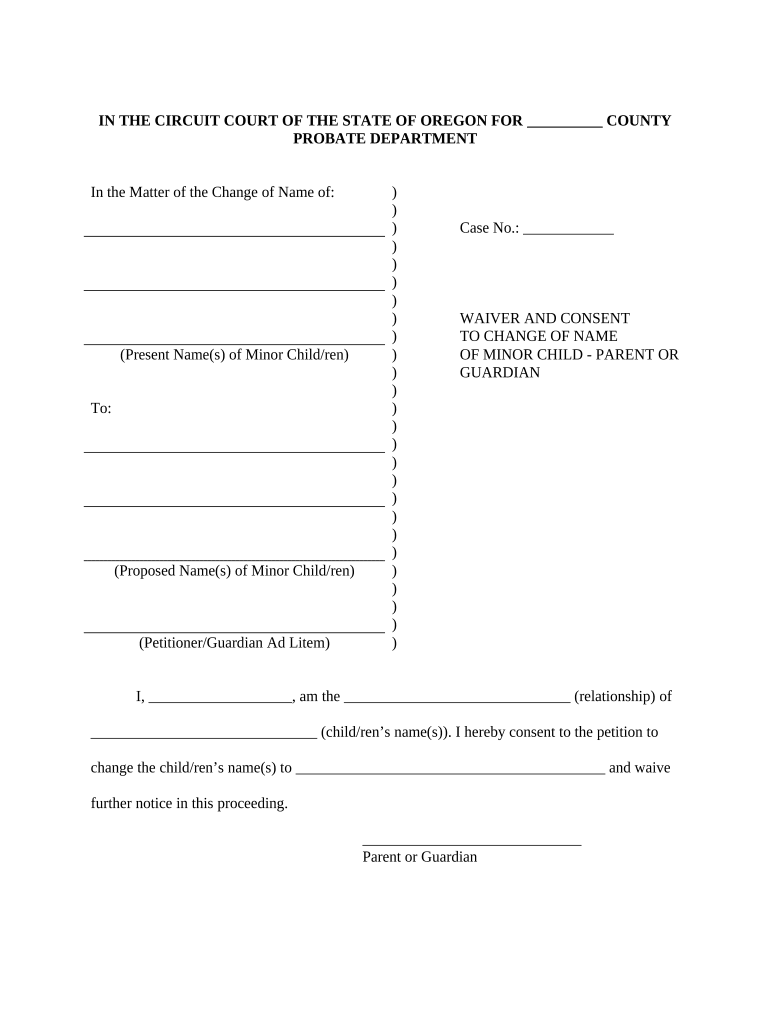
Requested name

The exact proposed new name spelled out fully, so the court order can reflect the precise legal change without ambiguity.

Consent language

A clear statement that the signing parent or guardian consents to the name change or knowingly waives notice rights as allowed by law.

Signature block

Lines for signature, printed name, date, and relationship; includes instruction for witness or notary completion as required.

Notary or witness

Notary acknowledgement or witness signature areas with county and state fields to verify execution and authenticity.

Attachments

Space to list enclosed documents such as birth certificate or proof of parental relationship that support the petition.

Real-world scenarios where the waiver is used

Two brief examples show how the waiver fits into common family court name-change matters.

Uncontested parental consent

A custodial parent petitions for a minor’s name change with the other parent signing a consent form

  • The noncustodial parent signs a notarized waiver to avoid formal notice
  • The court issues the order after verifying consent and supporting documents, minimizing the need for a contested hearing.

Guardian-initiated change

A court-appointed guardian seeks to change a minor’s surname for safety reasons

  • The guardian executes consent where parental rights have been limited
  • The waiver accompanies the petition and court reviews the guardian’s authority and best-interest factors before ruling.

Practical tips for accurate, efficient completion

Follow these best practices to reduce rework and ensure the waiver is court-ready.

Use full legal names
Avoid nicknames and include middle names where they appear on existing legal documents to prevent inconsistencies during processing.
Verify signatory authority
Confirm that the person signing has legal authority (parent, guardian) and document that authority as part of the petition.
Follow notary rules
Complete notarial wording exactly as required by the jurisdiction; for RON, ensure the technology and retention meet state standards.
Keep supporting copies
Attach certified birth certificates, custody orders, or guardianship documents to substantiate the petition and consent.

eSignature provider comparison for executing the waiver and consent

Common provider features and starting prices for electronic signature solutions used to collect consent and notarization; signNow is listed first for comparison.

signNow DocuSign Adobe Sign PandaDoc HelloSign
Starting Price $8/user/mo $15/user/mo $14/user/mo $19/user/mo $15/user/mo
Free Trial 7-day trial Varies Varies Varies Varies
Bulk Send Yes Yes Yes Yes No
Audit Trail Yes Yes Yes Yes Yes
Envelope Cap No cap 100 envelopes/user/year Varies Varies Varies

Frequently asked questions and troubleshooting

Answers to common questions about signing, notarization, and filing the Oregon waiver and consent.


Need help? Contact support

be ready to get more
Join over 28 million airSlate SignNow users