Establishing secure connection…Loading editor…Preparing document…

Contract for Church Organist

This template is fully customizable. Edit the text, fill out the fields, and send it for signature. Give it a try!
Contract for Church Organist

What the Contract for Church Organist Covers

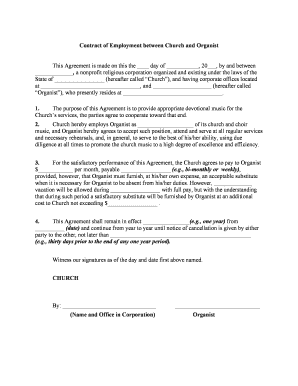
A Contract for Church Organist is a written agreement between a church (or parish) and an organist that defines the services to be provided, compensation, schedule, and the rights and duties of each party. Typical provisions name the parties, describe regular worship services, rehearsals, weddings and funerals, equipment or instrument responsibilities, payment terms (hourly, per service, or stipend), tax classification, confidentiality and intellectual property for service music, termination and notice procedures, and dispute resolution. The contract creates clear expectations for scheduling, replacement coverage, and any additional duties such as choir accompaniment or music selection.

Why a Written Organist Agreement Matters

A clear contract reduces misunderstandings about duties, pay, scheduling, and rights to perform or reproduce music. It documents tax and payroll responsibilities and protects both parties when services occur outside regular worship settings.

Why a Written Organist Agreement Matters

Who Typically Uses this Contract

The contract is used by churches, organists, and administrators to formalize musical services and payment terms.

  • Church Music Director or Pastor — Responsible for arranging services, approving repertoire, and overseeing scheduling and budgets.
  • Freelance or Staff Organist — Seeks written confirmation of duties, hours, compensation, and rehearsal expectations.
  • Parish Administrator or Treasurer — Manages payments, tax forms, and recordkeeping for payroll or independent contractor arrangements.

Use the document whenever hiring, renewing, or changing terms with an organist to ensure consistent expectations and compliance.

Core Elements to Include in a Professional Organist Contract

A well-drafted contract balances operational clarity with legal protections. Include explicit, measurable terms to reduce disputes and support bookkeeping.

Parties

Identify the contracting church entity and the organist by full legal names and business or individual status.
Scope of Services

List services (weekly services, rehearsals, weddings, funerals, special events), expected duration, and any repertoire or selection responsibilities.

Schedule & Availability

Specify recurring days/times, rehearsal expectations, blackout dates, and procedures for substitutions or emergency coverage.

Compensation

State rate (per service, hourly, or stipend), invoicing cadence, reimbursement policies, and whether benefits or payroll withholding apply.

Termination

Define notice period, grounds for immediate termination, and final payment procedures following resignation or dismissal.

Tax & Compliance

Clarify whether the organist is an employee or independent contractor and document required forms such as W-9 and 1099-NEC where applicable.

Step-by-Step: Completing the Contract for Church Organist

Follow these essential steps to prepare, review, and finalize the agreement.

  • 01
    Identify Parties: Enter church legal name and organist name exactly.
  • 02
    Define Services: Describe duties, rehearsals, special events, and any music-selection role.
  • 03
    Set Compensation: Record rates, invoicing schedule, and reimbursements.
  • 04
    Sign and Archive: Obtain dated signatures and store the signed copy securely.

Where to Send and File the Signed Contract

Routing the executed contract ensures payroll, tax, and scheduling systems are updated.

  • Church Office: Keep an original in the church administrative files for access by staff.
  • Organist Copy: Provide a signed copy to the organist for their records and schedule planning.
  • Payroll or Treasurer: Send compensation terms and W-9 information to payroll or the treasurer for processing.
  • Digital Archive: Store an electronic signed copy in the church's document system or secure cloud storage.

How to Customize and Complete the Contract Online

Set up an online template to repeat the process for new hires or renewals while preserving version control.

Field Configuration
Template Name Create a reusable template labeled 'Organist Contract' for consistency
Required Fields Mark name, effective date, compensation, and signature as mandatory
Signer Authentication Use email or SMS verification; stronger ID checks for payroll changes
Notifications Enable email copies to church admin and organist after signing

Digital Signing and Format Considerations

Use an e-signature-capable platform that supports PDF and DOCX and provides an audit trail.

  • File Formats: PDF and DOCX accepted; preserve original layout and signature fields.
  • Integrations: Supports Microsoft 365, Google Workspace, and cloud storage connectors.
  • Security: Audit trail, TLS in transit, and AES-256 at rest recommended.

Choose a platform that meets your security and recordkeeping needs and that can store signed copies for the required retention period.

Important Timelines and Tax-Related Dates

Track contract and tax dates to meet reporting and payroll obligations.

Provide W-9 on Request:

The organist should supply a completed W-9 when requested by a payer.

1099-NEC Reporting:

Issue 1099-NEC to contractors and file with IRS by Jan 31 each year.

Pay Periods:

Document pay frequency (weekly/biweekly/monthly) and net payment terms.

Notice to Terminate:

Observe the contract's specified notice, commonly 30 days for termination.

Contract Review:

Schedule periodic reviews (annual or biannual) for rate or scope adjustments.

Key Milestones from Offer to Ongoing Performance

Use a milestone sequence to track contract lifecycle events and obligations.

01

Offer and Negotiation

Agree on duties, schedule, and pay rates before drafting the contract.

02

Execution

Signatures dated; provide executed copies to both parties and payroll.

03

First Service

Confirm organist attendance and any rehearsal needs for initial services.

04

Performance Review

Conduct a review at the agreed probation point to confirm ongoing fit.

Common Preparation Mistakes to Avoid

  • Vague service descriptions — avoid non-specific language that leaves responsibilities uncertain; list exact events and times.
  • Unclear pay terms — specifying pay rate but not frequency or invoicing requirements causes payment delays and accounting errors.
  • Missing tax forms — failing to request a W-9 can create backup withholding or 1099 reporting issues for the payer.
  • No substitution policy — not documenting replacement procedures or emergency coverage leads to scheduling conflicts and last-minute cancellations.

Required Information and Security Considerations

Parties' Names: Full legal names
Dates: Effective and signature dates
Compensation: Rate and payment terms
Tax Info: W-9 or payroll ID
Authentication: Signer email or MFA
Record Audit: Timestamp and audit trail

Penalties, Liability, and Common Risks

Breach Damages: Contract breach can trigger liquidated or compensatory damages
Tax Penalties: Incorrect classification may cause IRS penalties for the payer
Missing Reporting: Failure to file 1099-NEC timely triggers IRS fines
Payroll Liability: Misclassified employees can create payroll tax liabilities
Intellectual Property: Unclear music rights can result in licensing disputes
Operational Disruption: Lack of substitute policy causes service cancellations

Real-World Contract Scenarios and Outcomes

Two practical examples show how terms affect day-to-day operations and risk allocation.

Local Parish Hire

A small parish engaged a part-time organist for weekly services and funerals with a per-service stipend.

  • The contract specified a 30-day notice for termination.
  • By documenting availability and pay per event, the parish avoided confusion about extra duties and ensured timely payment, reducing disputes and easing scheduling for pulpit supply and choir leadership.

Contractor for Weddings

A freelance organist provided accompaniment for weddings and rehearsals as independent services.

  • The agreement required a W-9 and invoicing within 30 days.
  • Clear invoicing and a clause for travel reimbursement streamlined billing and made year-end 1099-NEC reporting straightforward for the church treasurer.

eSignature Pricing Comparison for Executing the Contract

A concise vendor comparison helps select a signing platform that meets security and cost needs; signNow is listed first per table convention.

signNow DocuSign Adobe Sign PandaDoc HelloSign
Starting Price $8/user/mo $15/user/mo $14/user/mo $19/user/mo $15/user/mo
Free Trial 7-day free trial, no card Varies Varies Varies Varies
Bulk Send Yes (Business Premium) Varies Varies Varies Varies
Audit Trail Yes Yes Yes Yes Yes
HIPAA Compliant Yes Yes Yes No No

Practical Tips for Accurate and Efficient Contract Completion

Adopt clear drafting and operational practices to minimize disputes and administrative overhead.

Be Specific About Duties and Hours
List exact days, times, and expected duration for services and rehearsals to prevent scheduling conflicts; include substitute procedures and specify whether travel time or setup is separately compensated.
Clarify Payment Mechanics
State the payment amount, method, who issues payment, invoicing deadlines, and reimbursement rules; document whether the organist receives a stipend or is on payroll to guide tax handling.
Include Termination and Notice Terms
Define shorter and longer notice periods for resignation and termination, and list cause-based termination rights to avoid ambiguity and protect both parties.
Maintain Organized Records
Retain signed copies, W-9s, and invoices in a secure archive, and record dates of service and payments to support year-end reporting and dispute resolution.

Frequently Asked Questions About the Contract for Church Organist

Answers to common questions about e-signing, tax reporting, notarization, classification, and amendments.


Need help? Contact support

be ready to get more
Join over 28 million airSlate SignNow users