Establishing secure connection…Loading editor…Preparing document…

Contract for Promotion and Production of Annual Online Sports Competition

This template is fully customizable. Edit the text, fill out the fields, and send it for signature. Give it a try!
Contract for Promotion and Production of Annual Online Sports Competition

What this contract covers and when it applies

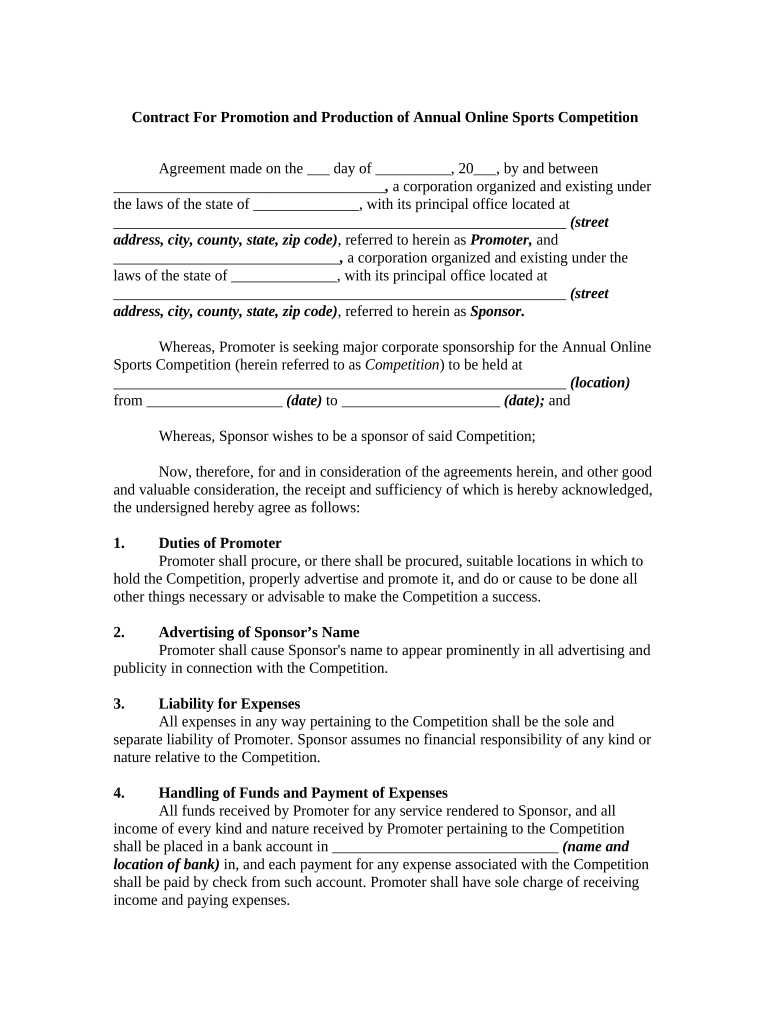
The Contract for Promotion and Production of Annual Online Sports Competition is a written agreement that allocates responsibilities, rights, and payment terms between the promoter, production services, sponsors, and any hosting platform. It typically covers scope of promotional activities, deliverables and production milestones, intellectual property and broadcast rights, sponsor placements, payment schedule and invoicing, participant eligibility, insurance and indemnity, data collection and privacy obligations, and termination conditions. Use this contract to document expectations for a recurring annual online sports event to reduce disputes and clarify financial and legal responsibilities among parties.

Why a formal promotion and production contract matters

A clear contract minimizes dispute risk, defines deliverables and payment schedules, protects intellectual property and usage rights, and records compliance obligations such as privacy and tax reporting. It also creates an auditable record for sponsors, vendors, and platforms.

Why a formal promotion and production contract matters

Common parties and stakeholders who use this contract

Typical users include event promoters, production companies, digital platforms, sponsors, and independent contractors who provide services to online sporting events.

  • Event promoters and rights holders managing event marketing and commercial relationships.
  • Production vendors handling streaming, graphics, commentary, and technical delivery.
  • Sponsors and advertisers securing placement, measurement, and exclusivity clauses.

Use this contract when roles, payments, IP assignments, or sponsor commitments must be documented formally to protect parties and enable reliable delivery year over year.

Who signs this agreement and in what capacity

Promoter — Executive

The promoter is usually an officer or authorized representative who controls commercial terms and sponsorships; signatory must have corporate authority to bind the organization and approve revenue sharing.

Production Company — Authorized Rep

A production company signatory should be the project manager, COO, or another person authorized to commit resources, subcontract work, and accept liability for delivery and technical compliance.

Core clauses to include in a professional production and promotion contract

Include specific, enforceable language for operational, commercial, and legal items so each party understands obligations and remedies.

Scope of Work

Detailed description of promotional activities, production deliverables, streaming specifications, and acceptance criteria for each milestone.
Payment Terms

Explicit fees, payment schedule, invoicing procedures, late payment interest, and conditions for withholding or setoff.

Intellectual Property

Ownership and licensing of footage, branding, trademarks, sponsor assets, and rights to use recordings across channels.

Sponsor Rights

Placement, exclusivity, reporting metrics, and remedies for failure to deliver promised impressions or placements.

Insurance and Indemnity

Minimum insurance limits, naming additional insureds, indemnification scope, and responsibility for third-party claims.

Data and Privacy

Limits on personal data collection, retention, security measures, and compliance with HIPAA or other applicable rules when health data is involved.

Step-by-step: completing the contract

Follow these steps in order to produce a signed, enforceable agreement and prepare for production and promotion activities.

  • 01
    Draft core terms: Confirm scope, deliverables, and payment milestones in plain language.
  • 02
    Allocate IP and rights: Specify ownership, licensing, and broadcast rights clearly.
  • 03
    Add compliance clauses: Include privacy, insurance, and tax-related obligations.
  • 04
    Execute and retain: Obtain authorized signatures and store copies securely.

How to configure an online signing workflow

Set up fields, authentication, and routing so signatures are captured and the audit trail is preserved.

Field Configuration
Signature Authentication Email link, SMS code, or higher assurance if required
Conditional Fields Show sponsor clauses only when sponsorship selected
Bulk Send Use for mass sponsor agreements or talent releases
Audit Trail Capture IP, timestamp, and signer actions automatically

Where and how to send the completed contract

Decide destination and distribution method before signing to ensure countersignature and recordkeeping go smoothly.

  • Send to Sponsor: Email the signed copy to sponsor contact and accounts payable
  • Provide to Production: Deliver executed SOW to production manager and technical lead
  • Upload to Platform: Archive the signed contract in the project document repository
  • Distribute to Legal: Send final executed copy to legal for retention and audit

Digital signing and platform integration considerations

Choose a signing platform that preserves signatures, audit trails, and required authentication.

  • Integrations: Salesforce, NetSuite, Google Workspace supported
  • File formats: PDF and DOCX maintain field fidelity
  • Authentication: Email, SMS, or advanced signer verification

Integration with CRM, document storage, and accounting systems reduces manual steps and centralizes executed agreements for future reference.

Security and compliance features to include

Encryption in transit: TLS 1.2/1.3 protected
Encryption at rest: AES-256 encrypted storage
Audit logs: Complete signing history captured
HIPAA readiness: BAA available when required
Regulatory support: 21 CFR Part 11 compliant options
Certifications: SOC 2 Type II and ISO 27001

Key penalties and legal risks to watch for

Breach liability: Monetary damages and reputational harm
Tax consequences: Backup withholding 24% for faulty TINs
Late reporting: 1099 penalties per IRC §6721
Privacy fines: HIPAA or state penalties possible
Insurance gaps: Uninsured claims shift to contracting party
IP disputes: Claims if rights not clearly assigned

Common preparation mistakes to avoid

  • Using vague scope language that omits technical delivery specifications, which invites disagreement about acceptance.
  • Failing to link payment milestones to measurable deliverables, creating disputes over whether work was completed.
  • Neglecting to include data-privacy or sponsor reporting obligations, which can violate contracts or regulatory requirements.
  • Overlooking signer authority or failing to confirm corporate signatory powers, which can invalidate the agreement.

eSignature vendor comparison relevant to contract execution

Compare basic pricing and key feature availability; signNow is listed first per vendor comparison standards.

signNow DocuSign Adobe Sign PandaDoc HelloSign
Starting Price $8/user/mo $15/user/mo $14/user/mo $19/user/mo $15/user/mo
Free Trial 7-day free trial Varies by plan Varies by plan Varies by plan Varies by plan
Bulk Send Yes Yes Yes Yes No
Audit Trail Yes Yes Yes Yes Yes
HIPAA Compliant Yes Yes Yes No No
Envelope Cap No cap 100 envelopes/user/yr Varies by plan Varies by plan Varies by plan

Contract timelines and typical deadline items

Set clear dates for deliverables, payments, insurance, and tax reporting to avoid missed obligations and penalties.

Execution Date:

Date contract is signed and obligations commence

Payment Milestones:

List specific due dates tied to deliverable acceptance

Insurance Certificate Due:

Require certificate of insurance before production starts

Sponsor Activation:

Dates for sponsor assets to be provided and approved

Tax Reporting:

Collect W-9s early to avoid 24% backup withholding

Practical tips for accurate and efficient completion

Adopt consistent templates, clear milestone language, and digital signing to reduce friction and errors.

Use standardized templates
Start from a well-reviewed template to ensure essential clauses are included and reduce attorney review time.
Tie payments to deliverables
Define objective acceptance criteria for each milestone to prevent payment disputes and align expectations.
Confirm signer authority
Verify signatory capacity and include corporate title to ensure enforceability and prevent later challenges.
Preserve the audit trail
Use an eSignature solution that records timestamps, IP addresses, and signer events for evidentiary support.

Real-world examples of online event document workflows

Organizations use eSignature and clear contracts to speed execution and improve compliance for digital events.

Optica Ventures — COO

Optica used standardized agreements for recurring online competitions to reduce administrative time and ensure consistency.

  • They used a single template across vendors and sponsors to scale.
  • "The interface is simple and easy-to-use for our team; more importantly, it is just as easy for our customers."

Tech Data — CEO

Tech Data centralized contract signing and production approvals to streamline sponsorship onboarding.

  • Bulk send and templates reduced turnaround time.
  • "Tech Data uses airSlate SignNow to improve our internal and external customer service while increasing our speed to revenue."

Frequently asked questions about execution and compliance

Answers to common questions about electronic signing, notarization, and post-execution steps for this contract.


Need help? Contact support

be ready to get more
Join over 28 million airSlate SignNow users