Establishing secure connection…Loading editor…Preparing document…

Sale of Copyright to a Published Book

This template is fully customizable. Edit the text, fill out the fields, and send it for signature. Give it a try!
Sale of Copyright to a Published Book

What the Sale of Copyright to a Published Book Means

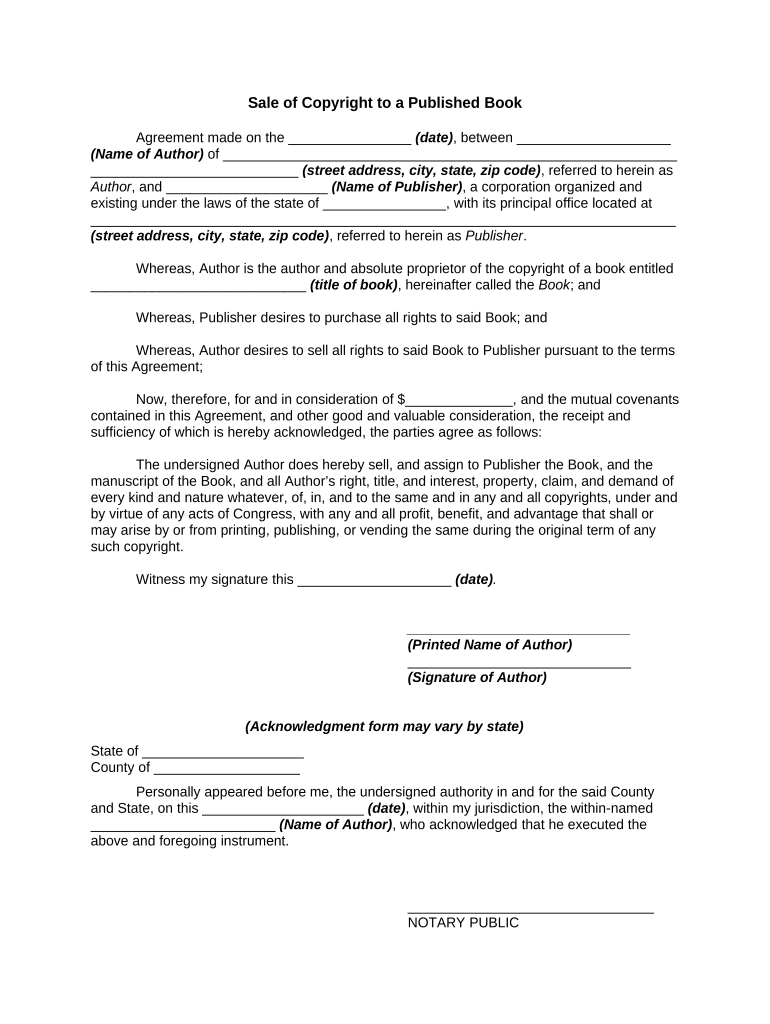
The Sale of Copyright to a Published Book is a legal agreement transferring ownership of the copyright in a published literary work from the original copyright holder (assignor) to another party (assignee). It documents the rights conveyed — whether all exclusive rights or specific subsets such as reproduction, distribution, adaptation, and public performance — and records the effective date, consideration, retained moral rights, and any licenses. The agreement commonly includes representations, warranties, indemnities, and signed execution blocks and may be recorded with the Copyright Office for priority and enforcement purposes.

Why a Written Sale Is Important

Transferring copyright by a written Sale of Copyright to a Published Book provides legal clarity over ownership and exploitation rights, supports licensing and enforcement, and reduces the risk of competing claims while documenting compensation and responsibilities for both parties.

Why a Written Sale Is Important

Who Typically Prepares and Signs This Assignment

Creators, publishers, literary agents, and acquiring companies commonly use the Sale of Copyright to a Published Book when transferring ownership.

  • Independent authors selling all their copyright and associated exploitation rights to a publisher or corporate buyer.
  • Publishers acquiring backlist titles to consolidate rights for reprints, translations, and licensing.
  • Literary estates or heirs transferring copyright as part of estate administration or an asset sale.

Step-by-Step: Prepare, Execute, and Record the Assignment

Follow these steps to prepare, execute, and record a Sale of Copyright to a Published Book accurately and in compliance with applicable law.

  • 01
    Draft Agreement: Describe scope of rights, exclusions, and consideration clearly.
  • 02
    Collect Identifiers: Include title, ISBN, publisher, and publication date.
  • 03
    Sign & Notarize: Obtain signatures and notarization if required or desired.
  • 04
    Register/Record: Consider recording assignment with the Copyright Office for priority.

Set Up an Electronic Workflow for Execution

Configure your online workflow to collect signatures, verify identities, and retain an audit trail for the copyright sale.

Workflow Field and Configuration Name Configuration
Signer Authentication and Verification Method Use email link; add SMS or ID verification for higher assurance.
Required Signature and Initials Field Settings Mark signature, date, and initials as required fields.
Document Retention and Audit Trail Settings Retain signed PDF and audit log per your retention policy.
Final Distribution and Archiving Instructions Deliver copies to all parties and securely archive master file.

Platform Capabilities to Look For

Choose a platform that supports secure e-signatures, detailed audit trails, role-based access, and optional notarization for assignments.

  • Formats Supported: PDF, DOCX, and HTML formats supported.
  • Authentication Options: Email, SMS, or knowledge-based verification available.
  • Integrations: Connect to Salesforce, NetSuite, Google Workspace.

How Electronic Execution Typically Works

Basic process for completing, executing, and delivering a Sale of Copyright to a Published Book electronically while preserving legal evidence.

  • Upload: Upload the agreement and any exhibits.
  • Place Fields: Add signature, initials, and date fields.
  • Authenticate: Select email, SMS, or stronger ID checks.
  • Complete: Collect signatures and distribute executed copies plus audit trail.

Core Clauses Every Assignment Should Include

Essential clauses and structural elements to include in a professionally drafted Sale of Copyright to a Published Book to ensure clarity, enforceability, and transferability of rights.

Rights Conveyed

Enumerate transferred exclusive rights (reproduction, distribution, public performance, adaptation, derivatives), specify geographic scope, media, and any retained rights to avoid later disputes.
Consideration

Set precise monetary sums, royalty rates, payment schedule, currency, escrow arrangements, and tax responsibility to prevent ambiguity and support tax reporting.

Warranties and Representations

Assignor should warrant ownership, absence of conflicting agreements, and authority to assign; include indemnities and remedies for breach or third-party claims.

Moral Rights & Attribution

Address whether moral rights are waived or retained, define attribution language, and note any approval rights for adaptations or derivative works.

Assignment Mechanics

Specify effective date, delivery of executed instruments, required approvals, and procedure to record assignment with the Copyright Office if the parties elect to do so.

Recordkeeping & Audit Rights

Require access to sales records, audit rights for royalty verification, and remedies for underreporting or unauthorized sublicensing.

Essential Data Fields to Include

Assignor: Full legal name and contact details
Assignee: Full legal name, entity type, and tax ID
Work Identifier: Title, publisher, publication date, ISBN
Effective Date: MM/DD/YYYY format
Consideration: Amount, royalty formula, or other value
Signatures: Names, titles, dates, and any notary details

Common Risks and Legal Consequences

Invalid Assignment: Void if assignor lacks authority
Tax Reporting: Possible backup withholding at 24%
Royalty Claims: Disputes over unpaid or misallocated royalties
Recording Omission: May affect priority against later claimants
Notarization Omitted: Can complicate ancillary estate or trust filings
Third-Party Claims: Risk of infringement litigation

Avoid These Common Preparation Errors

  • Vague scope language that fails to specify media, territory, or duration often leads to disputes over permitted exploitation and license scope.
  • Omitting precise consideration terms or payment schedules creates ambiguity in royalty computation and can trigger collection or audit conflicts.
  • Using incomplete work identifiers (missing ISBN or publication date) increases the risk of later title-misidentification and enforcement problems.
  • Failing to confirm signatory authority or missing corporate resolutions can render an assignment unenforceable against third parties or in litigation.

Time-Sensitive Items to Track

Track key dates for effectiveness, payment, recording, tax reporting, and retention to avoid missed obligations or reduced remedies.

Effective Date Entry:

Enter as MM/DD/YYYY; governs when rights transfer.

Payment Schedule Dates:

Define due dates, milestones, and late-payment remedies.

Record Assignment:

Consider recording with Copyright Office to preserve priority.

Tax Reporting Timing:

Report sale proceeds and consult relevant IRC rules.

Document Retention:

Keep executed copies according to tax and audit rules.

Key Milestones from Negotiation to Post-Closing

A clear sequence of negotiation, execution, payment, and post-closing obligations helps ensure an orderly transfer and enforceable records.

01

Negotiation

Agree on scope of rights, exclusions, and price.

02

Execution

Obtain signatures, notarization, and deliver instruments.

03

Payment

Complete payment per the agreed schedule and receipts.

04

Recording & Post-Closing

Record assignment if chosen; fulfill audits and reporting.

Practical Examples of How Assignments Are Used

These examples show typical transactions where a Sale of Copyright to a Published Book clarifies rights, payment, and ongoing duties.

Publisher Acquisition

A mid-size publisher purchases global rights to a backlist title to reissue and license translations.

  • Assignment covers print, ebook, and audio rights and limited merchandising.
  • The agreement specified a lump-sum payment plus tiered royalties, required recording with the Copyright Office, and included indemnities for prior licensing errors to reduce future litigation risk.

Author Estate Sale

An author’s estate assigns copyright to a foundation managing legacy works and charitable licensing.

  • Estate retains certain moral rights and attribution terms.
  • The sale clarified duration, charitable licensing percentages, and enforcement procedures; the estate recorded the assignment and preserved receipts for tax and fiduciary audit purposes.

eSignature Vendor Pricing and Feature Snapshot

Compare common pricing and feature criteria across major eSignature providers to select an appropriate platform for executing and storing copyright assignments.

signNow DocuSign Adobe Sign PandaDoc HelloSign
Starting Price $8/user/mo $15/user/mo $14/user/mo $19/user/mo $15/user/mo
Free Trial 7-day free trial Varies by plan Varies by plan Varies by plan Varies by plan
Bulk Send Yes (plan dependent) Varies by plan Varies by plan Varies by plan Varies by plan
Audit Trail Yes Yes Yes Yes Yes
HIPAA Compliant Yes Yes Yes No No

Frequently Asked Questions and Practical Answers

Common questions about execution, recording, electronic signatures, corrections, and retention are answered below to help avoid execution pitfalls.


Need help? Contact support

be ready to get more
Join over 28 million airSlate SignNow users