Establishing secure connection…Loading editor…Preparing document…

Joint Petition for Modification of Visitation Rights

This template is fully customizable. Edit the text, fill out the fields, and send it for signature. Give it a try!
Joint Petition for Modification of Visitation Rights

What the Joint Petition for Modification of Visitation Rights Is

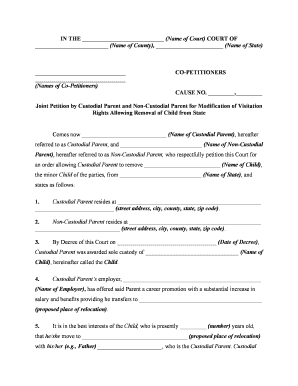
A Joint Petition for Modification of Visitation Rights is a signed court filing in which both parents or legal guardians ask a family court to change an existing visitation or parenting-time order. The document explains the current order, the specific changes requested, the reasons for modification, and any proposed new schedule or conditions. When both parties agree, a joint petition can simplify court processing by showing mutual consent, but the judge retains discretion to approve, modify, or deny the requested changes based on the child's best interests and applicable state law.

Why a Joint Petition Matters for Families and Courts

A jointly filed modification request signals agreement and can reduce contested hearing time, streamline evidence, and help the court focus on the child's best interests.

Why a Joint Petition Matters for Families and Courts

Who Typically Uses a Joint Petition for Modification of Visitation Rights

This petition is most relevant when both parents or guardians seek to change an existing parenting-time order by mutual consent.

  • Cooperative parents or guardians agreeing to a new schedule or conditions.
  • Family law attorneys preparing a joint, court-ready modification package.
  • Mediators or parenting coordinators documenting an agreed change for court approval.

Essential Parts of a Professional Joint Petition for Modification

A professionally prepared joint petition organizes the request clearly, attaches supporting evidence, and identifies precise changes to current visitation terms to assist the judge and court staff.

Caption

Court name, case number, and party names at the top of the petition for correct docket assignment and identification.
Background

Short summary of the existing order, the date it was entered, and any prior modifications relevant to the current request.

Requested Changes

Precise language describing new parenting-time schedules, pickup/drop-off details, holiday arrangements, and any supervised or suspended visitation terms.

Reasoning

Concise factual basis for modification (changed circumstances, relocation, parental agreement) as they relate to the child's best interests.

Support Attachments

Affidavits, school or medical records, signed agreement between parents, and any proposed parenting plan or schedule exhibits.

Signatures

Signature blocks for both parties, dates, and any attorney signature lines showing consent and verification of facts.

Step-by-Step: Filing a Joint Petition for Modification of Visitation Rights

Follow these practical steps to prepare, file, serve, and present a joint petition so the court can consider an agreed modification efficiently.

  • 01
    Prepare Draft: Draft petition with attachments and proposed order.
  • 02
    Review Agreement: Both parties review and sign the petition.
  • 03
    File with Court: Submit petition to the clerk's office or e-file portal.
  • 04
    Serve Parties: Serve copies per state rules and await hearing date.

Customizing an Online Workflow for Joint Petition Submission

Configure an online template and signer workflow to collect signatures, attachments, and service affidavits before court filing.

Template Prebuilt petition with required fields and attachment placeholders
Signer Order Simultaneous signing allows both parties to sign in any order
Authentication Email plus optional SMS code for signer verification
Conditional Fields Show additional fields when relocation or supervision is checked
Notifications Automatic send of completed copies to parties and attorney

Where and How to File, Serve, and Submit the Petition

Filing and service procedures vary by state and county; use the local family court clerk or approved electronic filing system and follow service rules precisely.

  • Court Clerk Filing: File petition at family court clerk or via authorized e-filing portal
  • Service of Process: Serve respondent using certified methods required by state law
  • Submit Proposed Order: Attach a proposed signed order for judge to approve or modify
  • Certificate of Service: File affidavit proving service before the hearing

Technical Considerations for eSigning and eFiling

Use an eSignature platform compatible with court e-filing and capable of secure signer authentication and tamper-evident records.

  • File Formats: PDF/A and DOCX accepted
  • Authentication: Email, SMS code, and advanced options
  • Integrations: E-filing portals and cloud storage

Typical Timelines and Court Deadlines to Expect

Timeframes vary by jurisdiction; the following are common milestones to plan around when filing a joint modification request.

Response Period:

Services and responses often required within 20–30 days

Hearing Scheduling:

Court commonly schedules a hearing within 30–90 days

Temporary Orders:

Judge may issue temporary visitation pending final hearing

Service Deadline:

Proof of service must typically be filed before the hearing

Appeal Window:

Post-order appeals follow state-specific appeal timelines

Key Processing Milestones for a Joint Petition

Track these sequential milestones from preparation through the final court decision to monitor progress and avoid delays.

01

Drafting and Signatures

Prepare the petition, attachments, and collect signatures from both parties.

02

Filing and Docketing

Submit to the clerk or e-file portal and receive a docket number.

03

Service and Proof

Serve opposing party and file a certificate or affidavit of service.

04

Hearing and Order

Attend hearing; judge issues temporary or final signed order.

Required Data Elements to Include in the Petition

Petitioner: Full legal name, address
Respondent: Full legal name, address
Case Number: Existing docket or case number
Child Details: Child name(s) and DOB(s)
Existing Order: Order date and court name
Requested Change: Specific new schedule and conditions

Penalties, Risks, and Consequences of Errors

Improper Service: May result in case dismissal
Delay: Hearing rescheduling and backlog
Contempt Risk: Violating current orders risks penalties
Financial Costs: Additional filing and attorney fees
Custody Impact: Court may reassess custody arrangements
Denied Modification: Request may be rejected by judge

Common Preparation Mistakes to Avoid

  • Failing to attach the existing order or including an incorrect order date can prevent the court from locating the case history and delay review.
  • Using inconsistent names or incomplete addresses for either party often leads to defective service and questions about proper notice.
  • Submitting an ambiguous or incomplete proposed schedule without times, locations, or handoff procedures forces clarification hearings and creates enforcement issues.
  • Neglecting to file a certificate or affidavit proving service before the hearing can result in the court continuing or dismissing the petition.

Frequently Asked Questions About Joint Petitions for Visitation Modification

Answers to common questions about form validity, signatures, filing, and typical court responses when both parties submit a joint petition.


Need help? Contact support

be ready to get more
Join over 28 million airSlate SignNow users