Establishing secure connection… Loading editor… Preparing document…
Navigation

Fill and Sign the Debtor Pro Se Form
Fill and Sign the Debtor Pro Se Form

How it works

Open the document and fill out all its fields.
Apply your legally-binding eSignature.
Save and invite other recipients to sign it.

Rate template

4.5
49 votes
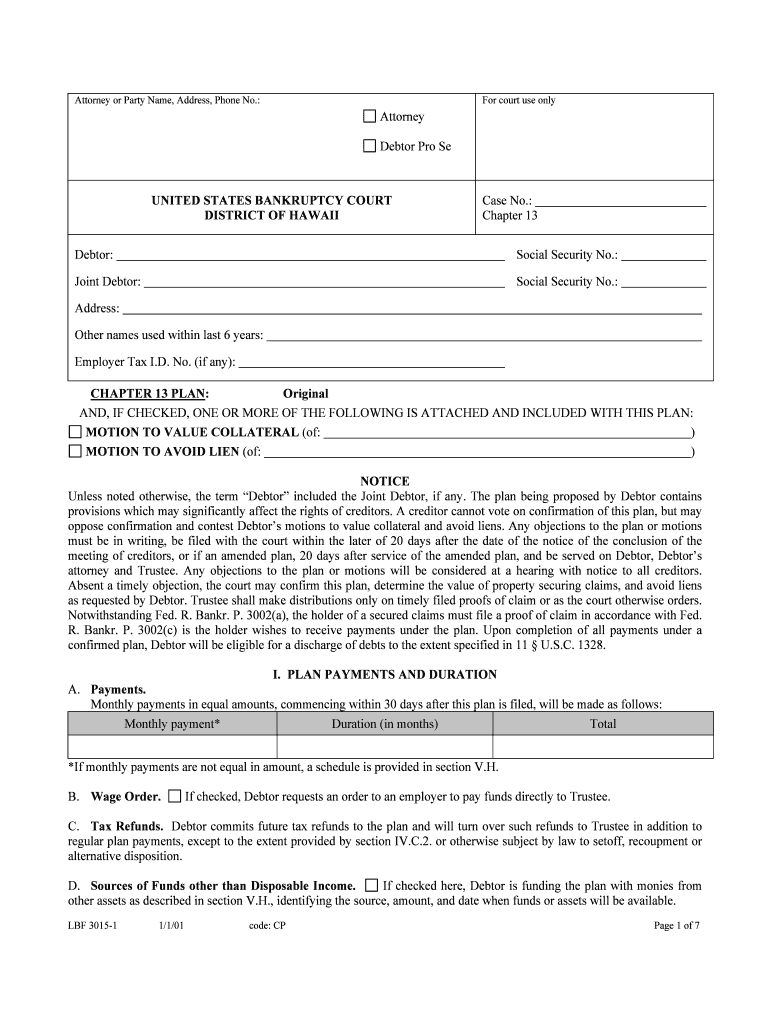
LBF 3015-11/1/01code: CP Page 1 of 7Attorney or Party Name, Address, Phone No.: Attorney Debtor Pro Se For court use only UNITED STATES BANKRUPTCY COURT DISTRICT OF HAWAII Case No.: Chapter 13Debtor: Social Security No.: Joint Debtor: Social Security No.: Address: Other names used within last 6 years: Employer Tax I.D. No. (if any): CHAPTER 13 PLAN: OriginalAND, IF CHECKED, ONE OR MORE OF THE FOLLOWING IS ATTACHED AND INCLUDED WITH THIS PLAN: MOTION TO VALUE COLLATERAL (of: ) MOTION TO AVOID LIEN (of: ) NOTICE Unless noted otherwise, the term “Debtor” included the Joint Debtor, if any. The plan being proposed by Debtor contains provisions which may significantly affect the rights of creditors. A creditor cannot vote on confirmation of this plan, but may oppose confirmation and contest Debtor’s motions to value collateral and avoid liens. Any objections to the plan or motions must be in writing, be filed with the court within the later of 20 days after the date of the notice of the conclusion of the meeting of creditors, or if an amended plan, 20 days after service of the amended plan, and be served on Debtor, Debtor’s attorney and Trustee. Any objections to the plan or motions will be considered at a hearing with notice to all creditors. Absent a timely objection, the court may confirm this plan, determine the value of property securing claims, and avoid liens as requested by Debtor. Trustee shall make distributions only on timely filed proofs of claim or as the court otherwise orders. Notwithstanding Fed. R. Bankr. P. 3002(a), the holder of a secured claims must file a proof of claim in accordance with Fed. R. Bankr. P. 3002(c) is the holder wishes to receive payments under the plan. Upon completion of all payments under a confirmed plan, Debtor will be eligible for a discharge of debts to the extent specified in 11 § U.S.C. 1328. I. PLAN PAYMENTS AND DURATION A.Payments. Monthly payments in equal amounts, commencing within 30 days after this plan is filed, will be made as follows: Monthly payment*Duration (in months) Total *If monthly payments are not equal in amount, a schedule is provided in section V.H.B.Wage Order. If checked, Debtor requests an order to an employer to pay funds directly to Trustee. C.Tax Refunds. Debtor commits future tax refunds to the plan and will turn over such refunds to Trustee in addition to regular plan payments, except to the extent provided by section IV.C.2. or otherwise subject by law to setoff, recoupment or alternative disposition.D.Sources of Funds other than Disposable Income. If checked here, Debtor is funding the plan with monies from other assets as described in section V.H., identifying the source, amount, and date when funds or assets will be available. LBF 3015-11/1/01code: CP Page 2 of 7 II. DISTRIBUTION OF PLAN PAYMENTS A.Administrative Expenses. Trustee’s fee of 10% or the percentage fee set by 28 U.S.C. § 586(e) will be paid in advance of all other claims. Unpaid Debtor’s attorney fees approved by the court will be paid before or at the same time as each payment to other creditors. Debtor’s attorney opts for allowance and payment under the Chapter 13 Attorney Fee Guidelines as follows: Attorney fees for Chapter 13 case Amount paid prepetition Balance Due Debtor’s attorney opts out of the Chapter 13 Attorney Fee Guidelines and will seek allowance of fees under applicable authority, including 11 U.S.C. §§ 329 & 330, Fed. R. Bankr. P. 2002, 2016 & 2017, and the court’s general Guidelines for Compensation and Expense Reimbursement of Professionals and Trustees.Administrative expenses Est. monthly amountNo. months Total Trustee10% = Debtor’s attorney Other (explain in section V.H.) B. Secured Claims. Class 1. Long-term secured claims that were delinquent when the petition was filed and that mature after the last payment under the plan. Except for the curing of an arrearage, these claims are not modified by the plan and creditors holding these claims will retain their liens. Distributions to cure prepetition arrearages, with interest (10% unless specified otherwise), will be paid pro rata with other secured claims through the plan. All payments due postpetition will be made directly by Debtor unless listed in section II.F. “Arrearage” includes principal owed, accrued and unpaid interest and other charges, such as attorney fees and foreclosure costs, through the date the petition was filed. Debtor’s statement of arrearage and monthly payment is a good faith estimate only and distributions will be determined by the arrearage stated in a proof of claim timely filed and allowed. Treatment of a prepetition arrearage under an unexpired lease or executory contract is provided for in section II.D. below. Creditor/Collateral Est. arrearage Interest Est. mo. pmt. [Continue in section V.H. or on continuation sheet as necessary.] Class 2. Secured claims which are modified by this plan or that will not extend beyond the plan’s duration. This class includes any secured claim that has matured or will mature prior to the completion of the plan. It also includes any secured claim, regardless of its maturity date, that is modified as permitted by 11 U.S.C. § 1322(b)(2) or (c)(2). Holders of Class 2 secured claims will retain any lien or security interest. They will be paid the full amount of the secured claims as stated on the creditor’s timely filed proof of claim, or the market value of their collateral, whichever is less, together with interest (10% unless specified otherwise). If Debtor believes that the market value of a creditor’s collateral is less than the amount of the claim, Debtor must include a Motion to Value Collateral with this plan. Any deficiency, i.e. the difference between the amount of the claim and the value of the collateral, will be treated as a Class 7 general unsecured claim unless the deficiency is a priority claim under Class 5. “Claim amount” includes principal owed, accrued and unpaid interest and other charges, such as attorney fees and foreclosure costs, through the date the petition was filed. Debtor’s statement of claim amount, market value and monthly payment is a good faith estimate only. LBF 3015-11/1/01code: CP Page 3 of 7(Class 2 – cont’d) Creditor/Collateral Claim amountMarket valueInterestEst. mo. pmt. [Continue in section V.H. or on continuation sheet as necessary.] Motion(s) to Value Collateral attached (LBF 3015-506 for personal property; not for use with real property). Creditor(s): Class 3. Secured claims satisfied by the surrender of collateral. As to personal property, Debtor will offer to surrender the property not later than 5 days after entry of the order confirming this plan. As to real property, Debtor consents to termination of the stays under 11 U.S.C. §§ 362(a) & 1301(a) to permit the secured creditor whose collateral is being surrendered to receive or foreclose upon that collateral and to exercise its rights and remedies as to its collateral. Entry of the order confirming this plan will constitute an order terminating the stays under 11 U.S.C. §§ 362(a) & 1301(a). Debtor will surrender possession not later than after entry of an order confirming sale or, in a nonjudicial foreclosure, after recordation of the mortgagee’s affidavit after sale. A secured creditor listed in Class 3 wishing to refuse Debtor’s surrender of collateral in full or partial satisfaction of its claim must file a written objection to this plan. The filing of a declaration by Debtor that the personal or real property has been surrendered, with proof of service on the creditor, will result in no distribution, as a secured claim, to a creditor listed below filing a proof of claim. Creditor/Collateral Claim amountEst. deficiency [Continue in section V.H. or on continuation sheet as necessary.] Class 4. Claims to be paid directly by Debtor or third party. This class is limited to (i) secured claims which extend beyond the length of the plan, were not delinquent when the bankruptcy was filed, and are not modified by this plan; and (ii) claims which will be paid with money or property not belonging to Debtor or to the bankruptcy estate. Holders of Class 4 claims will retain their liens and security interests. These claims are not modified in any respect, are not provided for under the plan, and will receive no distributions. Any proof of claim concerning the creditor and collateral listed below will be disregarded by Trustee for distribution purposes, unless the collateral later is surrendered, resulting in a deficiency claim. Creditor/Collateral Regular paymentMaturity date [Continue in section V.H. or on continuation sheet as necessary.] LBF 3015-11/1/01code: CP Page 4 of 7C.Unsecured Claims. Class 5. Priority unsecured claims. Claims, such as claims for delinquent child and spousal support and certain types of taxes, entitled to priority under 11 U.S.C. § 507, will be paid in full by deferred payments in installments after satisfaction of claims included in Classes 1 and 2, and before payment on other unsecured claims. Notwithstanding the amounts listed below, payments on priority unsecured claims will be made in accordance with timely filed proofs of claim unless the court otherwise orders. A holder of a particular claim entitled to priority but agreeing to other than full payment shall amend the proof of claim. Class 5 includes the under collateralized portion of a secured claim entitled to priority treatment. Creditor Type of priority Est. claim amount [Continue in section V.H. or on continuation sheet as necessary.] Class 6. Special unsecured claims. The following unsecured claims, such as co-signed unsecured claims, will be paid in full and ahead of general unsecured claims for the reasons stated. Creditor Reason for special treatment Claim amount [Continue in section V.H. or on continuation sheet as necessary.] Class 7. General unsecured claims. Unsecured claims, not entitled to priority under 11 U.S.C. § 507 nor special treatment under Class 6, will be paid after all other claims. Notwithstanding Debtor’s good faith estimate of percentage distribution on general unsecured claims in the section III liquidation analysis, for the purposes of 11 U.S.C. § 1328(a), completion of the plan will occur upon the earlier of 100% payment to all creditors filing a timely proof of claim or full payment of the amount stated in section I of the plan. D.Executory Contracts and Unexpired Leases Being Assumed. Debtor assumes the unexpired leases and executory contracts noted below. Debtor will pay directly to the other party to the contract or lease all postpetition obligations. Any executory contract or unexpired lease not assumed is rejected. A prepetition arrearage under an expired lease or executory contract being assumed will be treated as a claim in Class 1, Class 6, or as stated in section V.H. Party to lease or contract being assumed Prepetition arrearage (if any) If arrearage, treatment:(Class 1, Class 6, or other) [Continue in section V.H. or on continuation sheet as necessary.] LBF 3015-11/1/01code: CP Page 5 of 7E.Avoidable Liens and Security Interests. Debtor is moving to avoid a judicial lien or nonpossessory, non-purchase money security interest under 11 U.S.C. § 522(f) as noted below. Avoidance of a lien or security interest requires a separate motion for each lien and must be attached to this plan. Motion(s) to Avoid Lien attached (LBF 3015-522). Creditor(s):F.Postpetition Obligations. Debtor will pay directly to creditors all obligations coming due postpetition except:G.Order of Distribution. After confirmation of this plan, funds available for distribution will be paid monthly by Trustee in the following order; (i) Trustee’s monthly administrative fees; then (ii) administrative expenses as allowed under applicable rules and guidelines; then (iii) pro rata payments on Class 1 and Class 2 secured claims, including prepetition arrearages under unexpired leases and executory contracts being assumed and designated as Class 1 claims; then (iv) Class 5 priority unsecured claims; then (v) Class 6 special unsecured claims, and then (vi) Class 7 general unsecured claims. Within each such category, claims shall be paid on a pro rata basis. Unless a claim objection is sustained or a motion to value collateral or to avoid a lien is granted, or the court otherwise orders, distributions on account of claims in Classes 1, 2, 5, 6, and 7 will be based upon the classification and amount stated in each claim holder’s proof of claim rather than any classification or amount stated in this plan. III. LIQUIDATION ANALYSIS The value, as of the date the petition was filed, of property to be distributed under the plan on account of each allowed unsecured claim is not less than the amount that would be paid on such claim if the estate of the Debtor were liquidated on such date under chapter 7 of the Bankruptcy Code. Debtor estimates, in good faith, that liquidation under Chapter 7 would be as follows:1. Real property – Schedule A$ 5. Exemptions – Schedule C$ 2. Personal property – Schedule B$ 3. Property recoverable by avoiding powers$ 6. Secured claims (less unsecured portions if any) – Schedule D$ 4. Total assets – Add boxes 1 – 3$ $ 7. Priority claims – Schedule E8. Est. Ch. 7 administrative expenses$ 9. Total adjustments – Add Boxes 5 - 8$ 10. Amount available to pay general unsecured claims in liquidation – Subtract Box 9 from Box 4$ 11. Total amount of general unsecured debt from Schedule F + unsecured portions from Schedule D, if any$ 12. Estimated distribution on general unsecured claims in liquidation – Divide Box 10 by Box 11 % 13. Estimated distribution on general unsecured claims through this plan % IV. TAXES A. Tax Returns Due Prepetition. All federal and state tax returns due prepetition have been filed All federal and state tax returns due prepetition have not been filed but will be filed prior to confirmation. B.Postpetition Taxes. Debtor will file all postpetition federal, state and local tax returns and pay all postpetition taxes as they come due. Returns will be filed and payments made at the location specified by the taxing authority. Debtor will provide Trustee with a copy of each federal tax return, W-2 form, and 1099 form received or filed while the case is pending. LBF 3015-11/1/01code: CP Page 6 of 7C.Additional Provisions 1.This plan shall not affect the rights of any federal, state or local taxing authority to examine or audit Debtor’s tax returns. a.If there are any additional taxes due and owing as a result of such examination, such additional taxes shall be paid under this plan, through an amended plan, or directly by Debtor.b.Confirmation of this plan does not discharge any additional taxes. 2.Notwithstanding section 1.B., any refunds or overpayments due from any federal, state or local taxing authority may be applied to any outstanding tax liability owed to the respective taxing authority. V. OTHER PROVISIONS A. Guidelines for Chapter 13 Procedures. The court has established Guidelines for Chapter 13 Procedures which are applicable to all Chapter 13 cases filed on or after January 1, 2001, and to the extent practicable, all pending Chapter 13 cases. The Guidelines mandate use of this form plan and other documents, and contain a number of important provisions regarding the administration of Chapter 13 cases. Its terms are incorporated into this plan. A copy of the Guidelines may be obtained from the Clerk of the bankruptcy court and also is available and may be downloaded from the court’s website: www.hib.uscourts.gov.B.Vesting and Possession of Property. Property of the estate shall revest in Debtor upon plan confirmation. If the case is converted to a case under chapter 7, 11, or 12, or is dismissed, the property of the estate shall vest in accordance with applicable law.C.Debtor’s Duties. In addition to the duties and obligations imposed upon Debtor by the Bankruptcy Code and Rules, Local Bankruptcy Rules, and the Guidelines for Chapter 13 Procedures, this plan imposes certain additional requirements on Debtor, including: (i) Transfers of property. Debtor is prohibited from encumbering, selling, or otherwise disposing of any personal or real property other than in the regular course of Debtor’s business without first obtaining court authorization. (ii) New Debt. Except as provided in 11 U.S.C. § 364, Debtor shall not incur any new debt exceeding $1,000 without the prior written approval of Trustee or order of the court. (iii) Insurance. Debtor shall maintain insurance as required by any law, contract, or security agreement on all vehicles and property subject to a security interest in the amount of the outstanding claim of the creditor or value of the collateral, whichever is less, unless otherwise ordered by the court. (iv) Support payments. Debtor shall maintain ongoing child or spousal support payments directly to the court-ordered recipient. (v) Periodic reports. Debtor shall provide to Trustee any requested financial information regarding Debtor’s business in the manner and for the periods set by Trustee.DDismissal – Lack of Feasibility Based on Claims Actually Filed. Debtor understands that this case may be dismissed without a hearing if Debtor fails to respond adequately to Trustee’s Motion to Dismiss Case for Lack of Feasibility. Trustee may file a motion to dismiss if Trustee determines that the timely filed proofs of claim will make impossible the full payment, within 60 months from confirmation, administrative expenses, secured claims, priority unsecured claims and any claims placed in a special class for full payment. To respond adequately to Trustee’s Motion to Dismiss Case for Lack of Feasibility, Debtor shall file within 30 days after the date of such notice, an objection to claim which, if sustained, would ensure feasibility, or a motion to modify the confirmed plan. Failure to file an objection to a claim making the plan not feasible, or to file a motion to modify the plan within the 30-day period, or an overruling of the objection to claim, or denial of the motion to modify the plan, may result in dismissal of the case without further notice.E.Relief from Stay. If the order unconditionally permits the secured creditor to foreclose on or repossess it collateral, Trustee, as soon as practicable, shall cease making payments to all creditors whose claims are based entirely on a secured interest in the collateral being foreclosed on or repossessed, unless the order provides otherwise. Such action by Trustee will not affect the number or amount of periodic payments due from Debtor under the plan.F.Duration of Plan. The plan will run a minimum of 36 months, unless all timely filed claims are sooner paid in full. To ensure full payment of administrative expenses, secured claims, priority unsecured claims and any claims placed in a special class for full payment, Trustee may seek to provide for feasibility by filing a motion to extend plan up to 60 months. LBF 3015-11/1/01code: CP Page 7 of 7G.Certification. Debtor certifies that this plan has been proposed in good faith, that the foregoing information provided in the plan is true and correct, and that Debtor will be able to make all plan payments and otherwise comply with the plan. This plan will be served on the Chapter 13 Trustee, the federal, state and local taxing authorities, and all creditors and parties in interest.H.Other. Included below is any information concerning additional creditors or claims, irregular plan payments, funding of plan from other sources, special treatment of prepetition arrearages under an unexpired lease or executory contract being assumed, and any other special provisions. (Note: Additional provisions may not conflict with the substantive provisions of the court-approved form plan unless approved by the court upon separate motion.)Dated: DebtorJoint Debtor (if any) Dated: Debtor’s Attorney

Useful tips for finalizing your ‘Debtor Pro Se’ online

Are you fed up with the inconvenience of managing paperwork? Look no further than airSlate SignNow, the premier eSignature solution for individuals and organizations. Bid farewell to the monotonous routine of printing and scanning documents. With airSlate SignNow, you can effortlessly complete and sign documents online. Take advantage of the powerful features incorporated into this user-friendly and affordable platform, and transform your approach to document management. Whether you need to sign forms or gather signatures, airSlate SignNow takes care of it all with just a few clicks.

Adhere to this comprehensive guide:

  1. Access your account or register for a complimentary trial with our service.
  2. Click +Create to upload a file from your device, cloud storage, or our library of forms.
  3. Edit your ‘Debtor Pro Se’ in the editor.
  4. Click Me (Fill Out Now) to finalize the form on your end.
  5. Add and assign fillable fields for other participants (if necessary).
  6. Continue with the Send Invite settings to solicit eSignatures from others.
  7. Download, print your copy, or convert it into a reusable template.

Don’t fret if you need to collaborate with your colleagues on your Debtor Pro Se or send it for notarization—our platform provides everything you require to accomplish such tasks. Create an account with airSlate SignNow today and enhance your document management to a higher level!

Here is a list of the most common customer questions. If you can’t find an answer to your question, please don’t hesitate to reach out to us.

Need help? Contact Support

The best way to complete and sign your debtor pro se form
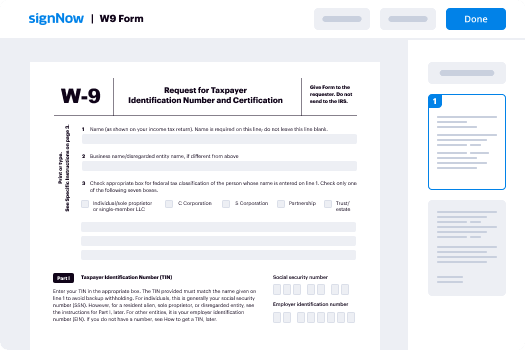
Save time on document management with airSlate SignNow and get your debtor pro se form eSigned quickly from anywhere with our fully compliant eSignature tool.

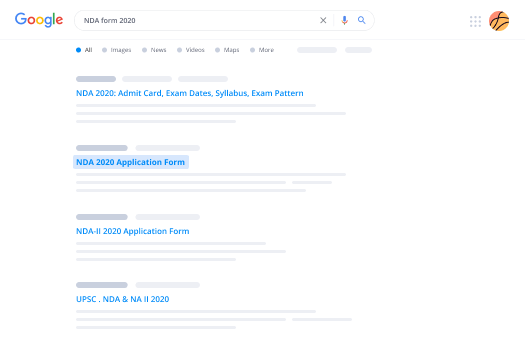
How to Sign a PDF Online How to Sign a PDF Online

How to complete and sign paperwork online

Previously, working with paperwork took pretty much time and effort. But with airSlate SignNow, document management is quick and simple. Our powerful and easy-to-use eSignature solution allows you to easily complete and eSign your debtor pro se form online from any internet-connected device.

Follow the step-by-step guidelines to eSign your debtor pro se form template online:

  • 1.Register for a free trial with airSlate SignNow or log in to your account with password credentials or SSO authorization option.
  • 2.Click Upload or Create and add a file for eSigning from your device, the cloud, or our form catalogue.
  • 3.Click on the document name to open it in the editor and utilize the left-side toolbar to complete all the empty areas appropriately.
  • 4.Put the My Signature field where you need to approve your sample. Type your name, draw, or upload a picture of your handwritten signature.
  • 5.Click Save and Close to finish editing your completed document.

Once your debtor pro se form template is ready, download it to your device, export it to the cloud, or invite other people to electronically sign it. With airSlate SignNow, the eSigning process only requires a few clicks. Use our powerful eSignature tool wherever you are to deal with your paperwork successfully!

How to Sign a PDF Using Google Chrome How to Sign a PDF Using Google Chrome

How to complete and sign documents in Google Chrome

Completing and signing paperwork is easy with the airSlate SignNow extension for Google Chrome. Adding it to your browser is a quick and efficient way to manage your paperwork online. Sign your debtor pro se form template with a legally-binding electronic signature in a couple of clicks without switching between applications and tabs.

Follow the step-by-step guidelines to eSign your debtor pro se form in Google Chrome:

  • 1.Navigate to the Chrome Web Store, locate the airSlate SignNow extension for Chrome, and add it to your browser.
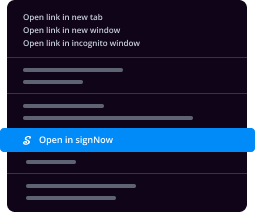
  • 2.Right-click on the link to a document you need to approve and select Open in airSlate SignNow.
  • 3.Log in to your account with your credentials or Google/Facebook sign-in buttons. If you don’t have one, you can start a free trial.
  • 4.Use the Edit & Sign toolbar on the left to fill out your template, then drag and drop the My Signature option.
  • 5.Insert a picture of your handwritten signature, draw it, or simply enter your full name to eSign.
  • 6.Verify all the details are correct and click Save and Close to finish modifying your form.

Now, you can save your debtor pro se form sample to your device or cloud storage, email the copy to other people, or invite them to electronically sign your document with an email request or a protected Signing Link. The airSlate SignNow extension for Google Chrome improves your document processes with minimum time and effort. Start using airSlate SignNow today!

How to Sign a PDF in Gmail How to Sign a PDF in Gmail How to Sign a PDF in Gmail

How to fill out and sign forms in Gmail

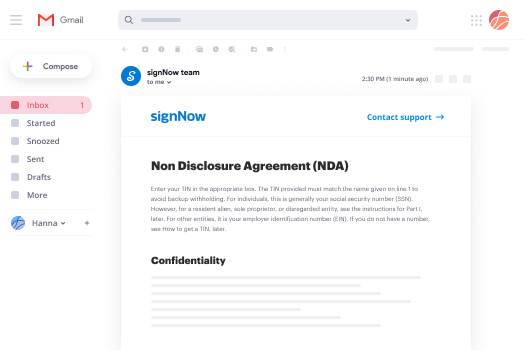
When you get an email with the debtor pro se form for approval, there’s no need to print and scan a file or save and re-upload it to another tool. There’s a much better solution if you use Gmail. Try the airSlate SignNow add-on to quickly eSign any documents right from your inbox.

Follow the step-by-step guide to eSign your debtor pro se form in Gmail:

  • 1.Go to the Google Workplace Marketplace and find a airSlate SignNow add-on for Gmail.
  • 2.Set up the tool with a related button and grant the tool access to your Google account.
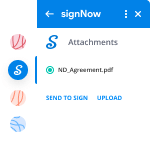
  • 3.Open an email containing an attachment that needs approval and use the S sign on the right panel to launch the add-on.
  • 4.Log in to your airSlate SignNow account. Select Send to Sign to forward the file to other people for approval or click Upload to open it in the editor.
  • 5.Drop the My Signature option where you need to eSign: type, draw, or import your signature.

This eSigning process saves efforts and only requires a couple of clicks. Use the airSlate SignNow add-on for Gmail to update your debtor pro se form with fillable fields, sign documents legally, and invite other parties to eSign them al without leaving your inbox. Improve your signature workflows now!

How to Sign a PDF on a Mobile Device How to Sign a PDF on a Mobile Device How to Sign a PDF on a Mobile Device

How to fill out and sign paperwork in a mobile browser

Need to rapidly complete and sign your debtor pro se form on a smartphone while working on the go? airSlate SignNow can help without needing to set up extra software applications. Open our airSlate SignNow solution from any browser on your mobile device and add legally-binding eSignatures on the go, 24/7.
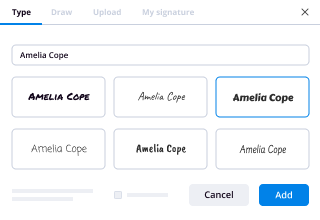
Follow the step-by-step guide to eSign your debtor pro se form in a browser:

  • 1.Open any browser on your device and go to the www.signnow.com
  • 2.Sign up for an account with a free trial or log in with your password credentials or SSO option.
  • 3.Click Upload or Create and import a file that needs to be completed from a cloud, your device, or our form collection with ready-to go templates.
  • 4.Open the form and complete the blank fields with tools from Edit & Sign menu on the left.
  • 5.Add the My Signature field to the form, then enter your name, draw, or add your signature.

In a few simple clicks, your debtor pro se form is completed from wherever you are. Once you're finished editing, you can save the document on your device, build a reusable template for it, email it to other individuals, or ask them to electronically sign it. Make your paperwork on the go prompt and effective with airSlate SignNow!
How to Sign a PDF on iPhone How to Sign a PDF on iPhone

How to fill out and sign documents on iOS

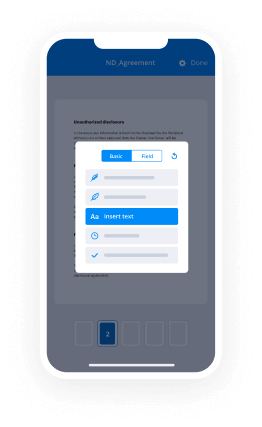
In today’s corporate environment, tasks must be accomplished rapidly even when you’re away from your computer. Using the airSlate SignNow application, you can organize your paperwork and approve your debtor pro se form with a legally-binding eSignature right on your iPhone or iPad. Set it up on your device to conclude agreements and manage forms from anyplace 24/7.

Follow the step-by-step guide to eSign your debtor pro se form on iOS devices:

  • 1.Open the App Store, find the airSlate SignNow app by airSlate, and set it up on your device.
  • 2.Open the application, tap Create to add a form, and select Myself.
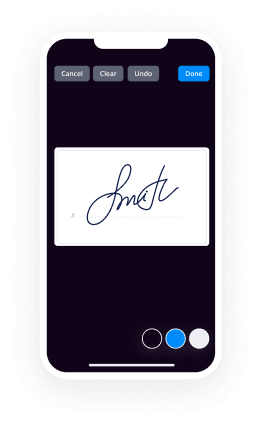
  • 3.Choose Signature at the bottom toolbar and simply draw your signature with a finger or stylus to eSign the sample.
  • 4.Tap Done -> Save right after signing the sample.
  • 5.Tap Save or utilize the Make Template option to re-use this paperwork later on.

This process is so easy your debtor pro se form is completed and signed within a couple of taps. The airSlate SignNow app works in the cloud so all the forms on your mobile device are kept in your account and are available any time you need them. Use airSlate SignNow for iOS to enhance your document management and eSignature workflows!
How to Sign a PDF on Android How to Sign a PDF on Android

How to fill out and sign documents on Android

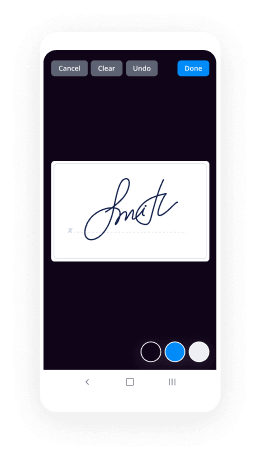
With airSlate SignNow, it’s easy to sign your debtor pro se form on the go. Install its mobile app for Android OS on your device and start enhancing eSignature workflows right on your smartphone or tablet.

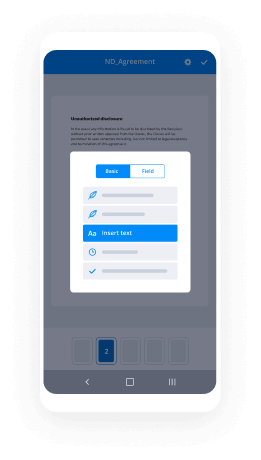
Follow the step-by-step guide to eSign your debtor pro se form on Android:

  • 1.Go to Google Play, search for the airSlate SignNow application from airSlate, and install it on your device.
  • 2.Log in to your account or create it with a free trial, then import a file with a ➕ option on the bottom of you screen.
  • 3.Tap on the imported document and select Open in Editor from the dropdown menu.
  • 4.Tap on Tools tab -> Signature, then draw or type your name to electronically sign the template. Fill out blank fields with other tools on the bottom if needed.
  • 5.Use the ✔ key, then tap on the Save option to finish editing.

With an intuitive interface and total compliance with primary eSignature laws and regulations, the airSlate SignNow app is the best tool for signing your debtor pro se form. It even works offline and updates all form changes once your internet connection is restored and the tool is synced. Fill out and eSign documents, send them for approval, and create multi-usable templates anytime and from anyplace with airSlate SignNow.

Sign up and try Debtor pro se form
  • Close deals faster
  • Improve productivity
  • Delight customers
  • Increase revenue
  • Save time & money
  • Reduce payment cycles