Establishing secure connection…Loading editor…Preparing document…

Defendants' Joint Motion to Dismiss Mississippi

This template is fully customizable. Edit the text, fill out the fields, and send it for signature. Give it a try!
Defendants' Joint Motion to Dismiss Mississippi

What the Defendants' Joint Motion to Dismiss Mississippi Is

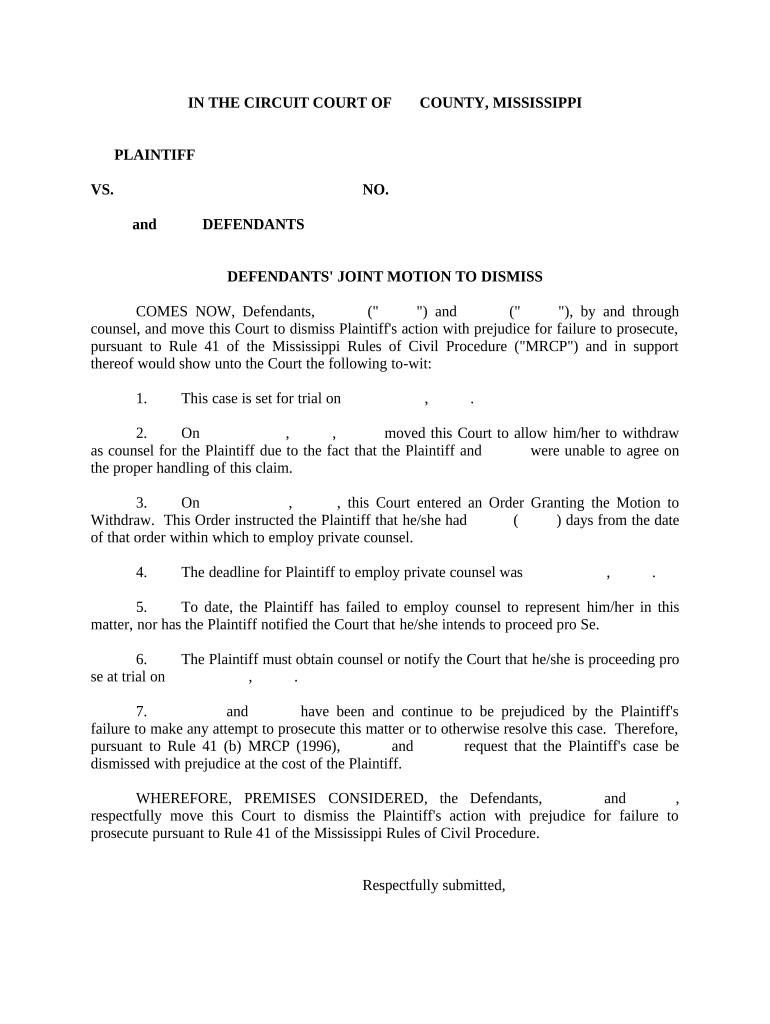
A Defendants' Joint Motion to Dismiss Mississippi is a formal court filing in which two or more defendants jointly ask a Mississippi court to dismiss all or part of the plaintiff's claims. The motion typically argues that the complaint fails to state a claim on which relief can be granted, that the court lacks subject-matter jurisdiction, or that the claims are barred by procedural or substantive defenses. This document frames legal arguments, cites authority, and requests specific relief such as dismissal with or without prejudice and may include a proposed order for the judge to sign.

Why a Joint Motion to Dismiss Matters

Filing a coordinated motion lets defendants present unified legal grounds, reduce duplicative briefing, and signal to the court consolidated issues of law. It can narrow claims early, preserve defenses, and may prompt early adjudication without costly discovery.

Why a Joint Motion to Dismiss Matters

Who Prepares and Uses This Motion

The joint approach is most effective when defendants share common facts or legal defenses; parties with divergent positions may favor separate motions.

  • Defense counsel coordinating arguments and authorities across defendants to avoid inconsistent positions and redundant filings.
  • In-house legal teams working with outside counsel to centralize procedural motions and control litigation costs.
  • Local counsel ensuring compliance with Mississippi local rules for motion practice, page limits, and certificate of service.

Core Components of a Professional Joint Motion to Dismiss

A professional joint motion to dismiss contains standardized sections and supporting materials so the court can resolve threshold issues without additional briefing. Clear structure and precise citations improve the motion's persuasiveness.

Caption

Court name, docket number, party names, and a short motion title identifying defendants collectively.
Introduction

A concise statement of the relief sought, the specific claims at issue, and why the motion is appropriate.

Statement of Facts

A neutral recitation of facts as pled, limited to what is necessary to assess the motion under Rule 12(b) or state equivalent.

Legal Argument

Organized points of law with citations to statutes, controlling precedent, and procedural rules supporting dismissal grounds.

Request for Relief

Clear prayer for dismissal, indicating whether dismissal should be with or without prejudice and whether alternative relief is requested.

Certificate

Certificate of service and any local-rule compliance statements (page limits, font size, word count).

Step-by-Step: Preparing the Joint Motion

Follow these steps to assemble, review, and file the joint motion while adhering to procedural requirements and local rules.

  • 01
    Coordinate Positions: Agree on grounds, structure, and who files the motion.
  • 02
    Draft Motion: Draft unified text, exhibits, and proposed order.
  • 03
    Local-Rule Check: Confirm page limits, font, filing format, and signature requirements.
  • 04
    File and Serve: File via court e-filing system and serve all parties per the certificate of service.

How to Customize and Complete the Motion Online

Configure a digital workflow that collects approvals from each defendant and produces a court-ready PDF with embedded signatures.

Field Configuration
Document Template Upload a Word or PDF template with clearly marked merge and signature fields.
Signer Order Set parallel signing if all defendants assent simultaneously, or ordered signing if required.
Authentication Choose email verification or stronger two-factor authentication for counsel signatures.
Export Settings Export as PDF/A compatible file with audit trail included for court submission.

Where to File and How the Document Moves Through the Court

Understanding filing destinations and routing helps avoid procedural defects and ensures timely consideration by the judge.

  • Federal Court: File via the court's CM/ECF system under the existing docket; motions within a case typically require no separate filing fee.
  • Mississippi State Court: File through the state or county clerk's accepted e‑filing portal or deliver paper copies if the court requires.
  • Service: Serve opposing counsel electronically per local rule and include certificate of service in the filing.
  • Proposed Order: Submit a proposed order as a separate attachment so the court can adopt the requested disposition easily.

Digital Signing and Electronic Filing Requirements

Confirm the court's local rules for electronic submissions and preserve native audit records in case of later challenges.

  • File Formats: PDF/A or searchable PDF recommended; courts often reject password-protected files.
  • Audit Trail: Maintain a tamper-evident audit trail showing signer identity, timestamps, and IP addresses.
  • Authentication: Use verifiable signer authentication (email+code or MFA) for counsel signatures when possible.

Typical Deadlines and Timing Considerations

Timelines vary by jurisdiction and case stage; missing response deadlines or service timing can waive defenses or require extensions.

Response Period:

Federal Rule 12(b) response usually due within 21 days after service or 14 days after answer is required.

Motion Hearing:

Hearing dates depend on local practice; some courts rule on briefs alone without a hearing.

Page Limits:

Observe local rule page or word limits for briefs; exceed limits only with court permission.

Amendment Window:

Courts often allow a plaintiff to amend once as of right before a responsive pleading.

Service Deadline:

Serve opposing counsel and file the certificate of service by the same day as filing the motion.

Common Mistakes to Avoid

  • Failing to coordinate content among defendants, producing inconsistent legal positions that the court may view unfavorably.
  • Omitting or mislabeling the certificate of service, which can result in a filing defect or rehearing.
  • Ignoring local rules on formatting, page limits, or required attachments, leading to clerical rejection or sanctions.
  • Relying on factual disputes that belong in discovery rather than arguing facial defects under Rule 12(b)(6) or the state equivalent.

Consequences of an Incorrect or Defective Motion

Waiver Risk: Procedural defenses may be waived if not timely raised or if improper service occurs.
Sanctions: Courts can impose sanctions for frivolous filings or repeated noncompliance with local rules.
Delay: Defective filings waste judicial resources and can delay adjudication, increasing litigation costs.
Procedural Dismissal: A motion that fails to satisfy procedural requirements may be denied on technical grounds.
Judicial Skepticism: Inconsistent or poorly supported joint positions can reduce credibility and persuasive force with the court.
Service Defect: Improper service may necessitate refiling and restart response deadlines.

Practical Examples of Joint Motions in Mississippi Cases

These short examples show how joint motions can be structured in common scenarios to address discrete legal defects.

Consumer Contract Case

Defendants moved to dismiss for lack of standing and contract formation issues

  • The motion focused on absence of a signed agreement
  • Court dismissed two claims without prejudice and allowed limited amendment with clear pleading instructions for the plaintiff.

Tort and Statutory Claim

Multiple defendants argued sovereign immunity and statutory preemption as common defenses

  • The briefs coordinated authority and exhibits to avoid duplication
  • The judge granted dismissal as to statutory claims and left state tort claims for discovery, narrowing the case.

eSignature Vendor Comparison for Signing and Managing the Motion

For electronically signing and managing court-ready PDFs, compare common provider features and starting prices; signNow is listed first for parity with other vendors.

signNow DocuSign Adobe Sign PandaDoc HelloSign
Starting Price $8/user/mo $15/user/mo $14/user/mo $19/user/mo $15/user/mo
Free Trial 7-day free trial No No Yes Yes
Bulk Send Yes Yes Yes Yes No
Audit Trail Yes Yes Yes Yes Yes
HIPAA Compliant Yes Yes Yes No No

Frequently Asked Questions About the Joint Motion

Answers to common procedural and practical questions about preparing, signing, and filing a Defendants' Joint Motion to Dismiss in Mississippi.


Need help? Contact support

be ready to get more
Join over 28 million airSlate SignNow users