Establishing secure connection…Loading editor…Preparing document…

Letter Delegating New Duties

This template is fully customizable. Edit the text, fill out the fields, and send it for signature. Give it a try!
Letter Delegating New Duties

What a Letter Delegating New Duties Is and when it’s used

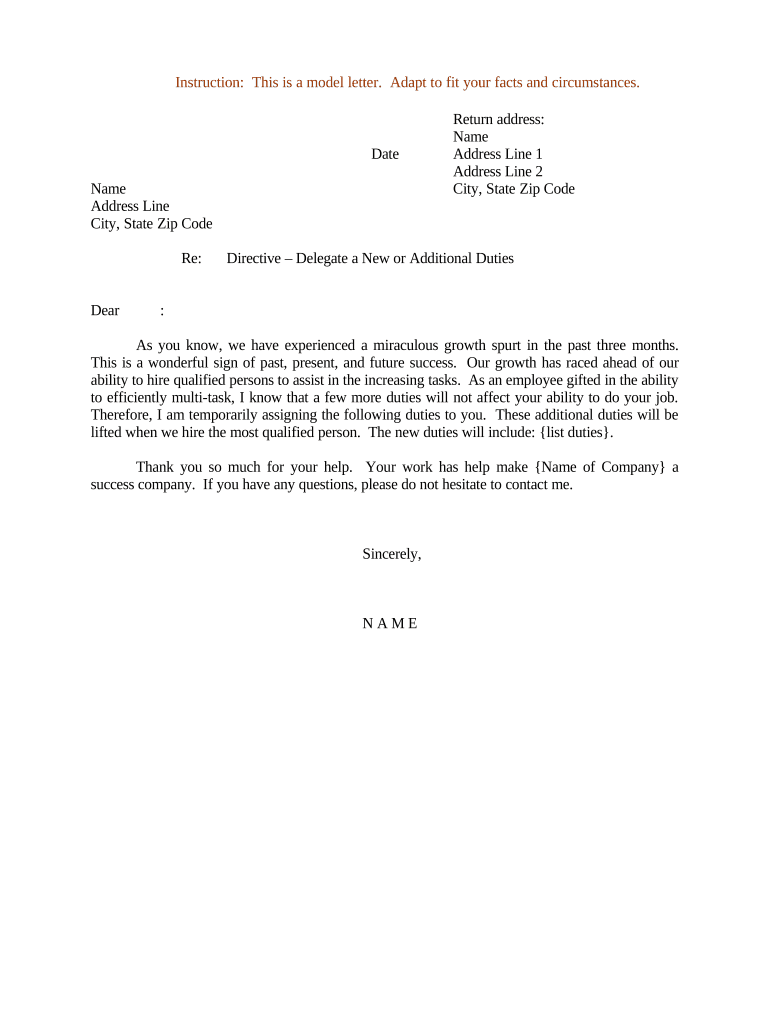
A Letter Delegating New Duties is a written notice that transfers specific responsibilities from one individual or role to another within an organization. It records which tasks are reassigned, the effective date and duration, any limitations on authority, and required approvals. These letters are commonly used during reorganization, temporary leave, promotions, or when assigning interim responsibilities. A clear delegation letter reduces ambiguity about accountability, preserves audit evidence of decision-making, and supports compliance when duties affect regulated activities or protected data.

Why a clear delegation letter matters and its legal standing

A concise Letter Delegating New Duties clarifies authority, prevents operational gaps, and documents consent to new responsibilities. When retained as an electronic record, it is generally enforceable under ESIGN and UETA so long as parties demonstrate intent, consent, attribution, and retention capabilities.

Why a clear delegation letter matters and its legal standing

Who typically prepares and receives these delegation letters

Use this letter when the reassignment affects operational authority, regulatory duties, or any task requiring a clear chain of responsibility.

  • HR and People Teams coordinating role changes for payroll and benefits adjustments.
  • Department Heads reassigning duties during leaves of absence or temporary transfers.
  • Compliance officers documenting role-based access changes for regulated functions.

Essential components to include in a professional delegation letter

Include unambiguous elements so recipients and downstream teams can act without confusion; the list below covers the standard clauses and formatting details that improve enforceability and traceability.

Header

Date, sender name and title, recipient name and title, and subject line that references 'Delegation of Duties' for easy retrieval.
Delegator

Full legal name and role of the person or office delegating duties, with contact details and any limits on delegator authority retained.

Delegatee

Full legal name and role of the person receiving duties, including business address, email and any alternate contacts for the temporary assignment.

Scope of Duties

A clear, itemized list of responsibilities being transferred, with examples or references to underlying policies or job descriptions.

Effective Terms

Effective date, expected end date or triggering event for reversion, and conditions for early termination or extension of the delegation.

Signatures

Signature blocks for delegator, delegatee, and any approving authority; include dates and, if required, witness or notary lines.

Required fields and minimum data to capture

Delegator Identity: Full legal name
Delegatee Identity: Full legal name
Duty Description: Concise task list
Effective Date: MM/DD/YYYY
Duration: End date or condition
Signatures: Signed and dated

Step-by-step: completing and issuing the delegation letter

Follow these sequential steps to prepare, approve, and distribute the letter so responsibilities transfer with documented authority and traceability.

  • 01
    Draft: Populate fields and itemize duties clearly.
  • 02
    Review: Obtain manager and HR review for accuracy.
  • 03
    Authorize: Secure required approvals and signatures.
  • 04
    Distribute: Send to delegatee, HR, and affected teams.

Customizing the letter in an online workflow

Configure an e-sign and routing workflow to match your approval matrix; the table below maps common settings to recommended values.

Field Configuration
Signer Order Sequential routing: delegator → delegatee → HR
Authentication Email link or SMS code; use stronger auth for sensitive duties
Conditional Fields Show end-date field only if 'temporary' selected
Retention Policy Save signed copy to HR folder and audit log

Where to send the signed letter and common filing locations

After signature, route the final document to all stakeholders and the authoritative records repository to ensure availability for audits and operational teams.

  • Delegatee Copy: Send signed PDF to the delegatee's work email.
  • HR File: Place a copy in the employee personnel file.
  • Manager Records: Store with department change logs and approvals.
  • Shared Archive: Upload to centralized records system for retention.

Recommended delivery and e-sign configurations

Use integrations (HRIS, shared drives) and secure storage settings to ensure the document is discoverable for audits and accessible under your retention policy.

  • Email Delivery: Direct signed PDF to stakeholders.
  • eSignature: Capture timestamp and signer identity.
  • Integrations: Sync with HR or document storage

Typical timing, deadlines, and processing expectations

Timelines depend on operational needs; here are common deadlines and expectations to include in your process.

Effective Date Required:

Specify the date duties begin to avoid retroactive ambiguity.

Acknowledgement Deadline:

Request delegatee acknowledgment within 3 business days.

HR Filing Deadline:

File final signed letter in HR within 5 business days.

Access Changes:

Implement system permission changes concurrent with effective date.

Review Interval:

Schedule a check-in within 30 days for temporary delegations.

Common mistakes to avoid when preparing the letter

  • Vague duty descriptions that lead to confusion or disputes about scope and accountability during the delegated period.
  • Omitting effective or end dates, which can create open-ended authority and compliance gaps for regulated tasks.
  • Failing to update system permissions with the delegation, leaving the delegatee unable to perform reassigned duties.
  • Not documenting approvals from required authorities (HR, compliance, finance), undermining internal controls.

Risks and potential consequences of an incorrect or incomplete letter

Operational Risk: Tasks missed or duplicated
Liability Exposure: Unauthorized actions by delegatee
Regulatory Compliance: Breach of duty-sensitive rules
Payroll Errors: Incorrect compensation or approvals
Data Privacy: Improper access to PHI or FERPA-protected data
Recordkeeping Gaps: Audit trail absent or incomplete

Typical eSignature vendor pricing and capability comparison for delegation letters

Electronic signing platforms vary by price model and capabilities; the table summarizes starting prices and common features relevant to secure delegation letter processing.

signNow DocuSign Adobe Sign PandaDoc HelloSign
Starting Price $8/user/mo $15/user/mo $14/user/mo $19/user/mo $15/user/mo
Free Trial 7-day free trial Varies by plan Varies by plan Varies by plan Varies by plan
Bulk Send Yes Yes Yes Yes No
Audit Trail Yes Yes Yes Yes Yes
HIPAA Compliant Yes Yes Yes No No

Frequently asked questions and troubleshooting

Answers to common procedural and legal questions about preparing, signing, and retaining a Letter Delegating New Duties.


Need help? Contact support

be ready to get more
Join over 28 million airSlate SignNow users