Establishing secure connection…Loading editor…Preparing document…

Louisiana Letters of Independent Administration

This template is fully customizable. Edit the text, fill out the fields, and send it for signature. Give it a try!
Louisiana Letters of Independent Administration

What Louisiana Letters of Independent Administration Are

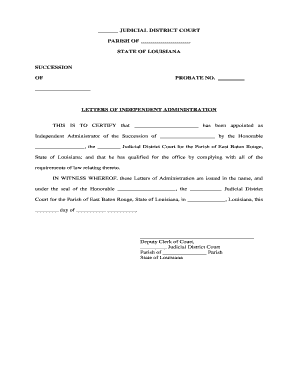
Letters of Independent Administration are court-issued credentials that empower a named administrator to manage, settle, and distribute a decedent’s estate in Louisiana without ongoing supervisory orders from the probate court. They follow a parish-level probate proceeding and grant the administrator authority to collect assets, pay valid debts and taxes, sell property if necessary, and make final distributions according to Louisiana succession law. The letters serve as official proof of authority for banks, title companies, and third parties when transferring assets or closing accounts on behalf of the estate.

Why Letters of Independent Administration Matter

They centralize authority for estate settlement, reduce repeated court intervention, and provide third parties with clear legal proof to transfer assets, collect debts and complete title changes under Louisiana succession procedures.

Why Letters of Independent Administration Matter

Who typically prepares and relies on these letters

The document is prepared during probate and used by administrators, attorneys, and institutions when settling a Louisiana estate.

  • Independent administrators and personal representatives who need legal authority to act for the estate.
  • Probate attorneys who draft the petition, obtain court orders, and advise on bond and inventory requirements.
  • Banks, brokerage firms, and title companies that require certified proof of authority to release funds or transfer property.

Key signer and preparer profiles

Independent Administrator

An individual named by the court to manage estate affairs. Responsibilities include locating assets, paying creditors, filing inventories, and distributing property; they must obey court orders and may need to post a bond.

Probate Attorney

A licensed attorney who files the petition for letters, prepares required inventories and accountings, advises on bond amounts, and represents the administrator at hearings and in interactions with third parties.

Required information at a glance

Decedent Name: Full legal name
Date of Death: MM/DD/YYYY
Parish of Domicile: Parish name
Heirs/Beneficiaries: Full legal names
Inventory Summary: High‑level asset list
Bond Amount: Bond required (if any)

Common preparation pitfalls

  • Using informal or partial names for the decedent that do not match death records or titles, causing third‑party refusals to transfer assets.
  • Failing to attach a certified death certificate or required inventory, which can delay issuance of letters by the parish court.
  • Neglecting to request the correct scope of authority (limited vs. independent) and thus requiring additional filings later.
  • Skipping bond calculations or failing to publish notices where required, which may trigger creditor claims or court objections.

How to complete the petition and obtain Letters

Follow these sequential steps to prepare the petition, obtain court approval, and present certified letters to third parties.

  • 01
    Prepare Petition: Draft petition listing decedent, heirs, and requested authority.
  • 02
    File with Court: Submit petition, death certificate, and required filing fee.
  • 03
    Bond/Inventory: Post bond if ordered and file inventory/appraisement.
  • 04
    Receive Letters: Court issues certified letters of independent administration.

Typical workflow from filing to distribution

This sequence shows the practical handoffs: court filing, administrative authority, asset collection, creditor resolution, and final distribution.

  • Filing: Petition filed at parish probate court.
  • Appointment: Court appoints administrator and sets bond.
  • Administration: Assets gathered, claims evaluated, taxes paid.
  • Distribution: Remaining estate assets distributed to heirs.

Core elements of a professional Letters package

A complete submission bundles the petition, proof of death, bond or waiver, inventory, orders, and the certified letters themselves to ensure clarity and acceptance by third parties.

Caption

Court caption identifies the parish, docket number, parties, and case type so the file is administratively traceable and enforceable.
Petition

Detailed petition states why independent administration is requested, names the nominee, and cites authority under Louisiana succession procedures.

Death Certificate

A certified copy of the decedent’s death certificate is required by nearly all institutions to verify the triggering event.

Bond or Waiver

If a bond is ordered, include the surety documentation or a valid waiver executed by an authorized party.

Inventory

A clear inventory and appraisement of estate assets supports creditor notice and valuation for distribution.

Certified Letters

The court-signed and sealed letters are the practical credential banks and title companies require to release assets.

Consequences of incorrect or incomplete filings

Delayed Access: Delayed estate distributions
Third‑Party Refusal: Banks may refuse releases
Increased Costs: Additional filings and attorney time
Creditor Claims: Unresolved creditor liabilities
Court Sanctions: Possible court sanctions or re‑filing
Void Transfers: Title transfers could be reversed

Typical deadlines and filing expectations

Probate timelines differ by parish; administrators should track filing, inventory, accounting, and distribution deadlines to avoid statutory complications.

File Petition:

As soon as practicable after death

Inventory Due:

Deadline set by court or local rule

Creditor Notices:

Published notice periods vary by parish

Accountings:

Periodic or final accounting per court order

Distribution:

After debts and taxes are settled

Key milestones from petition to final distribution

Track these numbered milestones to manage expectations and coordinate third‑party interactions during administration.

01

1. Petition Filed

Initiates the probate matter with the parish court.

02

2. Administrator Appointed

Court issues letters and sets any bond requirements.

03

3. Inventory Submitted

Administrator files inventory and appraisals for court and creditor review.

04

4. Final Accounting

Court reviews accounting before authorizing distribution to heirs.

Digital workflow settings for online completion and eSubmission

When completing forms online, configure authentication, notarization, audit trails, and retention rules to meet court and third‑party requirements.

Field Configuration
Authentication Email or SMS code; stronger KBA for notarization
Notarization RON or in‑person notarization as parish permits
Audit Trail Enable IP, timestamp, and action log capture
Retention Export signed PDF/A and store per retention policy

How Letters of Independent Administration compare to testamentary letters

Below are concise differences between independent administration and letters issued under a will to help distinguish procedural expectations.

Criteria Independent Administration Testamentary Letters
Court Supervision minimal may be supervised
Will Required
Typical Bond may be ordered often waived by will
Third‑Party Acceptance standard standard

eSignature vendor pricing and capability snapshot for estate workflows

Compare common eSignature vendor starting prices and selected capabilities relevant to filing, notarization, and secure transmission of probate documents.

signNow DocuSign Adobe Sign PandaDoc HelloSign
Starting Price $8/user/mo $15/user/mo $14/user/mo $19/user/mo $15/user/mo
Free Trial 7-day free trial No No Yes, limited Yes, limited
Bulk Send Yes Yes Yes Yes No
Audit Trail Yes Yes Yes Yes Yes
HIPAA Compliant Yes Yes Yes No No

Practical tips for accurate, efficient administration

Adopt consistent procedures to reduce rejection risk and speed third‑party acceptance of letters.

Verify Names and Dates
Cross-check decedent and nominee names with government IDs and the certified death certificate before filing to avoid rejections and downstream delays.
Include Complete Inventory
Prepare a clear, itemized inventory and appraisement to support creditor notice, tax reporting, and property transfer requests from title companies.
Confirm Notarization Needs
Check parish rules for notarization and whether remote online notarization is permissible; obtain required notarizations before submitting to institutions.
Maintain Audit Trails
Retain signed PDFs, audit logs, and certified letters in secure storage to satisfy court reviews, bank audits, and potential disputes.

Scenario examples illustrating common workflows

These scenarios show how letters and supporting documents are used to resolve estate matters in practical settings.

Small Estate Transfer

A surviving sibling petitions for letters to settle bank accounts and close utilities.

  • Court issues letters after filing an inventory and proof of death.
  • With certified letters in hand, the administrator obtained bank releases and promptly transferred remaining funds to heirs, avoiding extended court supervision.

Property Sale During Administration

An administrator needs to sell real property to pay debts and taxes.

  • Petition requests authority to sell with court approval.
  • After inventory and bond requirements were satisfied, certified letters allowed the title company to complete the sale and remit proceeds for creditor payment and distribution.

Frequently asked questions about Letters of Independent Administration

Answers to common questions about validity, witnesses, electronic signing, revocation, and what third parties typically require.


Need help? Contact support

be ready to get more
Join over 28 million airSlate SignNow users