Establishing secure connection…Loading editor…Preparing document…

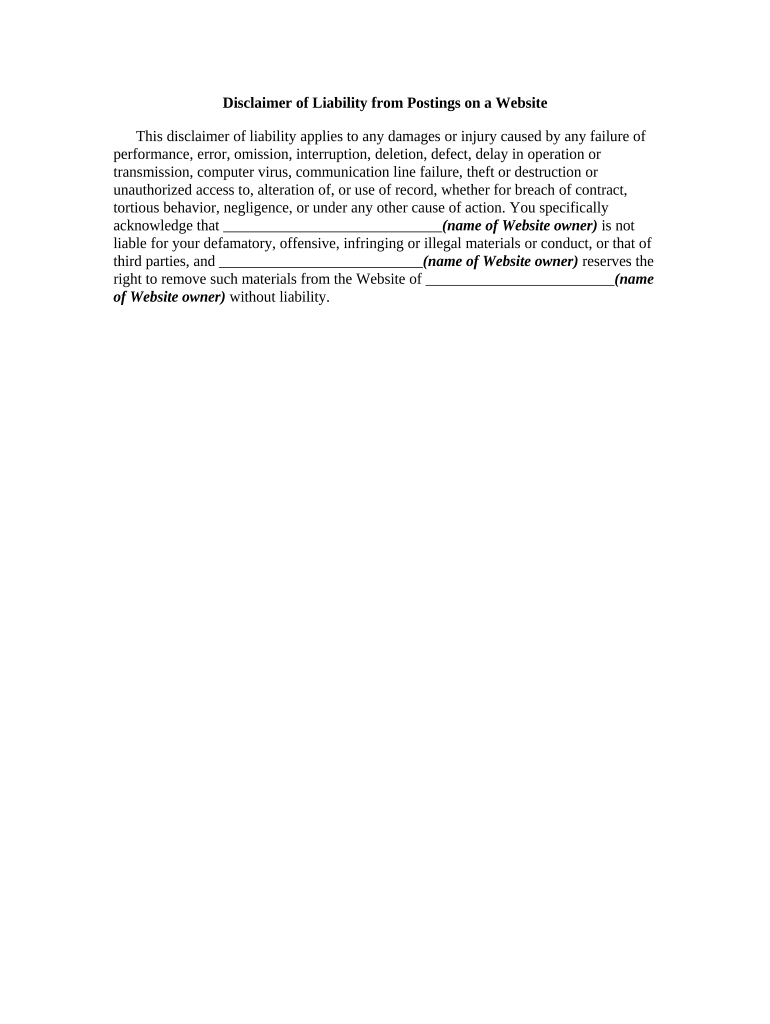
Disclaimer of Liability from Postings on a Website

This template is fully customizable. Edit the text, fill out the fields, and send it for signature. Give it a try!
Disclaimer of Liability from Postings on a Website

What the Disclaimer of Liability from Postings on a Website Does

A Disclaimer of Liability from Postings on a Website is a short legal notice displayed on a website that describes the site owner’s intent to limit responsibility for user-generated content, third-party links, and statements posted by guest contributors. It clarifies that content on the site does not necessarily reflect the owner’s views and typically asks users to verify information independently. The disclaimer does not eliminate all legal exposure but helps set expectations for visitors, supports risk management, and supplements terms of use and community policies.

Why add a Website Posting Disclaimer

A clear disclaimer reduces ambiguity about responsibility for comments, guest posts, and external links, supports moderation policies, and documents the site owner’s intent to limit liability under common-law and statutory theories.

Why add a Website Posting Disclaimer

Who commonly publishes this disclaimer

Organizations and individuals who host user content or publish third-party material often include this disclaimer to limit exposure and communicate moderation standards.

  • Small businesses and blogs that accept comments or guest articles and want to clarify responsibility for user posts.
  • Publishers and news sites that link to external sources and need to separate editorial positions from third-party opinions.
  • Educational institutions and nonprofits that post user submissions, event listings, or volunteer content.

Who can sign and approve the disclaimer

Company Counsel

General counsel or outside counsel typically reviews and signs off on the final text to ensure it aligns with corporate risk tolerance and applicable law, and can advise on required disclosures in regulated industries.

Authorized Officer

A company officer or website owner with authority to bind the entity can approve publication. For nonprofits and small businesses, the executive director or owner usually has signing authority.

Essential information to include

Entity Name: Full legal name
Scope: What content is covered
No Endorsement: Third-party links not endorsed
Accuracy: No warranty of accuracy
User Responsibility: Verify before relying
Contact: How to report issues

Core components of a professional disclaimer

A concise, well-drafted disclaimer typically combines factual limits, scope definitions, and procedural guidance so visitors understand what the site does and does not warrant.

Scope

Define whether the disclaimer applies to comments, forums, guest posts, third-party links, embedded content, or all of the above, and state the covered date range if needed.
No Warranty

State that content is provided 'as is' without warranties of accuracy, completeness, merchantability, or fitness for a particular purpose to reduce expectations of reliability.

No Endorsement

Clarify that external links, ads, or user submissions do not imply endorsement, sponsorship, or recommendation by the site owner.

Limitation of Liability

Describe the extent to which the owner disclaims liability for damages resulting from use of posted content while avoiding language that attempts to disclaim liability where state law forbids it.

Reporting and Removal

Provide instructions for reporting objectionable content and explain the site’s moderation or takedown procedures to show active oversight.

Governing Law

Identify the governing state law for interpretation and indicate that the disclaimer supplements terms of use or community guidelines.

How to prepare and publish your disclaimer

Follow a simple sequence to draft, review, publish, and monitor the disclaimer so it becomes an effective part of your site’s legal framework.

  • 01
    Draft Text: Create concise language tailored to your content and risks
  • 02
    Legal Review: Have counsel confirm enforceability and state-specific limits
  • 03
    Publish: Place on footer or relevant pages and link from content areas
  • 04
    Monitor & Update: Review periodically and after policy or law changes

Typical publication and enforcement flow

Publishing a disclaimer is a small part of a broader workflow that includes moderation, reporting, and periodic legal review.

  • Create: Draft based on content types and legal input
  • Approve: Obtain sign-off from legal or compliance
  • Deploy: Add to site template and link from posts
  • Enforce: Apply moderation and takedown processes

Online setup checklist for web publishing

Configure site settings, content templates, and moderation rules before publishing the disclaimer to ensure consistent enforcement.

Field Configuration
Footer Link Persistent link on every page
Content Banner Place on high-risk pages
Moderation Rule Define takedown timeframes
Audit Log Record publication and updates

Technical considerations for online completion and e-signing

Choose tools and integrations that preserve audit trails and version history when you publish or update legal text on your site.

  • Document Formats: PDF, HTML, DOCX supported
  • Integrations: Works with CMS and cloud storage
  • Audit Trail: Capture timestamps and actor IDs

Maintain an administrative copy with versioning, and ensure any e-signature provider used for approvals supports audit logs and retention required by your policies.

Recommended timelines and review cadence

Set a practical schedule for publishing, reviewing, and updating the disclaimer to reflect legal and operational changes.

Initial Publication:

Publish immediately upon enabling user-generated content

Legal Review:

Within 30 days of draft completion

Annual Update:

Review at least once per year

Trigger Review:

After law or policy changes

Incident Response:

Update within 7–14 days after major content dispute

Key milestones from draft to published policy

Track the milestone sequence below to manage approvals and public posting efficiently.

01

Draft Approval

Legal confirms language and scope

02

Stakeholder Sign-off

Operations and communications approve placement

03

Website Deployment

Link added to footer and relevant pages

04

Ongoing Monitoring

Moderation and reporting processes activated

Common mistakes to avoid

  • Using overly broad language that conflicts with state law or consumer protection statutes
  • Failing to link the disclaimer to detailed terms of use and moderation policies
  • Not recording publication or update versions for auditability
  • Relying on a disclaimer alone instead of maintaining active moderation and takedown procedures

Legal and practical risks of a deficient disclaimer

Defamation Exposure: May not shield against defamatory user posts
Consumer Claims: State consumer protection actions possible
Regulatory Risk: Industry rules may impose disclosures
Contractual Gaps: Conflicts with other site agreements
Reputational Harm: Public disputes and negative press
Ineffective Language: Courts may limit overly broad disclaimers

eSignature vendor pricing and suitability for publishing approvals

Compare common vendor starting prices and features relevant to signing and approving legal text; signNow is listed first per data availability and plan structure.

signNow DocuSign Adobe Sign PandaDoc HelloSign
Starting Price $8/user/mo $15/user/mo $14/user/mo $19/user/mo $15/user/mo
Free Trial 7-day free trial Varies by vendor Varies by vendor Varies by vendor Varies by vendor
Bulk Send Yes Yes Yes Yes No
Audit Trail Yes Yes Yes Yes Yes
HIPAA Compliant Yes Yes Yes No No

Representative use cases for a postings disclaimer

Short scenarios show how different organizations use the disclaimer to manage risk and expectations.

Local News Site

A community news site publishes a disclaimer clarifying that reader comments are the commenters' views, not the publisher's.

  • The site moderates comments and removes defamatory posts promptly.
  • The disclaimer plus active moderation reduced repeat takedown incidents and documented the publisher's intent in subsequent disputes.

Educational Blog

A university-run blog states that guest posts do not constitute institutional endorsement.

  • Faculty and student contributors accept submission terms in writing.
  • The policy makes it easier to handle complaints and aligns with FERPA obligations regarding student data.

Frequently asked questions about the Disclaimer of Liability from Postings on a Website

Answers to common questions address enforceability, updates, and interactions with other site policies.


Need help? Contact support

be ready to get more
Join over 28 million airSlate SignNow users