Establishing secure connection…Loading editor…Preparing document…

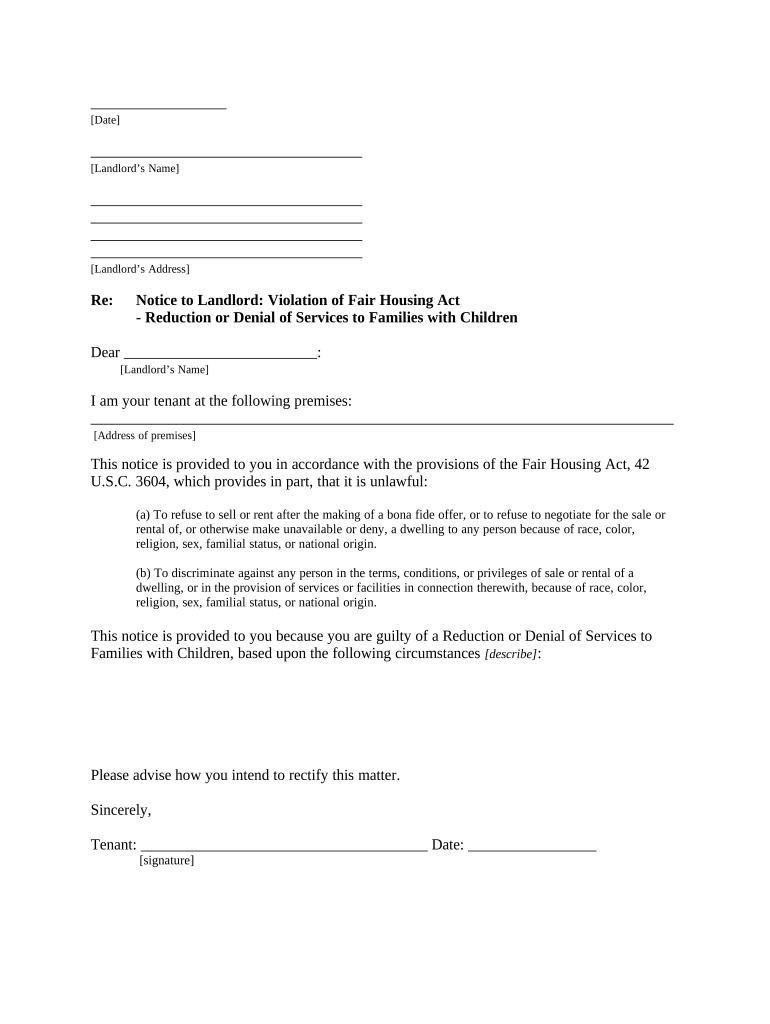
Notice of Violation of Fair Housing Act

This template is fully customizable. Edit the text, fill out the fields, and send it for signature. Give it a try!
Notice of Violation of Fair Housing Act

What the Notice of Violation of Fair Housing Act is and when it’s used

A Notice of Violation of Fair Housing Act is a formal written document that identifies alleged discriminatory housing practices and notifies the responsible party of the claim. The notice typically names the complainant and respondent, describes the incident(s), cites relevant legal provisions under the Fair Housing Act, states requested relief, and explains next steps. Organizations use it to begin administrative or internal resolution processes, to preserve evidence, and to provide clear record of the claim for HUD, state agencies, counsel, or internal compliance teams.

Why a clear, complete notice matters

A professionally prepared Notice of Violation clarifies facts, preserves statutory rights, supports investigations, and reduces the risk of procedural dismissal or misunderstandings when filing with HUD or a state agency.

Why a clear, complete notice matters

Who commonly prepares and receives this notice

Keep distribution records and proof of delivery for administrative filings and possible litigation; clear chain-of-custody and retention practices improve defensibility.

  • Property managers and landlords who must respond and document corrective steps within organizational and statutory timelines.
  • Fair housing agencies, tenants, and advocates who prepare and forward formal complaints to HUD or state civil rights offices.
  • Attorneys and in-house counsel who draft, review, and track formal notices and any subsequent filings.

Representative signers and document owners

Housing Manager

Sarah Lopez, Housing Manager. Responsible for preparing the notice with factual incident details, coordinating internal review, and serving the notice to tenants, owners, or contractors while retaining copies for corporate compliance files.

Fair Housing Attorney

Mark Jacobs, Civil Rights Counsel. Reviews allegations for sufficiency, confirms statutory citations, drafts requested relief language, advises on filing venue (HUD vs. state agency), and ensures evidence preservation for administrative or judicial actions.

Key document and security attributes to capture

Complainant Name: Full legal name
Respondent Name: Full legal name or entity
Incident Date: MM/DD/YYYY format
Property Address: Street, city, state, ZIP
Allegation Summary: Concise factual statement
Requested Relief: Remedies or corrective actions

Consequences of an incomplete or incorrect notice

Administrative Delay: Late or vague notices can delay investigations
Statute-of-Limitations Risk: Missing filing windows may bar claims
Civil Liability: Damages and injunctive relief exposure
Monetary Penalties: Civil fines or settlements possible
Reputational Harm: Loss of tenant trust and public scrutiny
Evidence Gaps: Incomplete records weaken defenses

Common mistakes to avoid when preparing the notice

  • Vague allegations without dates, locations, or specific actions make the claim hard to investigate and may lead to dismissal.
  • Misspelling names or using inconsistent party identifiers can create confusion and weaken attribution in administrative records.
  • Failing to attach or reference supporting evidence (emails, photos, witness contact info) undermines the notice’s credibility.
  • Not tracking delivery method and receipt (certified mail, email read receipt) removes proof of service required by some agencies.

How organizations use a Notice of Violation in practice

Two short examples show typical uses: internal compliance workflows and agency filings.

Property Management Example

A manager documents a tenant's disability-access complaint and files a Notice of Violation internally for remediation

  • The report includes dates, witness names, and photos as evidence
  • The organized record enabled a timely accommodation, formal remediation plan, and a clear audit trail for the owner and insurer.

Agency Filing Example

An advocate files a Notice of Violation with a state civil rights office and HUD for alleged familial-status discrimination

  • The complaint succinctly cites the Fair Housing Act and requests injunctive relief
  • The submission consolidated witness statements and produced a formal investigation opened by the agency.

Essential components to include in a professional notice

A complete Notice of Violation should be structured and factual so investigators and respondents can act, preserve evidence, and meet legal requirements.

Header

Document title and identifying number; date of issuance and contact information for the sender and organization.
Parties

Full legal names and contact details for the complainant, respondent, and property owner or manager if different.

Incident Summary

Clear, chronological description of events with dates, locations, and involved individuals or units.

Legal Basis

Cite the Fair Housing Act and relevant statutory provisions or state law allegedly violated.

Requested Relief

Specify corrective actions, damages sought, policy changes, or injunctive relief being requested.

Service and Signature

Method of delivery, signature block with signer name, title, date, and retained proof of service or receipt.

Step-by-step: preparing and issuing the notice

Follow these steps in order to create a complete, well-documented Notice of Violation suitable for internal records or agency submission.

  • 01
    Gather Evidence: Collect dates, photos, communications, and witness contact details.
  • 02
    Draft Notice: Write a concise factual statement citing the Act where relevant.
  • 03
    Legal Review: Have counsel or compliance review for sufficiency and risk.
  • 04
    Deliver & Record: Serve by certified mail and email; save proof of service.

Where and how notices are submitted or served

Notices should be routed to the correct recipients and agencies to ensure timely processing and preserve enforcement options.

  • Respondent Delivery: Send to respondent’s legal address and property manager with proof of service.
  • Internal Records: Keep a company compliance file with evidence and correspondence.
  • State Agency: File with the applicable state civil rights or human relations office if available.
  • HUD Filing: Submit to HUD or include notice as part of a formal complaint when required.

Configuring an eSubmission workflow for this notice

Set up a repeatable digital workflow to collect inputs, evidence, signatures, and delivery receipts while preserving an audit trail.

Field Configuration
Signature Authentication Email + SMS code or higher for respondent verification
Document Format PDF/A preferred for long-term retention
Attachments Allow JPEG, PNG, PDF; require evidence labels
Retention Setting Retain signed copy and audit log for configured years

Digital delivery and platform needs

Use systems that provide exportable audit trails and long-term file formats to meet discovery and retention obligations.

  • Integrations: Salesforce, NetSuite, Google Workspace compatibility
  • File Types: PDF, DOCX, HTML, Excel supported
  • Security: TLS 1.2/1.3 and AES-256 encryption

Key milestones from incident to resolution

Track these sequential milestones to manage the notice lifecycle and meet administrative response expectations.

01

Incident Documented

Record facts and evidence promptly after the event.

02

Notice Issued

Draft and serve notice to respondent with proof.

03

Agency Filing

If applicable, file with state agency or HUD.

04

Investigation / Resolution

Participate in investigation, conciliation, or legal process.

Timing expectations and typical processing windows

Processing times vary by venue; document action dates so statutory or procedural deadlines are preserved.

File Promptly:

Submit to agency as soon as facts are assembled to preserve options.

Acknowledgment:

Agencies usually issue a receipt or acknowledgment within days to weeks.

Investigation Timetable:

Investigations commonly span several weeks to months, depending on complexity.

Conciliation Offers:

Conciliation or settlement may occur before formal findings are issued.

Litigation Windows:

Private suits or appeals have separate statutory timing; confirm with counsel.

Comparing eSignature providers for Notice of Violation workflows

Overview of starting prices and select capabilities relevant to compliance, bulk send, and HIPAA support. signNow is listed first per comparison conventions.

signNow DocuSign Adobe Sign PandaDoc HelloSign
Starting Price $8/user/mo $15/user/mo $14/user/mo $19/user/mo $15/user/mo
Free Trial 7-day free trial Free trial available Free trial available Free trial available Free trial available
Bulk Send Yes Yes Yes Yes No
Audit Trail Yes Yes Yes Yes Yes
HIPAA Compliant Yes (BAA) Yes (BAA) Yes (BAA) No No

Common questions and answers about Notices of Violation

Answers to frequent procedural and technical questions when preparing or submitting a Notice of Violation of Fair Housing Act.


Need help? Contact support

be ready to get more
Join over 28 million airSlate SignNow users