Establishing secure connection…Loading editor…Preparing document…

Easement Deed Form

This template is fully customizable. Edit the text, fill out the fields, and send it for signature. Give it a try!
Easement Deed Form

What an Easement Deed Form Does

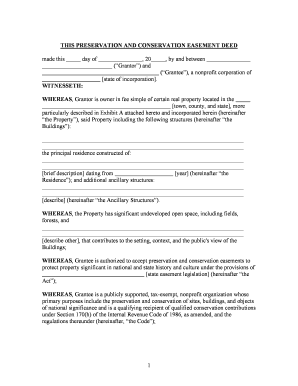
Easement Deed Form is a legal instrument that grants a nonpossessory right to use a portion of land for a specified purpose, such as access, utilities, or drainage. It describes the servient and dominant estates, the scope and location of the easement, duration, maintenance responsibilities, and any restrictions. Recording the instrument in the county land records typically provides constructive notice to third parties. Properly drafted easement deeds reduce boundary disputes, clarify rights, and create an enforceable property interest under state real property law.

Why a Proper Easement Deed Matters

An Easement Deed Form documents and clarifies use rights, reduces litigation risk, and preserves property value by recording specific access or utility rights. It serves as conclusive notice in land records and supports enforcement remedies if the easement terms are violated.

Why a Proper Easement Deed Matters

Who Typically Prepares or Signs an Easement Deed

Typical users who prepare or sign Easement Deed Forms include property owners, developers, utility companies, surveyors, and municipal authorities.

  • Property owners granting or receiving use rights, including homeowners and commercial landholders.
  • Utility and telecom companies securing access corridors for lines, conduits, and maintenance.
  • Developers, contractors, and surveyors documenting easement location, dimensions, and obligations for projects.

Essential Fields to Include in the Form

Grantor/Grantee: Full legal names with entity type
Property Description: Legal description or parcel ID
Easement Location: Metes and bounds or exhibit map
Purpose: Specific permitted uses and restrictions
Duration: Fixed term, perpetual, or condition
Consideration: Monetary amount or nominal statement

Core Components of a Professional Easement Deed Form

Core elements of a professional Easement Deed Form should define parties, property, scope, duration, maintenance, and filing instructions to ensure enforceability and clear notice.

Parties

Identify grantor and grantee by full legal names, business entity type, and authorized signatory authority to avoid challenges to authority or title later in recording and chain-of-title searches.
Property

Provide the full legal description, parcel number, survey reference, and attach an exhibit map to precisely locate the easement area for record and include bearings, distances, and tie points to adjacent landmarks.

Scope

Describe permitted activities, equipment, access rights, limitations, hours of use, and any exclusive or nonexclusive designation to prevent ambiguity and specify restoration obligations after use, and whether subleasing or assignment is allowed.

Duration

State whether the easement is perpetual, for a fixed term, or conditional; include commencement and expiration triggers or events and describe automatic renewal, termination upon abandonment, or reversion clauses.

Maintenance

Allocate maintenance responsibilities, cost-sharing formulas, repair standards, and access for inspections; require notice procedures for planned work and specify emergency repairs, dispute resolution for shared costs, and record-keeping obligations for invoices.

Recording

Provide filing instructions, jurisdiction, county recorder details, and any tax or recording fee obligations; include the plat reference number or book and page where available.

Step-by-Step: Prepare and Record the Easement Deed

Follow these sequential steps to prepare, execute, and record an Easement Deed Form so the interest is effective and enforceable in the relevant county.

  • 01
    Draft: Draft the deed, including legal description and exhibits.
  • 02
    Review: Have title and survey reviewed by counsel or title company.
  • 03
    Sign: Obtain signatures, dates, and notarization as required by state law.
  • 04
    Record: File with county recorder and obtain recording stamp and copy.

Where to File and How the Recording Process Works

After execution, deliver the Easement Deed Form to the county recorder and distribute copies to all parties and title insurers.

  • Prepare: Assemble signed deed and exhibits.
  • Submit: Submit original to county recorder with fees.
  • Obtain: Receive recorded copy with stamp and instrument number.
  • Notify: Provide recorded copies to grantee, grantor, and title insurer.

How to Customize and Complete the Form Online

Configure an online Easement Deed Form with fields, conditional logic, signer roles, and authentication to match recording and witness requirements.

Field Configuration
Signature Fields Place signature, date, and initials for each required signer.
Conditional Logic Show maintenance or termination clauses only if specific boxes checked.
Authentication Require email or SMS verification; use stronger ID for remote notarization.
Attachments Attach survey maps, exhibits, or title reports as PDF files.

Distribution and Technical Requirements for Sharing

Choose distribution channels that maintain chain of custody, comply with recording requirements, and support signed PDF output.

  • Email: Secure signed PDF to parties.
  • eRecording: Submit electronically to county if available.
  • Cloud Storage: Store executed copy with audit trail.

Timelines: Filing, Notices, and Scheduling

Key filing and notice deadlines depend on project milestones, recording office hours, and any contractual triggers; plan accordingly.

Recording after execution:

Record promptly to provide constructive notice; county processing varies.

Title update and insurance:

Deliver recorded deed to title company to update policy and endorsements.

Notice to adjacent owners:

Send written notice to affected neighbors if required by agreement.

Notary and witness windows:

Schedule signings so all witnesses and notary are present before recording.

Preservation of exhibits:

Ensure maps and surveys are dated and attached before submission.

Common Preparation Mistakes to Avoid

  • Incomplete legal descriptions that omit parcel identifiers or metes-and-bounds create enforceability issues and may result in rejection by the county recorder or title insurance exceptions.
  • Failing to record promptly can allow intervening interests to take priority and may complicate quiet title or boundary dispute resolution.
  • Using vague language for permitted uses or maintenance obligations leads to disputes; specify exact rights, limitations, and cost-sharing formulas.
  • Notarization without required witness acknowledgements in certain states will invalidate the document for recordation; verify state-specific witness rules first.

Penalties and Risks of an Incorrect Easement Deed

Title Cloud: Insurance exceptions
Priority Loss: Later interests take precedence
Litigation Risk: Costs and injunctions possible
Recording Rejection: County may refuse filing
Tax/Assessment: Potential property tax changes
Enforcement Limits: Diminished remedy scope

eSignature Pricing Comparison Relevant to Easement Deeds

Compare common eSignature pricing and plan features relevant to executing Easement Deed Forms and related workflows.

signNow DocuSign Adobe Sign PandaDoc HelloSign
Starting Price $8/user/mo $15/user/mo $14/user/mo $19/user/mo $15/user/mo
Free Trial Yes, 7-day free trial No No Yes, limited Yes, limited
Bulk Send Yes Yes Yes Yes No
Audit Trail Yes Yes Yes Yes Yes
HIPAA Compliant Yes Yes Yes No No

Real-World Examples of Easement Deed Use

Real-world examples show how signed, recorded easement deeds streamline closings and site access coordination across enterprises and small property firms.

Martin Properties

Martin Properties used online execution to sign and record easement deeds for multiple condominium access corridors during a large redevelopment project.

  • Faster closing and fewer title exceptions.
  • They reduced coordination delays between contractors and the municipality, ensured recorded notice to future buyers, and avoided litigation by clarifying maintenance and liability in a single recorded instrument before closing.

Optica Ventures LLC

Optica Ventures executed long-term utility easements remotely to provide access for drainage improvements across multiple parcels in a suburban development.

  • Consistent records across title chain.
  • By recording each deed, the developer documented rights-of-way for maintenance crews, simplified permitting with the county, and preserved resale value by eliminating uncertainty about access and servicing obligations ahead of settlements.

Who Is Authorized to Sign an Easement Deed

Individual Owner

If the property is owned by an individual, the named owner appearing on title must sign the easement deed. If multiple owners, all owners' signatures may be required to transfer or encumber the interest; consider joinder or spousal consent.

Corporate Officer

For entities, an authorized officer or manager with signing authority must execute the deed in the entity's name. Attach corporate resolutions or power of attorney when authority is not apparent on public records to satisfy title companies.

Frequently Asked Questions About Easement Deed Forms

Answers to common questions about completing, signing, notarizing, and recording an Easement Deed Form in the United States.


Need help? Contact support

be ready to get more
Join over 28 million airSlate SignNow users