Establishing secure connection…Loading editor…Preparing document…

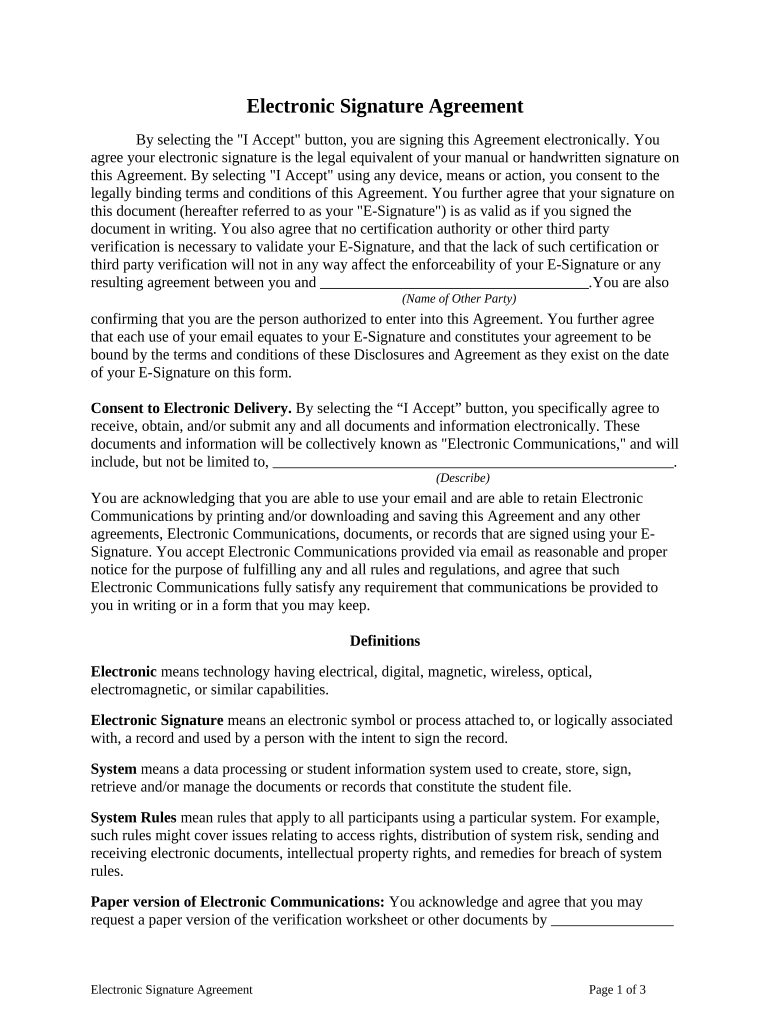
Electronic Signature Agreement

This template is fully customizable. Edit the text, fill out the fields, and send it for signature. Give it a try!
Electronic Signature Agreement

What an Electronic Signature Agreement Is

An Electronic Signature Agreement is a standalone contract where parties consent to use electronic records and electronic signatures to form, execute, and maintain legally binding agreements. It explains the method of signing, the types of electronic signatures accepted, authentication requirements, and how signed records will be retained and presented. In the United States this agreement operates under the ESIGN Act and applicable state UETA statutes; it may include consumer-facing disclosures required by 15 U.S.C. §7001(c). The agreement reduces reliance on paper while documenting intent, consent, attribution, and retention.

Why include an Electronic Signature Agreement

Use an Electronic Signature Agreement to ensure parties knowingly consent to e-signatures, document accepted signature methods, and set authentication and retention rules. It clarifies legal enforceability under ESIGN/UETA and reduces administrative friction for remote or high-volume signing workflows.

Why include an Electronic Signature Agreement

Who typically uses this agreement

Common users who need an Electronic Signature Agreement include organizations that transact with remote signers, manage regulated records, or run high-volume approvals.

  • Real estate brokers and property managers handling leases and purchase agreements electronically.
  • Healthcare administrators collecting patient authorizations under HIPAA with required privacy addenda.
  • Finance and HR teams issuing forms (W-9, I-9, offer letters) for remote onboarding.

Step-by-step: preparing and sending the agreement

Follow these steps to prepare, send, and capture legally defensible electronic signatures using a standard Electronic Signature Agreement.

  • 01
    Prepare: Upload document, insert signature and initial fields, and set signer order.
  • 02
    Identify: Enter signer contact details and authentication level required.
  • 03
    Send: Dispatch via email invite or secure signing link; support guest signing.
  • 04
    Archive: Store signed record and audit trail in secure repository for retention.

Configure the online workflow to match legal needs

Configure online settings to match authentication, notification, and retention needs when launching an Electronic Signature Agreement workflow.

Configuration Field and Setting Name Configuration
Authentication Method and Required Strength Email link, SMS code, or KBA per risk.
Signer Routing, Order, and Roles Sequential or parallel routing; role-based approvals supported.
Field Types, Validation and Calculations Text, date (MM/DD/YYYY), checkboxes, conditional and formula fields.
Retention Periods and Audit Trail Settings Keep signed PDF and metadata; exportable chain-of-custody logs.

Technical and platform considerations for e-submission

Electronic submission needs browser support, TLS connectivity, and a repository that preserves signed records and audit trails for legal defensibility.

  • Browser Requirements: Modern browser with TLS 1.2+ support.
  • Document Formats: PDF, Word (DOCX), and Excel supported.
  • Integrations: CRM, cloud storage, and ERP connectors.

How electronic submission typically flows

Typical e-submission flow for an Electronic Signature Agreement shows how documents are sent, authenticated, signed, and archived.

  • Upload: Sender uploads document to the signing platform.
  • Place Fields: Add signature, date, and conditional fields into the file.
  • Authenticate: Choose email, SMS, KBA, or advanced authentication.
  • Complete: Signed PDF and audit trail delivered to all parties.

Key timing and deadlines to watch

Key dates and timing to consider when using an Electronic Signature Agreement across tax, employment, and regulated workflows.

Consumer Consent Timing:

Obtain consent before sending consumer-facing records per ESIGN consumer-disclosure rules.

1099 and W-2 Deadlines:

Recipients must receive forms by Jan 31; IRS filing dates vary.

I-9 Retention Requirement:

Retain I-9 for 3 years after hire or 1 year after termination.

RON Recording Retention:

States often require A/V recording retention for 5–10 years.

Tax Return Deadline:

Individual tax returns due April 15; extensions extend to Oct 15.

Common preparation mistakes to avoid

  • Using ambiguous signature methods or missing consumer disclosure can undermine consent and allow a signer to contest the document's enforceability.
  • Filing signed records without a clear retention policy risks noncompliance with IRS, HIPAA, or state records rules and potential penalties.
  • Failing to authenticate high-value signers or using weak email-only validation increases fraud risk and may not meet regulatory standards.
  • Mismatched party names, missing corporate titles, or unsigned signature blocks are common clerical errors that can invalidate signatures in disputes.

Potential penalties and legal risks

Tax Penalties: 1099 late fines per IRC §6721
I-9 Violations: Civil fines $281–$2,789
Intentional Disregard: Higher per-form penalties, no cap
Contract Risk: Unauthenticated signatures may be unenforceable
Privacy Breach: HIPAA fines and remediation costs
Operational Delay: Re-execution or legal review required

Essential clauses to include in the agreement

A complete Electronic Signature Agreement typically defines scope, accepted signature types, authentication, record retention, revocation procedures, and witness or notary rules when required.

Scope

Describe which transactions are covered, which parties are bound, and any excluded document classes (for example, wills or court filings). Clear scope reduces future interpretation disputes.
Signature Types

List acceptable methods: typed name, drawn signature on device, uploaded image, click-to-sign, and PKI-based digital signatures. Specify when cryptographic (digital) signatures are required for non-repudiation.

Authentication

Define authentication levels by transaction risk: email-only for low-risk, SMS/KBA for medium-risk, and multi-factor or ID credential analysis for high-risk or regulated transactions like healthcare or finance.

Retention

State retention period for signed records and associated audit trails. Include export formats, access controls, and procedures for producing records in litigation or regulatory inquiries.

Revocation

Explain how a party may revoke consent to electronic transactions, any notice requirements, and whether revocation converts existing signed records into invalid or simply prevents future electronic transactions.

Notarization

Clarify when notarization or witnesses are required, whether RON is acceptable, and the retention obligations for any A/V recordings or notary journals and applicable state statutes require.

Practical features that support compliance

Core practical features to include in an Electronic Signature Agreement help ensure consistent execution, auditability, and integration with business systems.

Audit Trail

Require an immutable audit trail capturing signer identity, timestamps, IP addresses, and each action taken. Specify where audit data will be stored and how it will be produced in disputes or compliance reviews.

Export Formats

State file formats for signed records (PDF/A recommended), availability of native formats, and whether signed documents are downloadable or accessible via API for long-term storage.

Integrations

Document standard requires connectors to CRM, ERP, cloud storage, and common collaboration suites. Specify supported integrations and any limits on API access or user provisioning.

Accessibility

Confirm accessibility standards (WCAG 2.0 AA). Describe alternative signing flows for users with assistive technologies or for legally required in-person attestations and documentation support resources.

Industry examples of Electronic Signature Agreement use

Real-world examples show how organizations use an Electronic Signature Agreement to speed execution while preserving legal evidence and compliance.

Optica Ventures

Optica Ventures needed fast, user-friendly signature collection across tenants and clients to avoid in-person delays.

  • signatures returned without setup friction.
  • The Electronic Signature Agreement standardized accepted signature methods, clarified authentication requirements, and documented retention practices so the company could defend agreements and reduce turnaround times while remaining compliant with ESIGN and applicable state law.

Martin Properties

Martin Properties moved lease executions online to close rentals faster and reduce field paperwork while retaining legal evidence for tenant agreements.

  • Completed and archived leases remotely.
  • Their Electronic Signature Agreement specified acceptable signature methods and storage procedures, enabled remote notarization where allowed, and ensured signed leases included complete audit trails, which reduced vacancy turnaround and simplified compliance checks.

Who signs and approves this agreement

Legal Counsel

In-house or external counsel reviews Electronic Signature Agreements to confirm statutory compliance with the ESIGN Act and applicable UETA provisions. Counsel evaluates exceptions, notarization requirements, consumer disclosures, and state-specific rules to reduce litigation risk and ensure enforceability.

Operations Manager

Operations managers implement the agreement in workflows, set authentication levels, and coordinate retention policies. They ensure integration with document repositories and that signed records and audit trails are accessible for audits and business continuity needs.

Security and compliance features to document

Encryption: AES-256 at rest, TLS 1.2/1.3
Transport Security: TLS 1.2/1.3 in transit
Audit Trail: IP, timestamps, and action logs
Certifications: SOC 2 Type II, ISO 27001, PCI DSS
HIPAA BAA: Available with business associate agreement
Advanced Auth: MFA, KBA, ID credential analysis

Vendor feature and price comparison for eSignature solutions

Compare common eSignature vendor features and starting prices to assess compliance and cost considerations for an Electronic Signature Agreement.

signNow DocuSign Adobe Sign PandaDoc HelloSign
Starting Price $8/user/mo $15/user/mo $14/user/mo $19/user/mo $15/user/mo
Free Trial 7-day free trial Varies by plan Varies by plan Varies by plan Varies by plan
Bulk Send Yes Yes Yes Yes No
Audit Trail Yes Yes Yes Yes Yes
HIPAA Compliant Yes Yes Yes No No
Envelope Cap No cap 100 envelopes/user/year Varies by plan Varies by plan Varies by plan

FAQs and troubleshooting for Electronic Signature Agreements

Answers to common questions about enforceability, authentication, notarization, revocation, storage, and consumer disclosures for an Electronic Signature Agreement.


Need help? Contact support

be ready to get more
Join over 28 million airSlate SignNow users