Claimant
Provide the legal name and business entity of the claimant, including contact information and, where applicable, the contractor license or tax identification number used for billing and verification by the recorder.
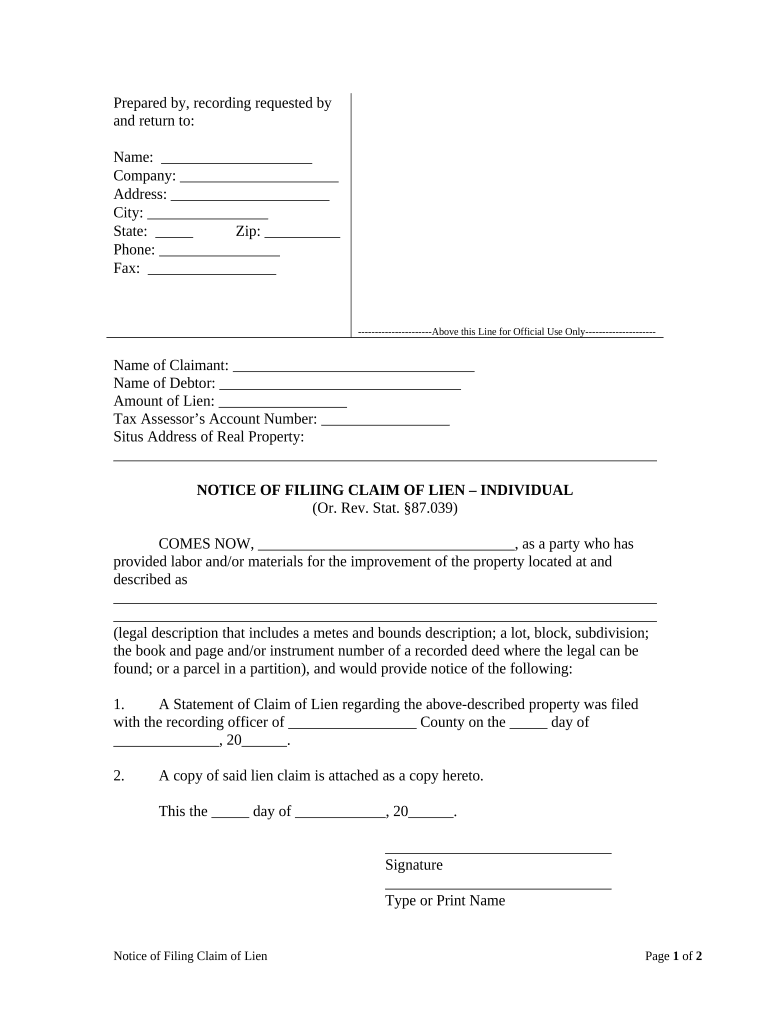
Filing an Oregon lien preserves remedy options for unpaid work or materials, notifies later buyers and lenders of the claim, and triggers statutory enforcement timelines. Proper filing reduces the risk of waiver, inaccurate notices, and costly litigation by establishing a public record of the claim.

Common users include contractors, suppliers, subcontractors, and property owners involved in construction or improvement projects.
Provide the legal name and business entity of the claimant, including contact information and, where applicable, the contractor license or tax identification number used for billing and verification by the recorder.
Give a precise legal description or assessor’s parcel number (APN); street addresses alone may be insufficient. Errors in description can render a lien unenforceable or impair priority against subsequent purchasers.
State the claim amount with breakdowns for labor, materials, retainage, and interest where allowed; include computation dates and references to invoices or contracts supporting the sum.
Include contract dates, dates work began and completed, delivery dates for materials, and the effective filing date. Statutory deadlines for enforcement run from these dates.
Attach a sworn statement or verification where required, signed under penalty of perjury by the claimant or authorized officer to attest to the accuracy of the claim.
File at the county recorder where the property is located before statutory deadlines; pay applicable recording fees and confirm indexation to ensure notice to title searchers.
| Field | Setting | Recommendation |
|---|---|
| Document Type | Mechanic’s Lien | Recorded PDF preferred |
| Recording County | County of property | File in property county |
| Authentication | Signer ID | Email + SMS code recommended |
| Delivery | To Recorder | Upload certified PDF and receipt |
Use platforms that support PDF, Word, and e-signature workflows, deliver audit trails, and integrate with cloud storage and title systems.
Provide statutory preliminary notice where required before recording lien.
Record lien within the statute period after completion or last furnishing.
Commence foreclosure action before statutory limitation expires.
Serve notices on owner and others as prescribed by statute.
Pay county fees at submission; amounts vary by county.
Dates work began and completed establish preliminary deadlines.
Any required preliminary notices must be timely delivered to preserve rights.
Recording triggers public notice and enforcement timelines under statute.
File suit or enforce within statutory period to avoid forfeiture.
| Type | Mechanic’s Lien | Lien Waiver |
|---|---|---|
| Recorded? | ||
| Purpose | secure payment | release claim |
| Effect on Title | cloud on title | clears encumbrance |
| When used | unpaid work | payment received |
| signNow | DocuSign | Adobe Sign | PandaDoc | HelloSign | |
|---|---|---|---|---|---|
| Starting Price | $8/user/mo | $15/user/mo | $14/user/mo | $19/user/mo | $15/user/mo |
| Free Trial | 7-day free trial | Trial varies | Trial varies | Trial varies | Trial varies |
| Bulk Send | Yes | Yes | Yes | Yes | No |
| HIPAA Compliant | Yes | Yes | Yes | No | No |
| Envelope Cap | No cap | 100 envelopes/user/year | Varies | Varies | Varies |
Brian Fitzgibbons of Optica Ventures highlights ease of use for internal teams and external clients when filing property claims digitally.
Tim Martin of Martin Properties describes executing lien-related paperwork online to maintain compliance and move closings forward without in-person signings.