Establishing secure connection…Loading editor…Preparing document…

Complaint for Encroachment

This template is fully customizable. Edit the text, fill out the fields, and send it for signature. Give it a try!
Complaint for Encroachment

What a Complaint for Encroachment Is

A Complaint for Encroachment is a civil pleading filed in state or local court to resolve disputes where a structure, fence, or improvement intrudes onto another party's property or onto public right-of-way. It identifies the property, describes the encroachment, alleges legal grounds such as trespass or nuisance, and requests relief — typically removal, injunctive relief, or damages. The complaint must include accurate legal descriptions, supporting evidence like survey plats or photographs, and a clear statement of requested remedies to give the court and defendant notice of the claim.

Why Filing a Complaint for Encroachment Matters

Filing a Complaint for Encroachment clarifies legal rights, creates a record for title and remedies, and starts judicial procedures to remove or compensate for intrusions. It preserves statutory limitations and compels evidence exchange, which is essential for resolving property boundary disputes.

Why Filing a Complaint for Encroachment Matters

Who Typically Uses a Complaint for Encroachment

Property owners, local governments, utility companies, and developers commonly file to remove encroachments or seek damages.

  • Individual homeowner asserting boundary intrusion after survey identifies unauthorized structure.
  • Municipality enforcing right-of-way encroachments affecting sidewalks, curbs, or public utilities.
  • Neighbor disputes following property line changes or improvements without written consent.

Essential Sections to Include in the Complaint

Core sections of a Complaint for Encroachment define parties, property description, factual allegations, legal claims, demanded relief, and required exhibits such as surveys and photographs.

Parties

Identify plaintiff(s) and defendant(s) with mailing addresses; include business entity formation details and contact information for service of process, ensuring names accurately match title records.
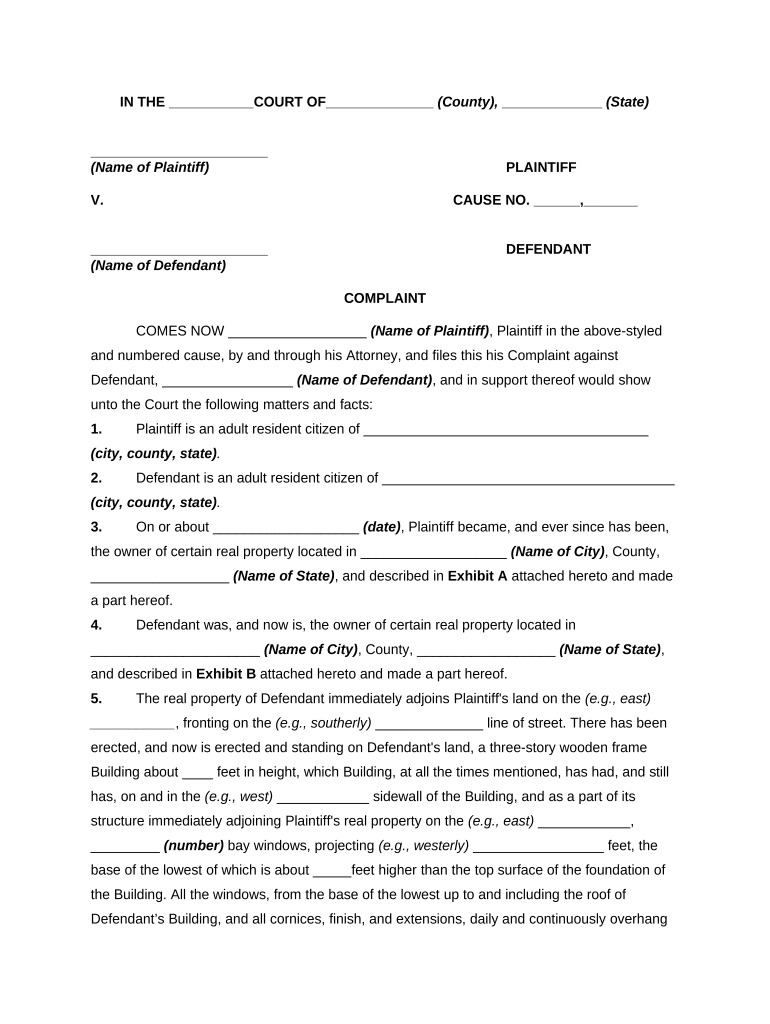
Property Description

Provide legal description, parcel or lot number, assessor parcel number, and attach a recent boundary survey accurately showing the encroachment's location relative to property lines.

Factual Allegations

Chronologically describe when the encroachment began, who constructed it, any prior notices, inspection dates, and physical evidence such as photos, expert reports, and measurements.

Legal Claims

Cite applicable causes of action—trespass, nuisance, ejectment, or declaratory judgment—and reference statutory provisions or controlling case law that supports the requested remedy and damages where applicable.

Relief Requested

Specify exact relief sought, such as removal of the encroaching structure, injunctive relief, abatement, monetary damages, costs and attorney fees, and any declaratory relief to clear title.

Exhibits

Attach exhibits: certified boundary survey, scaled site plan, dated photographs with captions and measurements, written notices exchanged, engineer or surveyor affidavits, and any recorded easements.

Step-by-Step: Preparing and Filing the Complaint

Follow these steps to draft, attach evidence, file, and serve a Complaint for Encroachment properly in the appropriate jurisdiction.

  • 01
    Draft Complaint: Draft complaint with full facts and legal claims.
  • 02
    Attach Exhibits: Add survey, photos, and maps.
  • 03
    File with Court: File according to local civil procedure rules.
  • 04
    Serve Defendant: Serve per state rules and proof of service.

Configure an Online Workflow for Preparation and e-Filing

Configure an online workflow for e-filing, attachments, and signer roles to streamline preparation and electronic submission of the complaint.

Field Configuration
Document Template and Field Mapping Use a reusable template that maps fields and triggers exhibits when conditions apply.
Assign Signer Roles and Permissions Assign roles for plaintiff, defendant, counsel, and authorized agents; set signing order.
Attachment Requirements and Validation Rules Make survey, site plan, and photos required attachments before filing.
E-Filing Integration with Court Portals Enable submission to supported court e‑filing portals and save confirmation.

Where to File and How Cases Are Routed

Routing depends on property location and relief sought; state trial courts or county courts typically have civil jurisdiction over encroachment claims.

  • Local Civil Court: File in county or superior court where property is located.
  • Municipal Actions: Municipalities may file for public right-of-way encroachments.
  • Alternative Dispute: Mediation or arbitration if contract requires it.
  • Enforcement Orders: Post-judgment remedies include removal and damages.

Technical Requirements for eSubmission and eSigning

For eSubmission use, confirm supported file formats, signer authentication, and court portal acceptance before relying exclusively on electronic filing.

  • File Formats: PDF/A preferred; DOCX accepted in some portals.
  • Signer Authentication: Email, SMS code, or stronger KBA where required.
  • Court Portal Support: Verify local court accepts e-file and e-sign.

Timelines, Deadlines, and Typical Scheduling

Timelines vary by court — local filing cycles, service deadlines, and discovery schedules determine how quickly encroachment matters progress to hearing.

Initial Filing and Service Deadline:

File according to local rules; serve defendants promptly to avoid default defense or statute issues.

Preliminary Injunction or Temporary Relief:

Emergency hearing may be requested; local rules govern timetable for temporary restraining orders.

Discovery and Evidence Exchange:

Surveyor reports, photographs, and expert disclosures commonly follow within scheduled discovery windows.

Motion Practice and Hearings:

Motions for summary judgment or hearings on injunctions usually set per court calendar.

Post-Judgment Enforcement Timeline:

After judgment, enforcement and removal timelines follow local enforcement and permit processes.

Key Case Milestones from Filing to Enforcement

Key stages in an encroachment action move from complaint filing through enforcement; expect fact development and potential court-ordered remediation.

01

File Complaint

Complaint filed and initial filing fees paid; case number assigned.

02

Service of Process

Defendant served with complaint and summons according to state rules.

03

Discovery Period

Parties exchange surveys, expert reports, and written discovery; depositions scheduled.

04

Judgment & Enforcement

Court issues ruling; remedies ordered and compliance supervised by court.

Penalties and Risks of an Incorrect Complaint

Dismissal Risk: Insufficient facts or improper parties
Statute of Limitations: Missed filing deadline bars claim
Service Defects: Improper service may void proceedings
Evidence Exclusion: Unpreserved survey or chain breaks
Sanctions: Frivolous claims invite sanctions
Title Complications: Unresolved encroachment affects marketability

Common Preparation Mistakes to Avoid

  • Using informal property descriptions instead of a legal description causes ambiguity and may require amendment or delay in court proceedings.
  • Failing to attach a certified survey or clear photographs leaves factual assertions unsupported and weakens requests for injunctive relief.
  • Naming the wrong defendant or omitting a necessary party can result in dismissal or later motions to add parties.
  • Skipping jurisdictional checks and filing in the incorrect court increases costs and may force re-filing in the proper forum.

Required Information and Common Data Fields

Plaintiff Name: Full legal name as on title
Defendant Name: Exact name for service of process
Legal Description: Metes and bounds or recorded grant
Assessor Parcel Number: APN or parcel identifier from county records
Exhibits: Survey, photos, site plan, affidavits
Signature Block: Printed name, title, date, contact info

eSignature Vendor Comparison for Filing and Executing the Complaint

Comparing common eSignature options for filing and executing legal complaints; pricing and feature trade-offs vary by plan and usage volume.

signNow DocuSign Adobe Sign PandaDoc HelloSign
Starting Price $8/user/mo $15/user/mo $14/user/mo $19/user/mo $15/user/mo
Free Trial 7-day free trial No No Yes, limited Yes, limited
Bulk Send Yes Yes Yes Yes No
Audit Trail Yes Yes Yes Yes Yes
HIPAA Compliant Yes Yes Yes No No

Representative Examples of Encroachment Cases

Real-world examples show how plaintiffs secure removal, negotiate easements, or obtain damages through properly prepared complaints and evidence.

Homeowner Dispute

A homeowner discovered a neighbor's retaining wall had been built three feet onto their lot after a survey for refinancing.

  • Plaintiff filed complaint and attached certified boundary survey.
  • The court ordered removal of the structure and awarded nominal damages; the parties later recorded an agreed easement to prevent recurrence and avoid further litigation.

Municipal Right-of-Way

A city removed an illegally installed fence obstructing a public sidewalk after repeated notices to the abutting property owner went unanswered.

  • Municipality filed a complaint seeking injunctive relief and removal.
  • The court granted injunctive relief; the owner complied with the removal order, and the municipality recovered abatement costs under its municipal code and avoided safety hazards.

FAQs and Practical Answers for Common Issues

Answers to frequent practical questions about preparing, signing, filing, and enforcing a Complaint for Encroachment in U.S. jurisdictions.


Need help? Contact support

be ready to get more
Join over 28 million airSlate SignNow users