Establishing secure connection…Loading editor…Preparing document…

Indiana Interrogatories Propounded to Garnishee Defendant

This template is fully customizable. Edit the text, fill out the fields, and send it for signature. Give it a try!
Indiana Interrogatories Propounded to Garnishee Defendant

What the Indiana Interrogatories Propounded to Garnishee Defendant Are

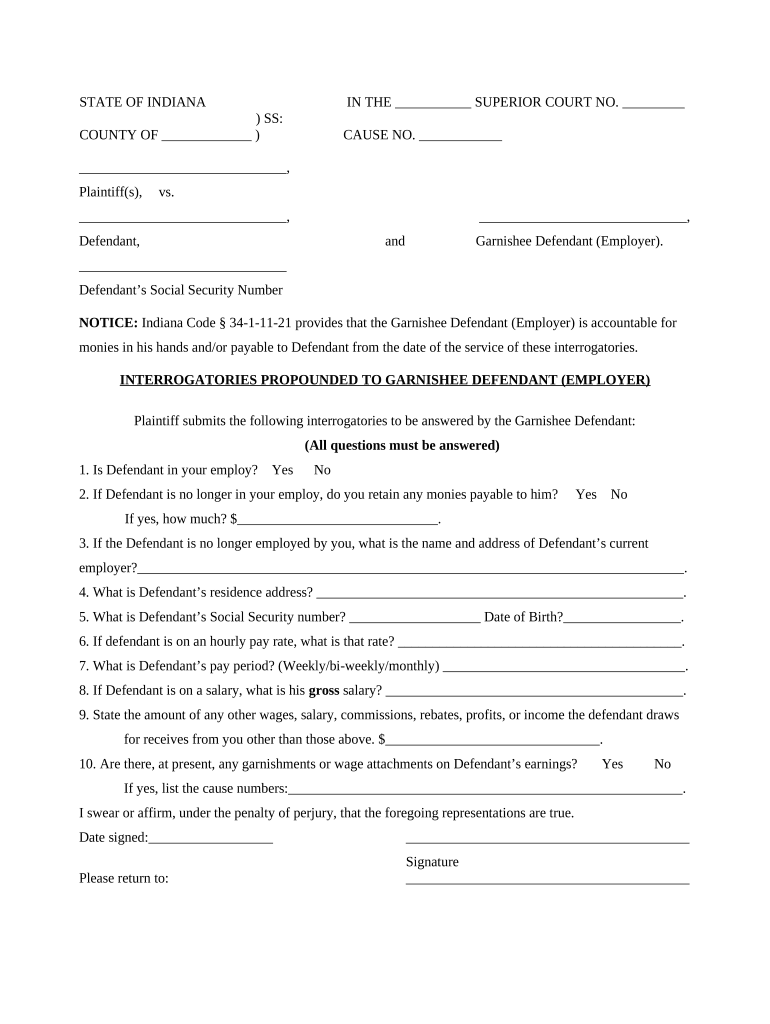
The Indiana Interrogatories Propounded to Garnishee Defendant is a discovery and enforcement document used after a money judgment is entered. It asks a garnishee (a third party who holds funds or property of the judgment debtor) to answer written questions about assets, accounts, or obligations owed to the debtor so the judgment creditor can identify collectable property. The form operates within Indiana civil procedure and local court rules and is often paired with a writ of garnishment, service proofs, and supporting affidavits.

Why this form matters in garnishment proceedings

Interrogatories to a garnishee streamline asset discovery, create a record of the garnishee's knowledge, and support collection actions. Properly completed interrogatories can lead to timely release of funds, reduce contested hearings, and provide evidence for contempt or turnover motions if answers are evasive.

Why this form matters in garnishment proceedings

Who typically prepares and answers these interrogatories

Typical users include judgment creditors, their attorneys, and court clerks coordinating service and filings.

  • Judgment creditors or their counsel who need to locate debtor assets and enforce a money judgment.
  • Garnishees such as banks, employers, or debtors holding property who must disclose account details or wages.
  • Court personnel and process servers handling service, returns, and proof of mailing or delivery.

In practice, attorneys prepare the interrogatories and garnishees either respond directly or through counsel, depending on complexity.

Core elements to include in a professional set of interrogatories

A complete packet is precise, properly captioned, and includes the interrogatories, a verification page, certificates of service, and references to the underlying judgment and case number.

Case Caption

Clear court name, case number, and party names so responses are legally attributable and filed to the correct docket.
Instruction Section

Plain instructions describing how to answer, time limits, format for attachments, and how to assert objections or privileges.

Interrogatory List

Numbered, focused questions about accounts, amounts owed, dates, and supporting documents to minimize evasive answers.

Verification

A sworn verification or affidavit signed by the garnishee confirming truthfulness under penalty of perjury.

Certificate of Service

A signed proof showing how and when the interrogatories were served, who received them, and the method used.

Attachments

Document list or sample forms for account statements, ledgers, or payroll records the garnishee should produce with answers.

Step-by-step: preparing and serving the interrogatories

Follow a clear sequence so the interrogatories are effective, timely, and enforceable under Indiana procedures.

  • 01
    Prepare packet: Draft interrogatories, verification, and certificate of service with case caption.
  • 02
    Attach judgment: Include a copy of the judgment or writ of garnishment to establish the basis for discovery.
  • 03
    Serve garnishee: Use court-approved service methods and obtain proof of service per local rules.
  • 04
    Track deadline: Calendar the response date and prepare to file motions if answers are missing or incomplete.

How to configure an online workflow for these interrogatories

Set up templates and authentication steps to reduce repetitive work and improve compliance when sending interrogatories online.

Field Configuration
Template Create a reusable template with case-caption and standard interrogatories.
Authentication Require email plus SMS code or ID verification for higher-assurance responses.
Reminders Enable automated reminders at 7 and 3 days before the due date.
Document Retention Archive signed responses and certificates with searchable metadata for the case number.

Typical eSubmission and response flow

A reliable digital process mirrors in-person service while ensuring a verifiable audit trail and easy evidence retrieval.

  • Upload Packet: Sender uploads interrogatories and supporting judgment document to the e-filing system.
  • Assign Signers: Designate the garnishee as signer and set verification level required for the response.
  • Deliver: System sends a secure link via email or SMS to the garnishee for review and signing.
  • Capture Audit: System stores timestamps, IP, and attachments as the certificate of completion for court use.

Technical considerations for digital filing and signatures

Confirm the e-filing system and eSignature provider support required file types, authentication, and retention before sending.

  • File formats: PDF and DOCX accepted
  • Integrations: Supports major platforms
  • Audit trail: Kept with each transaction

Ensure the chosen platform supports ESIGN/UETA-compliant records, allows export of signed PDFs, and preserves an immutable audit log for court submission.

eSignature solution comparison for completing and serving interrogatories

Compare core pricing and compliance features relevant to legal document workflows; signNow is listed first as the baseline for cost and capabilities.

signNow DocuSign Adobe Sign PandaDoc HelloSign
Starting Price $8/user/mo $15/user/mo $14/user/mo $19/user/mo $15/user/mo
Free Trial Yes, 7-day trial Varies by plan Varies by plan Varies by plan Varies by plan
Bulk Send Yes Yes Yes Yes Varies by plan
Audit Trail Yes Yes Yes Yes Yes
HIPAA Compliant Yes Varies by plan Varies by plan Varies by plan Varies by plan

Security and compliance considerations for responses and e-submission

Data in transit: TLS 1.2/1.3
Data at rest: AES-256 encryption
Regulatory standards: ESIGN and UETA compliance
Healthcare compliance: HIPAA (BAA required)
Audit evidence: Detailed audit trails retained
Certifications: SOC 2 Type II, ISO 27001

Common timing expectations and service deadlines

Deadlines depend on governing discovery rules and local court settings; calendar response and service dates immediately on filing.

Response Time:

Typically 30 days to respond to written discovery; local rules may shorten or lengthen this period

Service Proof:

File certificate of service promptly to document compliance with timing requirements

Motion to Compel:

Usually filed after a missed response and meet-and-confer attempts under court rules

Contempt or Turnover:

Can be sought if garnishee refuses to answer or turn over held funds

Renewal:

Enforcement steps may have separate timelines for renewing writs or garnishments

Key milestones from judgment to collection

A sequential milestone view helps coordinate filings, service, and enforcement actions efficiently.

01

Judgment Entered

Court enters money judgment and case becomes enforceable.

02

Issue Writ

Obtain writ of garnishment or writ of execution to begin asset collection.

03

Serve Garnishee

Serve interrogatories and writ on garnishee with proof of service.

04

Enforce or File Motion

If answers are insufficient, file motions to compel, turnover, or for contempt.

Common preparation pitfalls to avoid

  • Using ambiguous, compound questions that allow partial or evasive answers and require follow-up discovery.
  • Failing to include a verification or sworn statement, which can limit enforcement options for incorrect answers.
  • Serving the wrong party or failing to file a certificate of service, causing missed deadlines or rejected filings.
  • Not tailoring requests to the garnishee’s records, resulting in objections or production of irrelevant documents.

Consequences of incorrect or incomplete responses

Default judgment: Possible entry
Contempt: Court sanctions
Fines: Monetary penalties
Turnover order: Compel payment
Costs awarded: Attorney fees possible
Delay: Extended collection timeline

Real-world examples of interrogatories in garnishment matters

Examples illustrate how interrogatories surface assets and resolve enforcement efficiently.

Bank Account Discovery

A creditor sought account balances from a local bank to satisfy a judgment

  • Bank produced statements for the relevant period
  • The verified responses led to a turnover order and full collection without a contested hearing.

Wage Garnishment Lead

An employer listed as a garnishee was asked to report wages and withholdings

  • Employer provided payroll records identifying disposable earnings
  • The creditor used the payroll data to obtain a garnishment order that recovered installments over time.

Frequently asked questions about these interrogatories

Answers to common procedural and technical questions help avoid service mistakes and preserve enforceability.


Need help? Contact support

be ready to get more
Join over 28 million airSlate SignNow users