Establishing secure connection…Loading editor…Preparing document…

Garnishment Letter

This template is fully customizable. Edit the text, fill out the fields, and send it for signature. Give it a try!
Garnishment Letter

What a Garnishment Letter Is and when it's used

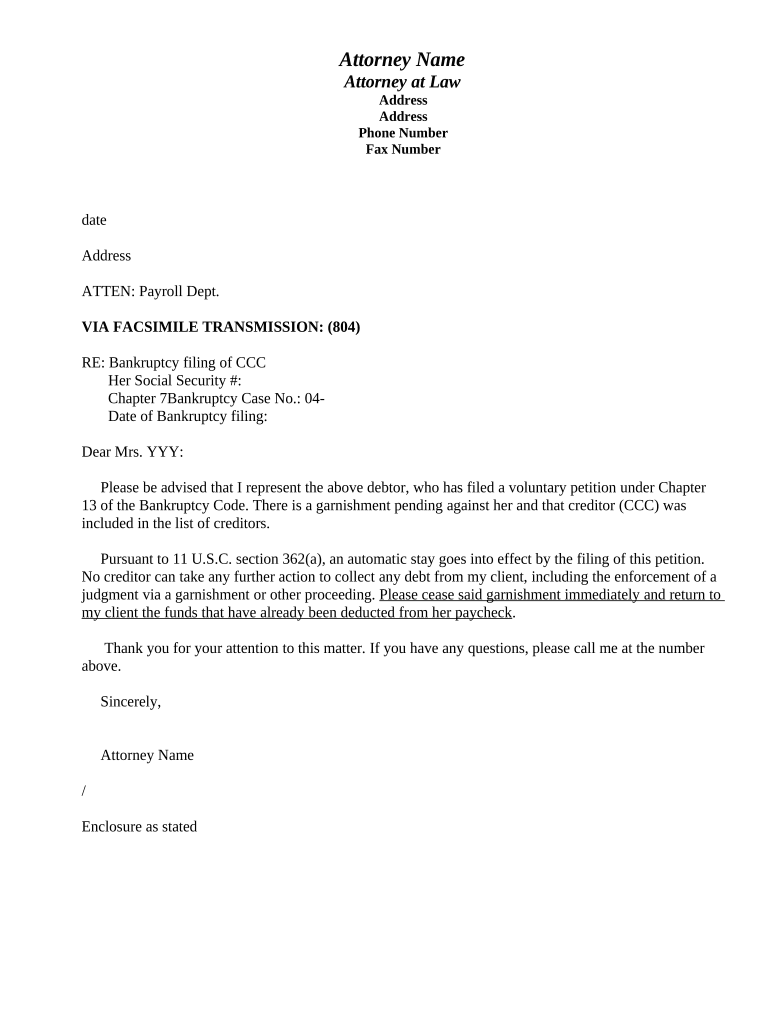
A Garnishment Letter is a written notice used by a creditor, judgment creditor, or government agency to instruct an employer, bank, or third party to withhold funds from an individual's wages or accounts to satisfy a debt or court judgment. It explains the debt, identifies the garnishee and debtor, specifies amounts or withholding formulas, and cites the controlling order or statute. Common uses include wage garnishments, defaulted loans, child support, and tax levies. Accurate, dated, and properly served letters are required to enforce collection and to protect garnishee compliance.

Why a clear Garnishment Letter matters legally

A Garnishment Letter provides a clear legal basis for collection, preserves creditor rights, and protects garnishees from liability when properly served. It reduces disputes by documenting amounts, deadlines, and proof of service, improving enforceability and administrative clarity.

Why a clear Garnishment Letter matters legally

Typical users and their roles

Typical users who prepare, receive, or process garnishment letters include creditors, payroll administrators, courts, and collection attorneys.

  • Creditors and collection agencies seeking court-ordered repayment or enforcing judgments.
  • Employers or payroll departments served as garnishees required to withhold wages.
  • Courts and clerks issuing orders; attorneys preparing compliant, state-specific notices for service.

Essential components to include in the letter

Core sections in a professional Garnishment Letter clarify authority, amounts, recipient duties, deadlines, service instructions, and appeal rights and contact information.

Header

Identify issuing party, court or agency, case or account number, and date; establishes the legal source and contact for questions to avoid processing delays and prompt follow-up.
Debtor Details

Provide full legal name, current address, Social Security number or tax ID where required, employment details, and any aliases to ensure correct identity matching records.

Amount Owed

State the total judgment or debt, itemize fees, interest, and costs, and include the calculation date and any periodic payment amounts or withholding formula specified.

Garnishee Instructions

Clearly instruct the employer or financial institution on withholding amount, payment address or remittance method, timeline for forwarding funds, and required documentation for compliance and retention.

Service & Proof

Specify acceptable service methods, required proof such as return receipts or certified mail, and where to file evidence of service to protect garnishee from double liability.

Legal Notice

Include citation to the controlling judgment or statute, notice of rights and appeal procedures, deadlines for response, and contact information for legal questions and counsel.

Step-by-step: preparing and serving a Garnishment Letter

Follow these steps to prepare and serve a Garnishment Letter in compliance with court and state rules.

  • 01
    Prepare: Gather judgment, account numbers, and debtor identity.
  • 02
    Draft: Write clear amounts, calculation, and service instructions.
  • 03
    Serve: Use required method: certified mail, personal service, or statutory process.
  • 04
    File: File proof of service with the court and notify parties.

How to customize and complete the letter online

Configure an online workflow to place fields, set signer roles, and enable secure delivery for remote completion.

Field Configuration
Signature Field Placement Drag to signature location; set required.
Signer Authentication Choose email, SMS code, or KBA.
Conditional Fields Show attachments only if checkbox selected.
Audit Trail Enable timestamps, IP logs, and completion certificates.
Retention Settings Set export formats and legal hold options.

Where to send or file a Garnishment Letter

Common destinations include employers, banks, court clerks, and designated collection addresses; choose service method required by governing law.

  • Employer: Serve payroll or HR to begin wage withholding.
  • Bank: Send to account custodian with account and garnishee details.
  • Court: File judgment or order with clerk to authorize garnishment.
  • Agency: Deliver tax levies or support orders to the specified agency.

Digital signing, formats, and platform considerations

Digital submission options affect authentication, storage, and service evidence; choose platform features to meet legal and privacy requirements.

  • File Formats: PDF, DOCX widely accepted.
  • Integrations: Works with Salesforce, NetSuite, Microsoft 365.
  • Authentication: Support email/SMS, KBA, MFA.

Key timing considerations and statutory deadlines

Key deadlines depend on judgment entry, service rules, and statutory response periods for garnishees and debtors.

Service Period:

Follow state law for timely service after judgment entry.

Employer Withholding Start:

Begin withholding on next pay period per statute.

Remittance Deadline:

Forward withheld amounts by employer deadline specified in the letter.

Notice to Debtor:

Provide debtor with notice and explanation of rights within specified days.

Record Filing:

File proof of service and accounting with the court as required.

Notarization, witness, and authentication steps

Authentication steps vary: notarization, witness counts, and RON use depend on document type and state notary rules.

01

Verify State Law

Confirm whether the jurisdiction requires notarization or witnesses.

02

Notarization Needed

Most states require notarization for official garnishment filings.

03

Witness Count

Witness requirements are rare but vary by instrument and state.

04

Remote Notarization

RON may be allowed; check state notary commission rules.

05

Retention of Recordings

RON sessions often require audio-video retention for several years.

06

Affidavit of Service

File a notarized affidavit when service is completed.

07

Proof in Court

Produce originals, notarizations, and service proofs at hearing.

08

Attorney Review

Have counsel confirm formalities before filing to prevent rejection.

Common mistakes to avoid

  • Using incomplete debtor identifiers such as initials or old addresses, which can lead to misdirected withholding and creditor liability for incorrect collection.
  • Failing to include case number or judgment date, causing courts or garnishees to delay enforcement while requesting clarifying information from the creditor.
  • Sending via improper service method when statute requires personal service or certified mail, potentially invalidating the garnishment and exposing sender to sanctions.
  • Omitting instructions for exempt income or statutory caps, which may cause garnishee over-withholding and create double liability or employer disputes.

Potential penalties and legal risks

Garnishee Liability: Employer may face double liability.
Court Sanctions: Fines or contempt possible.
Invalid Service: Garnishment can be voided.
Tax Penalties: IRS backup withholding risk.
Delay Costs: Accrued interest increases balance.
Legal Fees: Attorney costs and court costs.

How a Garnishment Letter compares with related enforcement instruments

Compare the Garnishment Letter with related enforcement documents to choose the correct instrument for collection and service.

Document Type Garnishment Letter Levy Notice Wage Order Subpoena
Purpose collect debt tax levy wage deduction obtain evidence
Issuer creditor or court irs or state court court
Service Required statutory methods tax statute court process judicial process
Typical Remedy withholding funds levy accounts reduce pay compel testimony

Saving, exporting, and supporting documents to include

Provide signed originals and digital copies in standard formats and include supporting documentation to ensure enforceability and auditability and retention practices.

Export Formats

Save and distribute final signed letters as PDF/A for long-term archival, and keep editable DOCX copies for internal recordkeeping; include an embedded audit trail or certificate when possible.

Supporting Docs

Attach judgment copies, service affidavits, payroll records, and correspondence demonstrating prior notices or default; these attachments substantiate amounts and support court enforcement actions efficiently online.

Signed Certificate

Include a certificate of service and completion showing signer identity, timestamps, IP addresses, and method of service to strengthen admissibility in court and preserve chain of custody.

Retention Copy

Retain an original signed copy and an electronic copy with audit trail for the retention period required by law; store in encrypted archives with access controls and documented retention policies.

Real-world examples of garnishment use

Real-world examples show how Garnishment Letters operate across payroll, tax, and family-support contexts to secure payments and document compliance.

Payroll Garnishment

A mid-size employer received a court-ordered garnishment after a creditor judgment; payroll integrated the order into its system to begin deductions.

  • Withheld per court formula successfully.
  • The employer retained proof of service, itemized deductions, and forwarded payments on schedule; accurate documentation shielded the employer from secondary liability and resolved the creditor claim without court sanctions expediently.

Tax Levy

State revenue agency issued a levy requiring the bank to freeze and remit funds from a taxpayer's account after notice and statutory waiting period elapsed.

  • Bank complied after verification and reporting.
  • The agency attached certified proof of judgment and provided exact account identifiers; the bank's prompt, documented compliance prevented further enforcement actions, subsequently reduced procedural challenges by the taxpayer, and closed the matter efficiently.

Who may lawfully sign a Garnishment Letter

Authorized Signer — Creditor

An authorized corporate officer, attorney, or designated collections manager signs on behalf of the creditor. Their signature must match court filings or be supported by corporate resolution; incorrect authority can render the garnishment unenforceable or subject to judicial challenge.

Garnishee Signer

An employer or financial institution's authorized representative acknowledges receipt and executes any required notices; their compliance starts withholding and forwarding. Employers should consult legal counsel before refusing or modifying orders to avoid liability for noncompliance.

How to update, correct, or withdraw a Garnishment Letter

Use a controlled amendment process to correct amounts, update debtor info, or withdraw garnishment notices.

01

Identify Change:

Document reason for revision and supporting evidence.
02

Prepare Amendment:

Draft amendment referencing original judgment and new figures.
03

Obtain Approval:

Get creditor or court approval before reissuing notice.
04

Serve Parties:

Serve revised letter to garnishee and debtor per statute.
05

File Proof:

File amended proof of service with court records.
06

Retain Versions:

Keep prior and revised copies with audit trail.

Security and compliance controls for stored letters

Encryption: TLS 1.2/1.3 in transit, AES-256 at rest.
Certifications: SOC 2 Type II, ISO 27001, PCI DSS.
HIPAA: BAA available for protected health information.
Authentication: Support MFA and advanced signer verification.
Audit Trail: Detailed timestamps, IP, and action logs.
Accessibility: WCAG 2.0 Level AA compliance.

eSignature vendor pricing and capability snapshot

Comparing common eSignature vendors helps choose an option for secure, compliant Garnishment Letter execution and distribution.

signNow DocuSign Adobe Sign PandaDoc HelloSign
Starting Price $8/user/mo $15/user/mo $14/user/mo $19/user/mo $15/user/mo
Free Trial 7-day trial Varies by plan Varies by plan Varies by plan Varies by plan
Bulk Send Yes Yes Yes Yes No
Audit Trail Yes Yes Yes Yes Yes
HIPAA Compliant Yes Yes Yes No No
Envelope Cap No cap 100 envelopes/user/year Varies Varies Varies

Frequently asked questions about Garnishment Letters

Answers to frequent questions about drafting, serving, and enforcing Garnishment Letters, plus steps to resolve common problems.


Need help? Contact support

be ready to get more
Join over 28 million airSlate SignNow users