Establishing secure connection…Loading editor…Preparing document…

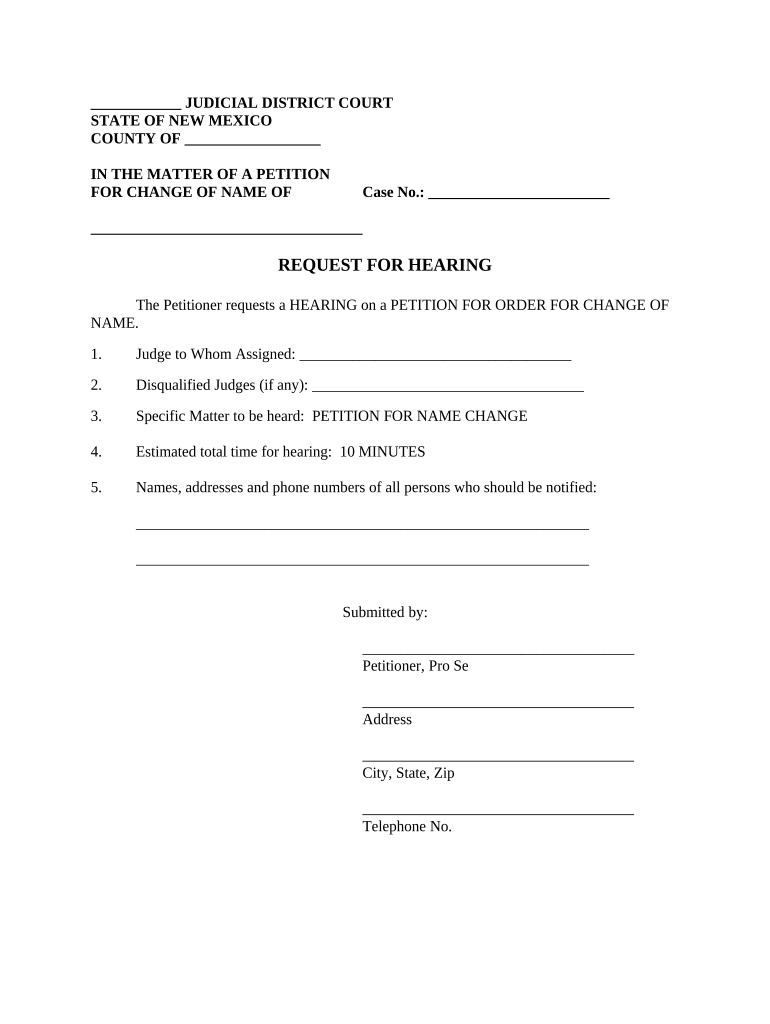
New Mexico Petition for Name Change Hearing

This template is fully customizable. Edit the text, fill out the fields, and send it for signature. Give it a try!
New Mexico Petition for Name Change Hearing

What the New Mexico Petition for Name Change Hearing Is

The New Mexico Petition for Name Change Hearing is the formal court process used to request a legal change of name in New Mexico. A petitioner files a written petition in district court (usually in the county of residence), provides required identifying information and supporting documents, and appears for a hearing where a judge will consider statutory criteria, public notice or publication requirements if applicable, and any objections. If granted, the court issues an order legally changing the name that can be used to update government and private records.

Why People Seek a Name Change through Court

A judicial name change aligns legal identity with current personal circumstances, corrects errors, supports gender transition, provides clarity after marriage or divorce, or establishes a minor’s new name. A court order is the authoritative record accepted by agencies, employers, schools, and financial institutions.

Why People Seek a Name Change through Court

Who Typically Files a New Mexico Name Change Petition

Individuals and guardians use the petition when a voluntary, non-probate name change is needed.

  • Individuals after marriage or divorce seeking to restore or adopt a surname
  • Parents or guardians filing on behalf of minor children with court approval
  • Transgender or nonbinary individuals updating legal name to match identity

Key Roles and Who Signs

Petitioner

The person requesting the name change. The petitioner completes the petition, signs under penalty of perjury, files with the court, appears at the hearing, and must supply identification and supporting documentation.

County Clerk

The clerk accepts filings, assigns a case number, schedules the hearing, and provides procedural guidance. The clerk does not provide legal advice and will refer complex legal questions to court staff or counsel.

Core Components of the Petition and Hearing File

A complete petition package bundles the formal petition, supporting affidavits, identity documents, notice information, and proposed order; the hearing focuses on statutory fitness and any objections.

Petition

A sworn statement by the petitioner describing current name, proposed name, reasons for the change, residency, and affirmation that the change is not for fraud or evasion of debts.
Supporting Affidavit

Affidavit verifying identity details, residence, and confirmation of lack of intent to defraud; may include criminal-history disclosures where required by statute or local rule.

Identification Documentation

Certified copy of a birth certificate, driver's license, or passport and secondary ID to confirm identity during filing and at the hearing.

Notice or Publication

Some counties require public notice or publication of the petition to allow objections; requirements vary by jurisdiction and statutory exception.

Court Hearing

A judge reviews the petition, hears any objections, assesses statutory criteria, and determines whether to grant the requested name change.

Final Order

The signed court order legally changing the name; this document is used to update government and private records after the hearing.

Required Information Typically Collected

Full Legal Name: As shown on government ID
Proposed Name: Exact new name requested
Date of Birth: MM/DD/YYYY format
Residency: County and state of current residence
Reason for Change: Concise lawful explanation
Supporting IDs: Birth certificate, passport, or license

Consequences of Incomplete or Misleading Filings

Dismissal: Court may deny petition
Fines: Sanctions for false statements
Delay: Extended processing and hearing dates
Identity Issues: Mismatch can hinder record updates
Contempt: False affidavits risk contempt
Collateral Effects: Impact on custody or benefits

Common Mistakes to Avoid

  • Using inconsistent name formats across documents delays verification and acceptance by agencies.
  • Failing to disclose prior criminal convictions when required can result in denial or sanctions.
  • Submitting unsigned or unclearly dated affidavits causes administrative rejection and filing delays.
  • Ignoring local publication or notice obligations may result in procedural dismissal or rescheduling.

Step-by-Step: From Petition to Court Order

Complete these main steps in order; timelines vary by county, so confirm with the local court clerk before filing.

  • 01
    Prepare Petition: Fill form accurately and attach IDs
  • 02
    File with Court: Submit petition and pay filing fee
  • 03
    Notice or Publication: Publish if local rule mandates
  • 04
    Attend Hearing: Appear and present the petition

How the Filing and Hearing Process Flows

This sequence shows the typical routing from preparation through court order; local procedures and timelines differ.

  • Document Assembly: Draft petition, affidavits, and exhibits
  • Court Filing: Deliver documents to district court
  • Public Notice: Post or publish when required
  • Judicial Decision: Judge issues signed order

Configuring an Online Petition Workflow

When preparing the packet for online completion or e-signature, configure authentication, required fields, and routing to match court expectations.

Field Configuration
Authentication Email + SMS code or identity proofing
Required Fields Full name, DOB, address, signature, date
Notarization RON or in-person notarization where accepted
Routing Petitioner → Clerk → Judge

Digital Filing and eSignature Considerations

Confirm that electronic submission and e-signature methods meet New Mexico court rules and evidence standards before relying on them.

  • File Formats: PDF/A or PDF preferred
  • Integrations: Connectors: Salesforce, NetSuite, Google Workspace
  • Authentication: Email links, SMS codes, or KBA

Practical Tips for a Smooth Hearing and Record Updates

Follow these practices to reduce delays, ensure acceptance of the order, and streamline downstream updates to identifications and accounts.

Use Exact Government Names
Enter names exactly as shown on primary identification to avoid mismatches when agencies check records; update all supporting documents before submitting where possible.
Confirm Local Rules
Contact the county clerk or review local court rules for publication, filing fees, and courtroom procedures to avoid procedural rejections or unnecessary postponements.
Preserve Audit Trails
When using electronic signatures, retain the audit trail showing signer email, IP address, and timestamps to support authenticity for courts and agencies.
Coordinate Post-Order Updates
Prepare certified copies of the signed order and plan updates for Social Security, DMV, passport, banks, and employers to avoid identity verification delays.

Representative Scenarios for Filing a Name Change Petition

These short examples show typical reasons and procedural outcomes people encounter in New Mexico name-change petitions.

Adult Restoring Maiden Name

A petitioner files to restore a maiden name following divorce

  • Filed petition with spouse name history documented
  • The court grants the order; the petitioner used the certified order to update Social Security, DMV, and employer records without further litigation.

Minor Name Change by Guardian

A guardian petitions to change a child’s surname to reflect both parents' names

  • Consent from custodial parent provided
  • The court reviews best-interest factors, approves the change, and issues an order used to amend the child’s birth record and school enrollment.

How Name Change Petitions Differ from Related Court Filings

Compare common document types so you file the correct petition and avoid jurisdictional or procedural confusion.

Criteria Name Change Petition Adoption Petition
Purpose change legal name establish parental relationship
Court Venue district court family or district court
Notice Requirements possible publication generally required for adoption
Post-Order Use update ids and records update parental rights and records

Timing and Typical Deadlines to Track

Expect variable timelines; below are common scheduling milestones to plan for when filing in New Mexico.

Filing to Hearing:

Two to eight weeks, county-dependent

Publication Period:

If required, typically runs two to four weeks

Order Issuance:

Immediately after hearing or within days

Record Updates:

Allow 2–6 weeks for agencies to process changes

Retention Start:

Keep certified order indefinitely for identity proof

eSignature Vendor Pricing and Feature Snapshot

Pricing and core feature availability for common eSignature vendors; signNow is listed first per platform comparison conventions.

signNow DocuSign Adobe Sign PandaDoc HelloSign
Starting Price $8/user/mo $15/user/mo $14/user/mo $19/user/mo $15/user/mo
Free Trial 7-day trial Varies by vendor Varies by vendor Varies by vendor Varies by vendor
Bulk Send Yes Yes Yes Yes No
Audit Trail Yes Yes Yes Yes Yes
HIPAA Compliant Yes Yes Yes No No

Frequently Asked Questions About Filing a Name Change in New Mexico

Answers to common procedural and legal questions when preparing and filing a New Mexico Petition for Name Change Hearing.


Need help? Contact support

be ready to get more
Join over 28 million airSlate SignNow users