Establishing secure connection…Loading editor…Preparing document…

Alabama Heirship Affidavit

This template is fully customizable. Edit the text, fill out the fields, and send it for signature. Give it a try!
Alabama Heirship Affidavit

What an Alabama Heirship Affidavit Does

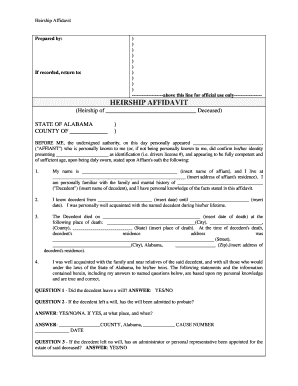
An Alabama Heirship Affidavit is a sworn written statement used to identify surviving heirs and describe property of a decedent when there is no valid will or when a formal probate proceeding is impractical. The affidavit records the decedent's identity, date of death, marital history, children and other heirs, and a legal description of real property intended for transfer or title clarification. Courts, county probate offices, title companies, and land recorders commonly accept a properly completed, notarized affidavit to support small‑estate actions, quiet title requests, or recording chain‑of‑title corrections.

Why an Heirship Affidavit Matters in Alabama

It allows heirs to establish ownership and clear title without full probate, reducing time and expense for small estates or uncontested property transfers.

Why an Heirship Affidavit Matters in Alabama

Who typically prepares and relies on an Heirship Affidavit

Common users include close relatives, estate administrators, probate attorneys, title examiners, and county clerks who need a concise record of heirs and property.

  • Relatives and heirs preparing transfer documents for small estates
  • Probate and real estate attorneys verifying heirship facts for title work
  • Title companies and county recorders accepting evidence to clear clouded title

Step-by-step: Completing and submitting an Alabama Heirship Affidavit

Follow these sequential steps to prepare a valid affidavit for county recording or title review.

  • 01
    Gather documents: Collect death certificate, last deed, and ID for affiant.
  • 02
    Draft affidavit: Complete affidavit using exact legal descriptions and heir details.
  • 03
    Notarize: Sign before a notary public; include notary jurat.
  • 04
    Record or present: Submit to county recorder or provide to title company.

How the affidavit functions in a typical title or probate workflow

The affidavit provides documented proof of heirs and property facts so downstream parties can act without a full probate docket entry.

  • Create record: Affiant signs sworn affidavit detailing heirs and assets.
  • Notary authentication: Notary attaches jurat and signature to verify oath.
  • Submission: File with county recorder or deliver to title company.
  • Outcome: Title company or recorder processes release or records new instrument.

Digital completion and eSubmission considerations

Electronic preparation and eSignature workflows can speed completion, but must meet legal and recorder requirements for admissibility.

  • File formats: PDF or PDF/A required by most recorders.
  • Authentication: Signer ID verification recommended.
  • Notarization: RON or in-person notarization may be required.

Typical online workflow settings for digital affidavits

Configure the online signing workflow to include identity checks, required fields, and document retention for audit purposes.

Field Configuration
Signature block Require signer signature and date fields
Notary block Include jurat and notary name as mandatory
Identity check Enable SMS or ID verification if available
Audit trail Capture IP, timestamp, and authentication method

eSignature vendor comparison for executing affidavits and related documents

Pricing, trial availability, bulk send, audit trail, and HIPAA support vary across providers. signNow is listed first for comparison purposes.

signNow DocuSign Adobe Sign PandaDoc HelloSign
Starting Price $8/user/mo $15/user/mo $14/user/mo $19/user/mo $15/user/mo
Free Trial Yes, 7-day free trial, no credit card required Varies by vendor Varies by vendor Varies by vendor Varies by vendor
Bulk Send Yes Yes Yes Yes Limited
Audit Trail Yes Yes Yes Yes Yes
HIPAA Compliant Yes Yes Yes No No

Data and security considerations when storing affidavits electronically

Encryption in transit: TLS 1.2/1.3
Encryption at rest: AES-256
Audit trail: Detailed timestamps and IP logs
Compliance standards: SOC 2 Type II, ISO 27001
Healthcare support: HIPAA-compliant with BAA
Long-term access: Export to PDF/A for archival

Risks and consequences of incorrect or incomplete affidavits

Title rejection: Recorder or title company may refuse to accept
Civil disputes: Surviving heirs may contest validity
Delays: Transfers and fund releases can be postponed
Perjury risk: False statements could lead to criminal exposure
Tax consequences: Incorrect reporting may trigger IRS review
Record gaps: Incomplete descriptions create future title defects

Common preparation errors to avoid

  • Using incomplete legal descriptions that do not match recorded deeds can cause recorders to reject the affidavit and delay transfers.
  • Listing heirs with inconsistent or informal names (nicknames, initials) leads to identity verification issues and may require affidavits of identity.
  • Failing to attach a certified death certificate or required deed pages often causes title companies to request additional documentation and pause closing.
  • Omitting notary jurat details or using an out-of-state notarization method without recorder acceptance risks rejection at the county level.

Key elements of a professional Alabama Heirship Affidavit

A complete affidavit clearly identifies the decedent, lists heirs, describes property, and includes sworn signature and notary attestation to be effective for title purposes.

Caption

Court or county caption referencing decedent name and estate purpose; this orients recorders and title examiners to the affidavit’s intent and use.
Decedent details

Full legal name, date of death, and last residence; accurate decedent details help apply intestacy rules and match public records.

Property description

Full legal description as recorded, or book/page/instrument number; precise wording ensures the affidavit links to the correct parcel or tract.

Heir listings

Each heir with relationship, birth year, and current address; clear heir identification reduces future disputes and supports releases.

Statement of facts

Concise sworn statements about marital status, prior conveyances, and absence of a will; avoid legal conclusions and stick to verified facts.

Jurat and notary

Affiant signature under oath, notary jurat with date and seal; required for acceptance by most recorders and title insurers.

Download formats and supporting documents to include

Provide the affidavit with common attachments to speed review: certified death certificate, last recorded deed pages, and identity documents for the affiant.

PDF (preferred)

Use flattened PDF or PDF/A for recording. Most county recorders and title companies require a high‑quality PDF for electronic submission.

Certified death certificate

Attach an official certified copy to prove date of death; photocopies are often rejected by title examiners and recorders.

Deed excerpts

Include deed page(s) showing the legal description and prior chain of title to match the affidavit to recorded instruments.

Affiant ID

Provide a government‑issued photo ID for the affiant to support identity verification and notarization records.

Real-world scenarios where an affidavit is used

Two common examples illustrate how an heirship affidavit resolves small estate or title issues without full probate.

Small Estate Transfer

A surviving child prepares an affidavit to document heirs and attach the certified death certificate

  • The county recorder accepts the affidavit and the bank releases funds after title review
  • The property is conveyed to heirs without a formal probate docket, saving time and expense.

Clearing a Cloud on Title

A neighbor discovers an old deed with an unrecorded heir interest and requests an affidavit to confirm heirs

  • Title examiner reviews affidavit plus deed pages to clear discrepancies
  • The title company issues a policy after the affidavit cures the chain‑of‑title defect.

Frequently asked questions about Alabama Heirship Affidavits

Answers to common questions on validity, signing authority, notarization, e-signatures, required attachments, and correcting mistakes.


Need help? Contact support

be ready to get more
Join over 28 million airSlate SignNow users