Establishing secure connection…Loading editor…Preparing document…

Idaho Codicil to Will

This template is fully customizable. Edit the text, fill out the fields, and send it for signature. Give it a try!
Idaho Codicil to Will

What an Idaho Codicil to Will Is

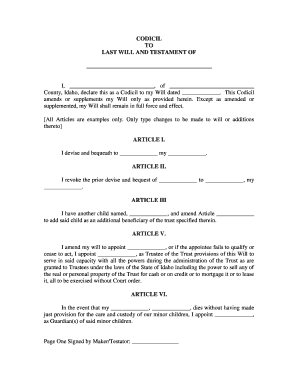
The Idaho Codicil to Will is a written amendment that modifies specific provisions of an existing last will and testament without replacing the original will. It identifies the testator, cites the will being altered, states precise changes (such as beneficiary adjustments, property dispositions, or executor substitutions), and is executed with the same formalities required for wills in Idaho. A properly drafted codicil preserves the remaining terms of the will while documenting the testator’s intent to alter discrete sections, reducing the need for a full will redraft when only limited changes are needed.

Why Use a Codicil Instead of Rewriting a Will

Use a codicil when you need limited, clearly described changes to an existing Idaho will without revoking or replacing it. A codicil can be faster and less costly than drafting a new will and helps keep probate records consistent with the testator’s most recent intentions.

Why Use a Codicil Instead of Rewriting a Will

Who Commonly Prepares or Signs an Idaho Codicil

Typical users include individuals updating beneficiary designations, attorneys preparing targeted amendments, and executors managing estate changes after life events.

  • Individuals who have small asset changes or new beneficiaries to add.
  • Attorneys issuing narrow amendments without drafting a complete new will.
  • Executors documenting the decedent’s late-in-life adjustments for probate clarity process

Representative Roles Involved

Estate Attorney

An estate attorney preparing a codicil will ensure clear will references, draft precise amendment language, advise on witness and notarization requirements under Idaho law, and propose a self-proving affidavit to streamline probate admission and reduce witness testimony needs.

Individual Testator

An individual testator making a narrow change—such as a beneficiary update or small bequest adjustment—uses a codicil to avoid full will redrafts, but must follow execution formalities to prevent invalidation and ensure probate acceptance.

Core Elements of a Professional Idaho Codicil

A professional Idaho codicil includes clear references to the original will, precise amendment language, signing blocks, witness attestations, optional notary language, and guidance for record attachment.

Will Reference

Identify the original will by its execution date and location; include clause or page numbers when possible so the probate court can easily reconcile the codicil with the underlying will.
Amendment Text

Spell out deletions, additions, or replacements in full text; avoid cross-references like 'as above' that may create ambiguity during probate or estate administration and ensure precise monetary and property descriptions.

Signature Block

Provide a signature line for the testator with printed name and date; include spaces for witness signatures and printed names as required by Idaho formalities; consider self-proving affidavit.

Witness Attestation

Include a clear witness attestation clause stating that witnesses observed the testator sign and that the testator appeared to be of sound mind and under no undue influence.

Notary Clause

If using a self-proving affidavit or notarized acknowledgement, include standard notary language and spaces for the notary seal, signature, and commission expiration details to streamline probate.

Attachment Instructions

State where the codicil will be kept, note attachment to the original will, and provide instructions for filing with the clerk of the probate court when necessary.

Step-by-Step: Drafting and Executing an Idaho Codicil

Follow these steps to prepare and execute an Idaho codicil correctly, ensuring it meets state formalities and clearly references the original will.

  • 01
    Identify Will: Name the will and date you intend to amend.
  • 02
    Describe Change: State precise provision changes and affected clauses.
  • 03
    Signatures: Testator signs in presence of required witnesses or notary.
  • 04
    Attach/Store: Attach codicil to original will and note location in estate file.

How to Configure an Online Codicil Workflow

Configure an online codicil workflow to collect signatures, optional notary, and attachment of the original will for recordkeeping.

Field Configuration
Signer Order Set role order: testator, witnesses, notary if required.
Authentication Email link default; add SMS or knowledge-based auth as needed.
Attach Will Upload original will PDF and attach codicil as an exhibit.
Notifications Enable reminders and completion emails for all parties.

Typical Execution and Filing Flow

Typical routing: prepare codicil, collect signatures, notarize if needed, attach to original will, and place in the estate file.

  • Prepare Document: Draft codicil referencing will date and clauses.
  • Add Signers: Assign testator and witness roles with contact info.
  • Authenticate: Choose appropriate signer verification method.
  • Store Copy: Attach signed codicil to original will and save.

Platform Requirements for Digital Execution and eSubmission

Digital signing for an Idaho codicil requires platform support for identity verification, secure storage, and audit trails that meet legal standards.

  • ID Verification: Email, SMS, or KBA options available.
  • Audit Trail: IP, timestamps, and action logs.
  • Document Formats: PDF/A, DOCX accepted for signatures.

Timing Considerations and Processing Expectations

Timing for a codicil is driven by execution, witness availability, notarization, and when documents are filed for probate or preservation.

Execution Date:

Date the testator signs; controls effective timing.

Witnessing:

Two witnesses typically sign contemporaneously.

Notarization:

Self-proving affidavit requires notary acknowledgement.

Recordkeeping:

Attach codicil to original will immediately for custody.

Probate Filing:

File original will and codicil with court when probating estate.

Key Milestones from Draft to Probate Inclusion

Milestones for a codicil process show drafting, execution, notarization, and filing stages from start to probate inclusion.

01

Drafting

Prepare precise amendments with clause references.

02

Review

Attorney or reviewer checks formalities and ambiguity.

03

Execution

Testator signs with witnesses present or uses notarization.

04

Recording

Attach codicil to will and preserve original custody documents.

Common Mistakes to Avoid

  • Failing to reference the original will precisely can create ambiguity about which provisions are amended, risking probate disputes or court interpretation.
  • Using vague language or broad phrases when describing changes invites litigation; specify exact clauses, amounts, or property descriptions to avoid challenges.
  • Omitting required witness signatures or failing to follow Idaho witnessing formalities can render the codicil invalid and lead to delays in estate administration.
  • Attaching the codicil incorrectly—such as filing a copy instead of the original—may complicate probate; always retain and file the original signed instrument.

Risks and Consequences of Incorrect Codicils

Invalid Amendment: Codicil may be declared void.
Probate Delay: Court disputes prolong estate settlement.
Beneficiary Disputes: Increased litigation risk.
Tax Issues: Timing affects tax year treatment.
Notary Noncompliance: RON or notarization errors cause rejection.
Record Loss: Missing original complicates probate.

Supporting Documents and Export Options

Include supporting materials and export options for long-term preservation: original will copies, self-proving affidavits, and signed codicil saved in durable file formats for court submission.

Signed Original

Retain the original signed codicil attached to the original will; probate courts prefer originals and authenticated self-proving affidavits, and originals should be stored securely with estate records.

Self-Proving Affidavit

A notarized self-proving affidavit entered at execution can allow witnesses to avoid testifying in probate, simplifying the admission of the will and associated codicils in most jurisdictions.

File Formats

Save signed documents as PDF/A for long-term preservation; keep editable DOCX copies only for drafting history and not as the probate-submitted original or as court exhibits.

Cloud Backup

Store encrypted copies in secure cloud storage and maintain a local original in a safe or with the estate attorney for redundancy and preserve audit logs for authenticity.

Practical Examples: How Codicils Solve Specific Problems

Real-world codicil scenarios show how narrow amendments simplify estate updates after life events such as births, property sales, or beneficiary changes.

Changing a Beneficiary

A testator who remarried needed to adjust a single beneficiary designation without rewriting the entire will.

  • Codicil amended the beneficiary clause.
  • The codicil referenced the will by date, described the new beneficiary name and share, was signed with two witnesses, and filed with estate records—avoiding a full will redraft and minimizing attorney time.

Clarifying Property Bequest

After selling a parcel listed in a will, a testator used a codicil to redirect the specific bequest to remaining property or cash alternative.

  • Codicil swapped property for monetary equivalent.
  • The amendment named the replacement asset value, updated clause references, included witness attestations, and provided appraisal instructions and deadline for sale, reducing ambiguity and avoiding contested interpretation during probate.

Security and Compliance Considerations

In-Transit Encryption: TLS 1.2 and TLS 1.3
At-Rest Encryption: AES-256 full-disk encryption
Certifications: SOC 2 Type II, ISO 27001, PCI DSS
HIPAA: Compliant with signed BAA
eSignature Laws: ESIGN and UETA compliant
Accessibility: WCAG 2.0 Level AA

eSignature Vendor Pricing and Feature Snapshot

Compare common eSignature vendor features and pricing for executing an Idaho codicil; signNow appears first per platform comparison rules.

signNow DocuSign Adobe Sign PandaDoc HelloSign
Starting Price $8/user/mo $15/user/mo $14/user/mo $19/user/mo $15/user/mo
Free Trial Yes, 7-day trial Yes, limited trial Yes, limited trial Yes, limited trial Yes, limited trial
Bulk Send Yes Yes Yes Yes No
Audit Trail Yes Yes Yes Yes Yes
HIPAA Compliant Yes Yes Yes No No
Envelope Cap No envelope cap 100 env./user/yr Varies by plan Varies by plan Varies by plan

Practical Tips for Accurate and Efficient Completion

Follow practical best practices to ensure a codicil is enforceable: be precise, use correct witnesses, consider notarization, and store documents securely for probate access.

Reference the original will by date and place
Always reference the original will’s execution date and location, and quote the clause or page numbers being amended. This reduces ambiguity and makes judicial interpretation straightforward during probate and expedites estate administration.
Use clear, unambiguous amendment language
Avoid shorthand or sweeping phrases; explicitly state deletions and insertions, using full names, property descriptions, or dollar amounts. Precision prevents contests and simplifies executor duties and provides clear audit trail documentation.
Confirm witness and notary rules before signing
Check Idaho statutory witness requirements and whether a self-proving affidavit is advisable; if notarizing, ensure the acknowledgement follows Idaho form and consider RON only if permitted by state law or court guidance.
Store originals and back up signed copies securely
Keep the original signed codicil with the original will in a secure location, provide copies to the executor and attorney, and preserve encrypted backups with access logs to establish custody and authenticity.

Frequently Asked Questions about the Idaho Codicil to Will

Common questions address electronic signatures, witness and notary rules, revocation, storage, and the consequences of improper execution.


Need help? Contact support

be ready to get more
Join over 28 million airSlate SignNow users