Establishing secure connection…Loading editor…Preparing document…

Idaho Small Claims Form

This template is fully customizable. Edit the text, fill out the fields, and send it for signature. Give it a try!
Idaho Small Claims Form

What the Idaho Small Claims Form Is

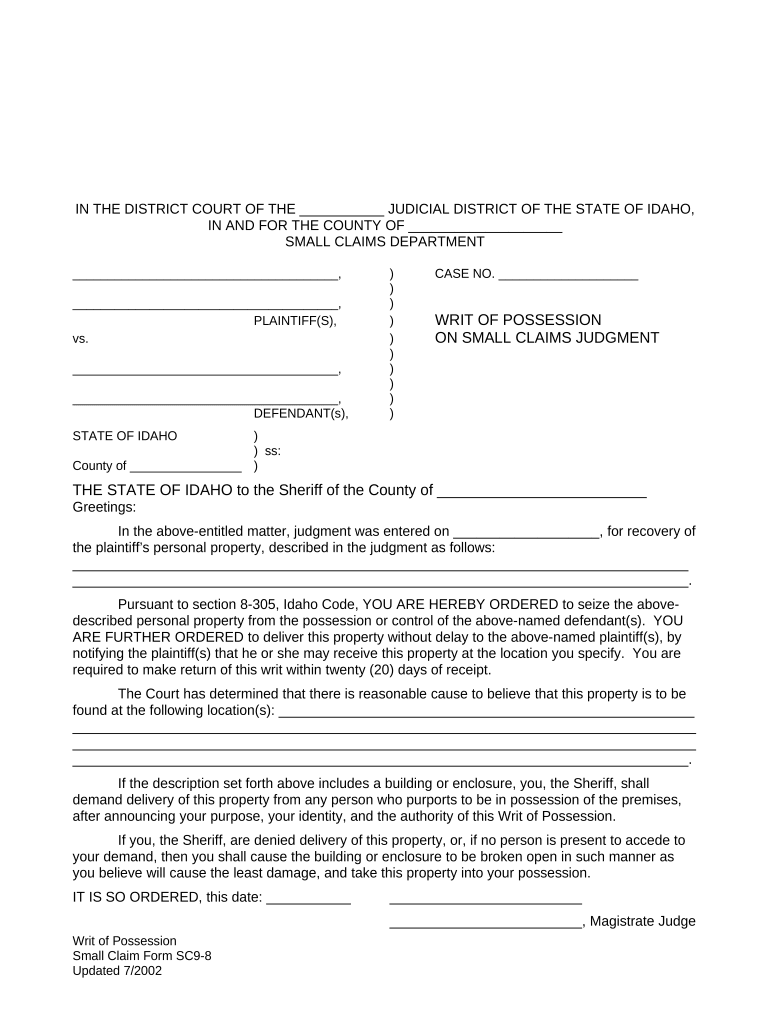
The Idaho Small Claims Form is the standard court filing used to begin a small claims action in an Idaho magistrate court. It records plaintiff and defendant names and contact details, the dollar amount sought, a concise statement of the facts and legal basis for the claim, and the relief requested. Filing the form starts the local court's scheduling and service procedures and creates the official case record; accurate completion helps avoid intake rejection, delays, or jurisdictional defects. County courts sometimes publish tailored local variants and fee schedules.

Why This Form Matters for Low-Value Disputes

Using the Idaho Small Claims Form correctly establishes a clear, court-recognized claim for monetary relief, shortens administrative processing, and documents evidence and service for the record. Complete forms reduce the risk of dismissal or continuance and make it easier to enforce a judgment if the court finds in your favor.

Why This Form Matters for Low-Value Disputes

Who Typically Files and Signs

Common filers include individuals, small-business owners, landlords, and agents bringing claims for unpaid amounts or property damage.

  • Individual consumers pursuing unpaid debts, personal property damage, or contract claims within the court's monetary limit.
  • Small businesses or sole proprietors seeking unpaid invoices or fees without engaging full civil litigation counsel.
  • Landlords or property managers filing for unpaid rent, damages, or lease-related charges under county rules.

Step-by-Step: Complete and File the Form

A clear sequence reduces filing errors: gather documents, complete the form, sign, file, and serve per local court rules.

  • 01
    Gather Information: Collect names, addresses, itemized damages, and supporting invoices or receipts.
  • 02
    Complete Form: Enter plaintiff/defendant details, claim amount, and concise statement of cause.
  • 03
    Sign & Date: Sign as plaintiff or authorized agent; date in MM/DD/YYYY format.
  • 04
    File & Serve: File with county magistrate court and arrange proper service per local rules.

Setting Up an Electronic Filing or eSignature Workflow

Configure document, signature, and submission settings so the electronic version complies with court requirements and preserves an audit trail.

Field Configuration
Document Format PDF/A preferred; preserve form fields
Signature Method Use ESIGN/UETA-compliant electronic signatures
Authentication Email link or SMS code; KBA if court requires stronger ID
Audit Trail Keep timestamps, IP, and signer details

File Format, Integrations, and Court System Compatibility

Electronic filing and e-sign choices depend on court systems, integrations, and accepted file formats.

  • Integrations: Salesforce, Microsoft 365, NetSuite integrations
  • Formats: PDF, DOCX, HTML supported
  • Authentication: Email, SMS, KBA, 2FA options

From Filing to Judgment: The Typical Case Flow

A short overview of how a small claims filing progresses through filing, service, hearing, and judgment.

  • File: Submit the completed form and pay filing fee to county magistrate court.
  • Serve: Arrange service on defendant per court rules and file proof of service.
  • Appear: Attend the hearing with copies of evidence and witness testimony ready.
  • Enforce: If successful, use writs or garnishment per local procedures to collect.

Essential Elements Every Idaho Small Claims Form Should Include

A professional submission includes clear contact data, a factual claim, documented damages, labeled evidence, service details, and correct court and fee information.

Complete Contact Info

List full names, business names, phone numbers, email addresses, and physical addresses for all parties. Accurate contact details ensure proper service, faster notices, and fewer intake delays for the magistrate clerk.
Clear Statement of Claim

Provide a concise, chronological factual description that links alleged conduct to the damages claimed. Avoid argumentative language and focus on verifiable facts the judge can weigh quickly.

Amount Breakdown

Itemize unpaid balances, fees, and any calculations supporting the total claim. A transparent breakdown helps the court determine the correct award without frequent requests for clarification.

Evidence Attachments

Attach numbered exhibits (contracts, invoices, photos, receipts) and reference them in the body of the claim. Properly labeled exhibits streamline hearings and reduce evidentiary disputes.

Service Instructions

Provide the defendant's physical service address and indicate the chosen service method so the court can verify jurisdiction and accept proof of service without delay.

Court & Fee Details

Record the correct magistrate court name, case caption, and submit the required filing fee or fee waiver paperwork to prevent rejection at intake.

Real-World Examples of How the Form Is Used

Two concise case summaries show common claim types, the evidence submitted, and how organized filings helped secure judgments.

Landlord Rent Dispute

A landlord filed after missed payments and documented notices to the tenant.

  • Claimed two months' rent plus late fees.
  • The landlord attached payment records, lease excerpts, and email notices as numbered exhibits; proof of service was filed and the court entered judgment for the landlord after the defendant did not appear.

Contractor Payment Claim

A contractor sought unpaid balance after completing repair work and providing an itemized invoice.

  • Requested remaining balance plus interest.
  • The contractor submitted signed work orders, before-and-after photos, and delivery receipts labeled as exhibits; clear exhibit references and timely service resulted in a favorable judgment and collection instructions.

Common Pitfalls to Avoid

  • Using the wrong county form or misidentifying the defendant's service address causes service failures and case dismissal or delay.
  • Failing to attach organized exhibits or not labeling evidence makes hearings less persuasive and increases the chance of continuances.
  • Entering incorrect claim amounts or omitting applicable fees and interest can lead to reduced awards or require amendments.
  • Assuming e-filing or e-signature is accepted statewide without checking county procedures can result in rejected submissions.

Consequences of Inaccurate or Incomplete Filings

Filing Rejection: Incomplete form may be rejected.
Missed Deadline: Statute or local deadline lost.
Improper Service: Case may be dismissed.
Incorrect Defendant: Judgment unenforceable until corrected.
Lost Evidence: Weakened claim at hearing.
Perjury Risk: False statements may have sanctions.

Required Core Information on the Form

Plaintiff Name: Full legal name required
Defendant Name: Full legal name required
Claim Amount: Enter dollars and cents
Cause of Action: Brief factual statement
Service Address: Physical address required
Signature & Date: Signer and MM/DD/YYYY

eSignature Provider Comparison (signNow First)

Basic vendor pricing and capability comparison for e-signature tools commonly used with court forms and administrative filings in the United States.

signNow DocuSign Adobe Sign PandaDoc HelloSign
Starting Price $8/user/mo $15/user/mo $14/user/mo $19/user/mo $15/user/mo
Free Trial 7-day free trial No No Varies by plan Varies by plan
Bulk Send Yes Yes Yes Yes No
Audit Trail Yes Yes Yes Yes Yes
HIPAA Compliant Yes Yes Yes No No

Frequently Asked Questions About the Idaho Small Claims Form

Answers to common questions about eligibility, filing, service, evidence, e-signatures, and next steps if problems arise.


Need help? Contact support

be ready to get more
Join over 28 million airSlate SignNow users