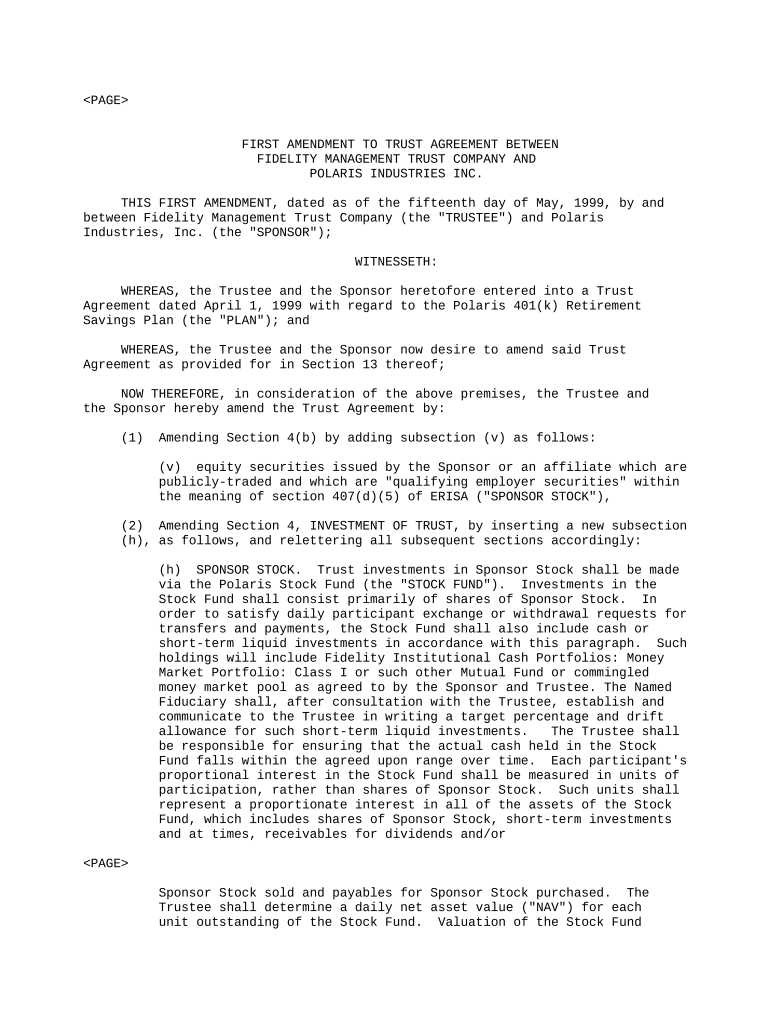
First Amendment to Trust Agreement
What a First Amendment to Trust Agreement Is
Why You Might Use a First Amendment
A First Amendment lets settlors or trustees make targeted changes—such as updating beneficiaries, clarifying trustee authorities, or fixing drafting errors—without creating a new trust. It preserves continuity, avoids re‑funding assets, and keeps probate or tax consequences minimal when correctly executed.
Who Typically Prepares and Signs an Amendment
Common participants include the settlor (if alive and competent), current trustees, trust counsel, and beneficiaries who must be notified when required.
- Individual settlors or grantors who retain amendment rights and wish to change beneficiaries or terms.
- Acting trustees who must adopt revisions to trustee powers or administrative procedures.
- Estate planning attorneys preparing precise amendment language and confirming legal formalities.
In some jurisdictions notarization or witnesses are recommended or required; consult state rules and counsel before finalizing execution.
Representative Signers and Roles
Individual Settlor
A settlor who retains amendment authority must sign if alive and competent; the amendment should reference the original trust date and explicitly state the amendments to avoid ambiguity.
Corporate Trustee
A corporate trustee signs per its internal authorization procedures; attach a board resolution or officer certificate when corporate signature authority or trustee acceptance is required.
Stepwise Completion and Execution Process
-
01Draft Amendment: Identify original language and draft precise replacement or insertion text.
-
02Review with Counsel: Confirm tax, fiduciary, and state law implications before finalizing.
-
03Execute Properly: Have required parties sign with any required witnesses or notary present.
-
04Distribute Copies: Provide executed copies to trustees, beneficiaries, and custodians of trust records.
Typical Routing and Acceptance Workflow
-
Drafting: Attorney or trustee drafts the amendment language for review.
-
Internal Approval: Trustee or board reviews and authorizes execution steps.
-
Execution: Signatures obtained with any necessary witnesses or notarization.
-
Delivery and Storage: Executed copies delivered to interested parties and stored securely.
Digital Workflow Settings for Online Completion
| Field Mapping | Match amendment fields to template inputs for consistent data capture. |
|---|---|
| Signer Order | Set signer sequence: Settlor → Trustee → Witness/Notary if required. |
| Authentication | Require email + SMS code or stronger authentication for high-assurance signing. |
| Audit Trail | Enable a complete Certificate of Completion capturing IP, timestamps, and actions. |
| Retention Rule | Configure long-term storage and exportability in PDF/A format. |
Technical and Integration Considerations
Choose a platform that supports required authentication, notarization workflows, and secure record retention.
- Integrations: Connectors for Salesforce, NetSuite, and Google Workspace simplify record linking.
- Document Formats: Support for PDF, DOCX, and export to PDF/A ensures archival compatibility.
- Authentication Options: Email, SMS, knowledge‑based, or advanced signer authentication for higher assurance.
Ensure the chosen platform supports any required RON or notary workflows in your state and can produce an audit trail and tamper-evident signed copy for retention.
Comparison: eSignature Solutions for Trust Amendments
| signNow | DocuSign | Adobe Sign | PandaDoc | HelloSign | |
|---|---|---|---|---|---|
| Starting Price | $8/user/mo | $15/user/mo | $14/user/mo | $19/user/mo | $15/user/mo |
| Free Trial | Yes, 7-day trial | No | No | Yes, limited | Yes, limited |
| Bulk Send | Yes | Yes | Yes | Yes | No |
| Audit Trail | Yes | Yes | Yes | Yes | Yes |
| HIPAA Compliant | Yes | Yes | Yes | No | No |
Timing Considerations and Typical Deadlines
Effective Date Entry:
Specify the effective date clearly; it governs when amended powers or distributions begin
Trustee Acknowledgment:
Obtain trustee acceptance promptly—delays may affect administration and asset disposition
Beneficiary Notice:
Deliver notice to beneficiaries when required by the trust instrument or state fiduciary rules
Recording Window:
If a deed is involved, record per county procedures; fees and timing vary by jurisdiction
Document Retention:
Archive signed amendment immediately in the trust records and digital repository
Key Milestones From Draft to Archive
Draft Finalization
Complete precise amendment language and cross-reference original trust provisions.
Legal Review
Counsel verifies tax, fiduciary, and statutory implications before execution.
Execution and Authentication
Collect signatures, witnesses, or notary acknowledgments as required by jurisdiction.
Distribution and Storage
Deliver copies to trustees, beneficiaries, and maintain secure long-term storage.
Risks and Potential Consequences of Errors
Common Preparation Mistakes to Avoid
- Failing to reference the original trust date or exact clause leads to uncertainty about which instrument is modified.
- Using vague substitution language such as 'replace as appropriate' rather than quoting the original and providing exact replacement text.
- Omitting signer capacities or corporate authorization documentation when entities act as trustees causes acceptance delays with financial institutions.
- Assuming electronic notarization is available in every jurisdiction; state rules on RON and notary acknowledgement differ and must be verified.
Practical Examples of First Amendments
Beneficiary Update
A settlor updates contingent beneficiaries after a life event
- change clarifies distribution percentages and order
- executed, notarized where recommended, and copies provided to trustee and financial institutions to update account registrations.
Trustee Authority Clarification
A trustee clarifies investment authority to permit alternative asset classes
- amendment adds specific investment powers and delegation terms
- corporate trustee executes with resolution attached and custodians receive certified copies for account updates.
Practical Tips for Accurate Amendments
Frequently Asked Questions and Troubleshooting
-
Is an electronic signature valid?
Yes. Electronic signatures are generally valid under the federal ESIGN Act (15 U.S.C. ch. 96) and state UETA laws, provided the signature meets intent, consent, attribution, and record retention requirements.
-
When is notarization required?
Notarization is not universally required for trust amendments but is often necessary when the amendment affects real property or when state law or third parties demand a notarized affidavit or acknowledgment.
-
Can a trustee amend without settlor?
Only if the original trust grants the trustee amendment power or if a court order authorizes the change; otherwise the settlor’s consent or reserved amendment power is typically required.
-
How should copies be distributed?
Deliver executed copies to all trustees, affected beneficiaries, and custodians of trust assets; keep an original executed amendment in the official trust file.
-
What if a signature is missing?
A missing required signature can invalidate the amendment; obtain corrective execution (re-execution) or a confirmatory affidavit or court approval where available.
-
Does an amendment change tax reporting?
Potentially. Material changes to trust interests or distributions may affect tax reporting; consult tax counsel and preserve documentation per IRC guidelines.