Establishing secure connection…Loading editor…Preparing document…

Indiana Affidavit

This template is fully customizable. Edit the text, fill out the fields, and send it for signature. Give it a try!
Indiana Affidavit

What an Indiana Affidavit Is and when it’s used

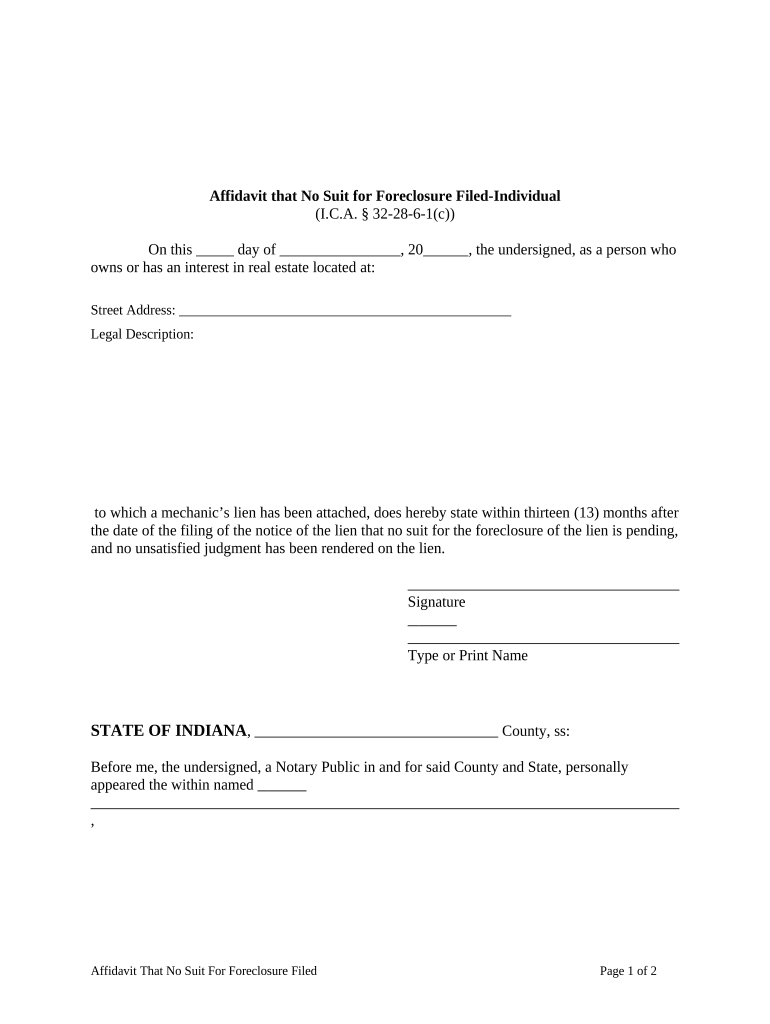
The Indiana Affidavit is a sworn written statement used in Indiana to provide factual testimony outside of court. It captures the declarant's facts, dates, and signature under oath or affirmation before a notary public or other authorized official, and is commonly filed with courts, government agencies, or private parties. Typical uses include property declarations, probate affidavits, identity or residency statements, and sworn business or administrative attestations. Electronic signing and remote notarization may be available where state rules permit, but parties should verify Indiana notary regulations before using e-notarization or online workflows.

Why the Indiana Affidavit matters for legal and administrative processes

An Indiana Affidavit creates an evidentiary record of sworn facts, reducing the need for in-person testimony and speeding administrative or legal processes. Properly executed and notarized affidavits can support court filings, title transfers, benefit claims, and agency submissions while preserving a clear written record.

Why the Indiana Affidavit matters for legal and administrative processes

Who typically prepares or relies on an Indiana Affidavit

Common users include private individuals, attorneys, title companies, lenders, and government officials who routinely prepare or require sworn factual statements in Indiana.

  • Individuals: residents providing sworn statements about identity, residency, or facts for legal or administrative matters.
  • Real estate professionals: sellers, buyers, and title agents use affidavits for property, ownership, or closing matters.
  • Attorneys and courts: submitted as evidence, verification of facts, or to satisfy procedural requirements.

Core parts of a professional Indiana Affidavit

A complete affidavit groups identity, factual recitation, oath language, notarization, exhibits, and jurisdiction information so courts, agencies, and private parties can verify and accept sworn statements.

Caption

Case caption or matter heading identifying parties, docket number, or administrative file so the affidavit attaches correctly to the proceeding or record.
Declarant

Full legal name, current address, and contact details of the person swearing the affidavit, matching government ID to avoid identity disputes.

Statement of Facts

Clear, numbered paragraphs stating the declarant's personal observations or knowledge; avoid hearsay and separate distinct facts into separate numbered items.

Oath/Affirmation

Explicit oath or affirmation clause attesting the truth of the facts under penalty of perjury, formatted to meet Indiana or local court expectations.

Notary Block

Notary acknowledgement with venue (county, state), date, notary signature, official seal, and remote-session metadata if remote notarization is used.

Attachments

Exhibits such as deeds, identification, or receipts labeled and referenced in the affidavit to corroborate the factual claims.

Step-by-step: prepare, execute, and submit an Indiana Affidavit

Follow these sequential steps to prepare, execute, notarize, and file an Indiana Affidavit correctly.

  • 01
    Draft Facts: Write concise, numbered facts in first person.
  • 02
    Add Oath: Include statutory oath language or affirmation.
  • 03
    Notarize: Sign before a notary public and record venue and date.
  • 04
    File or Serve: Submit to the court, agency, title company, or requesting party per instructions.

How to configure an online workflow for an Indiana Affidavit

Configure your electronic workflow to capture signatures, notarization metadata, attachments, and a complete audit trail before sharing an Indiana Affidavit.

Field Configuration
Signature Field Allow typed, drawn, or uploaded signatures; require signer name and timestamp.
Date Field Use MM/DD/YYYY and enable automatic timestamping to capture execution time.
Notary Block Include fields for venue, notary name, seal image, and remote-session ID when applicable.
Authentication Require email + SMS code or KBA for higher-assurance signings.

Where a completed Indiana Affidavit is sent or filed

Typical submission paths for a completed Indiana Affidavit depend on the use case, recipient, and whether a court filing, agency submission, or private delivery is required.

  • Court Filing: Attach to pleadings or file with the clerk per local court procedures.
  • Agency Submission: Submit to a state or local agency via its portal or accepted delivery method.
  • Title or Closing: Provide to the title company or closing agent along with supporting exhibits.
  • Private Recipient: Deliver the notarized affidavit to the requesting party, lender, or counterparty.

Timing considerations and common deadlines

Affidavits themselves rarely have a statutory deadline, but timing affects related filings, probate matters, and agency requests; confirm any recipient deadlines before executing.

Execution Date:

Sign and have affidavit notarized on the execution date.

Court Deadlines:

File within court-specified deadlines for motions or evidentiary submissions.

Probate Use:

Submit affidavits for small estates according to local probate timelines.

Agency Requests:

Provide affidavit within the timeframe requested by the agency.

Record Retention:

Keep originals per retention guidance in the retention timeline below.

Key milestones from drafting to archival

High-level milestones for preparing and completing an Indiana Affidavit, presented as sequential stages to track compliance, notarization, and filing steps.

01

Drafting

Prepare clear numbered facts and reference required exhibits.

02

Notarization

Execute and notarize in-person or via authorized RON processes.

03

Submission

File with the court, agency, or deliver to the requesting party per instructions.

04

Archive

Retain originals and secure electronic copies per retention rules.

Required fields and essential data elements

Declarant Name: Full legal name as on ID
Address: Street, city, state, ZIP
Date: MM/DD/YYYY execution date
Facts: Numbered factual statements in first person
Notary Block: Venue, signature, seal, date
Attachments: Exhibits labeled and referenced

Technical requirements for eSigning and eSubmission

For e-signing and electronic submission, use platforms that capture signature intent, notarization metadata, and a verifiable audit trail.

  • Document Formats: PDF, DOCX, image support
  • Integrations: Sync with storage and case management
  • Authentication: Email, SMS, KBA, MFA options

eSignature vendor comparison for affidavit workflows

Selected plan and capability comparisons to consider when choosing an eSignature provider for affidavit execution and storage; signNow is listed first per table convention.

signNow DocuSign Adobe Sign PandaDoc HelloSign
Starting Price $8/user/mo $15/user/mo $14/user/mo $19/user/mo $15/user/mo
Free Trial 7-day free trial Varies Varies Varies Varies
Bulk Send Yes Yes Yes Yes No
Audit Trail Yes Yes Yes Yes Yes
HIPAA Compliant Yes Yes Yes No No
Envelope Cap No cap 100 envelopes/user/year Varies by plan Varies by plan Varies by plan

Potential penalties and risks from incorrect affidavits

Perjury Risk: Criminal penalties under state perjury laws
Invalid Evidence: Court may exclude unsigned or improperly notarized affidavits
Processing Delays: Missing information or notarization causes rejections
Civil Liability: False statements can lead to civil claims
Notary Errors: Improper notary procedures may invalidate document
Data Privacy: Sensitive data mishandled may trigger regulatory risks

Practical tips for accurate and efficient affidavits

Use clear language, verify identity, and retain records. The checklist below helps reduce mistakes and improves acceptance of the sworn statement.

Verify signer identity and ID documents
Confirm government-issued photo ID, matching name spellings, and capture identity verification methods. For electronic signings, use multi-factor authentication and preserve identity evidence in the audit trail to prevent later disputes.
Use precise, numbered factual statements
Avoid opinions or legal conclusions; present facts in numbered paragraphs with dates, locations, and exhibit references to strengthen admissibility and reduce hearsay objections.
Confirm notary block and venue details
Ensure the notary adds venue, date, signature, and seal. For RON, verify recording retention and journal entries meet state requirements to preserve evidentiary weight.
Retain originals and create secure copies
Store originals in a secure physical or electronic archive, preserve the audit trail, and follow statutory retention periods applicable to the affidavit's purpose.

Two practical examples showing common uses

These brief case examples illustrate how an Indiana Affidavit functions in probate and title contexts.

Probate Affidavit

A personal representative files an affidavit to verify small estate assets and distribution when formal probate is unnecessary under local rules.

  • Used to transfer modest assets without full probate.
  • The affidavit lists assets, identifies heirs, and is sworn before a notary; the court accepts it with supporting documentation, expediting closures while reducing legal fees and procedural complexity for eligible estates.

Title Affidavit

A seller executes a title affidavit at closing to confirm property status, absence of liens, or possession facts to support a clean title transfer.

  • Attached to closing package for the title company.
  • When notarized and accompanied by recorded deeds or supporting exhibits, the affidavit helps the title company clear title issues and finalize insurance, reducing post-closing disputes and streamlining underwriting.

Frequently asked questions about Indiana Affidavits and electronic signing

Common questions and concise answers about drafting, notarizing, eSigning, and storing Indiana Affidavits using online or in-person workflows.


Need help? Contact support

be ready to get more
Join over 28 million airSlate SignNow users