Establishing secure connection…Loading editor…Preparing document…

Information Compilation for Identifying Absconded Spouse

This template is fully customizable. Edit the text, fill out the fields, and send it for signature. Give it a try!
Information Compilation for Identifying Absconded Spouse

What the Information Compilation for Identifying Absconded Spouse Is

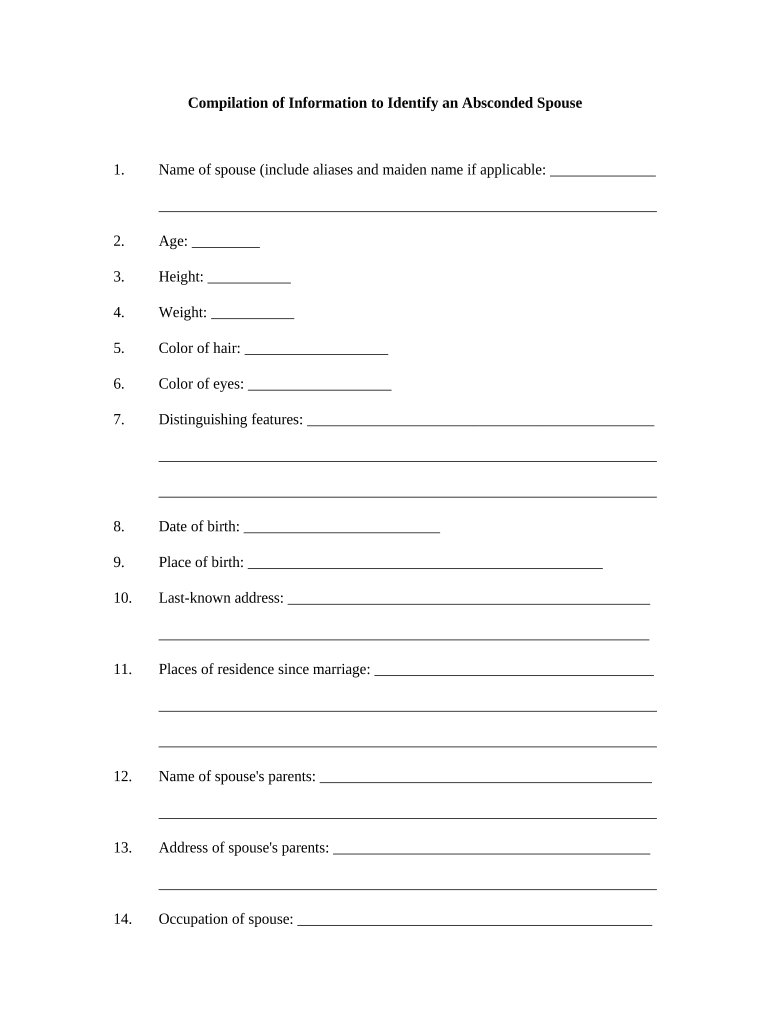
The Information Compilation for Identifying Absconded Spouse is a structured document used to gather verified contact, financial, employment, and locational details when a spouse cannot be located or has left without notice. It consolidates full legal names, aliases, dates of birth, Social Security identifiers (where authorized), current and prior addresses, employer and vehicle records, property ownership, digital account indicators, known associates, and recent transactions into a single source of truth to support service of process, enforcement proceedings, and investigative follow-up. Collect only necessary facts and record source citations and custody details for each entry.

Why a Centralized Compilation Matters

Use this compilation to centralize verifiable leads that assist attorneys, child support agencies, law enforcement, and private investigators. A complete, well-sourced compilation reduces delays in service, supports motions for substitute service, and strengthens evidence for enforcement or protective orders.

Why a Centralized Compilation Matters

Who Prepares and Relies on This Compilation

Typical users who prepare or rely on this compilation include attorneys, child support enforcement staff, private investigators, and court clerks handling service and enforcement matters.

  • Family law attorneys assembling evidence for missing-service affidavits and motions.
  • Child support agencies tracing absent parents for income withholding or support orders.
  • Private investigators and process servers locating subjects using public and proprietary records.

Core Components of a Professional Compilation

A professional compilation organizes verified identifiers, source citations, timelines, and chain-of-custody notes to support legal filings and onward investigation or enforcement.

Identification

Full legal name, known aliases, birthdate, and Social Security Number when authorized; include photocopies of government-issued IDs and explain discrepancies between records with source citations and dates.
Contact History

Current and prior addresses, phone numbers, email addresses, employer locations, and emergency contacts; annotate last known dates of contact, verification method, and whether attempts at service were made.

Financial Footprint

Known bank accounts, employers, payment platforms, recent transactions, property ownership, outstanding liens, and vehicle registrations; include document identifiers and the date ranges searched.

Movements & Associates

Travel history, frequent locations, social network references, family and business associates, and known hangouts; identify online profiles and usernames with dates of last activity when available.

Legal Records

Court filings, prior judgments, child support orders, warrants, restraining orders, and bankruptcy filings; include docket numbers, filing dates, and the jurisdiction where each record resides.

Source Log

Detailed citations for each data point—public records, vendor names, report IDs, date accessed, method of verification, and the preparer's initials and date.

Step-by-Step: Assemble and Verify the Compilation

Follow these steps to assemble, verify, and use identifying information legally and efficiently for court or agency use.

  • 01
    Gather Basics: Collect full name, DOB, SSN if available.
  • 02
    Trace Records: Search addresses, property, vehicle, and employment records.
  • 03
    Verify Sources: Confirm through official records or corroborating documents.
  • 04
    Document Chain: Log who accessed, when, and source citations.

How to Configure an Online Form for This Compilation

Configure online forms to validate input, apply conditional fields, and capture audit logs for each compiled entry.

Field Configuration
Validation Use regex, required fields, and Magic detection.
Conditional Logic Show fields based on prior answers to reduce errors.
Authentication SMS code or email link; consider KBA for sensitive cases.
Audit Trail Capture IP, timestamps, signer name, and document history.

Where and How to Send the Completed Compilation

This section explains routing options for submitting compilation results to courts, agencies, or investigators securely.

  • Send to Attorney: Provide certified copies or signed affidavits.
  • File with Court: Attach compilation to motion or affidavit.
  • Share with Agencies: Deliver to child support or law enforcement.
  • Use with PIs: Grant access or provide encrypted extracts.

Technical Requirements for Digital Submission

Digital submission options must meet authentication, encryption, and retention requirements for admissibility and privacy in court contexts.

  • File Format: PDF/A preferred for long-term retention.
  • Authentication: Use at least email or SMS code.
  • Storage: Encrypted storage with audit trail.

Price and Feature Snapshot for Common eSignature Vendors

Side-by-side pricing and capability snapshot for common eSignature vendors to consider when digitizing compilations and legal evidence workflows.

signNow DocuSign Adobe Sign PandaDoc HelloSign
Starting Price $8/user/mo $15/user/mo $14/user/mo $19/user/mo $15/user/mo
Free Trial 7-day trial Varies by plan Varies by plan Varies by plan Varies by plan
Bulk Send Yes (plan) Plan-dependent Plan-dependent Plan-dependent Plan-dependent
Audit Trail Yes Yes Yes Yes Yes
HIPAA Compliant Yes Yes Yes No No
Envelope Cap No envelope cap 100 envelopes/user/year Plan limits vary Plan limits vary Plan limits vary

Essential Data Elements to Collect

Full Legal Name: As on government ID exactly.
Aliases and DOB: Include nicknames and birthdate.
Social Security Number: Provide complete SSN if available.
Current and Prior Addresses: Include dates of residence.
Employment Details: Employer, job title, contact info.
Assets and Vehicles: VINs, titles, property addresses.

Consequences of Incorrect or Incomplete Compilations

Incorrect Identity: Wrong ID leads to misservice.
Privacy Violations: Potential HIPAA or privacy breaches.
Perjury Risk: False statements may carry penalties.
Delayed Proceedings: Insufficient evidence delays court actions.
Financial Penalties: Fines or fee assessments possible.
Civil Liability: Negligent disclosure invites lawsuits.

Common Mistakes to Avoid

  • Relying on unverified online profiles without source documentation, which can produce false leads and waste investigative resources.
  • Using incomplete addresses or outdated employer information that prevents service attempts and leads to court continuances or denied enforcement efforts.
  • Failing to follow privacy statutes when requesting protected records, exposing the preparer to regulatory penalties or evidence suppression.
  • Mixing hearsay or anonymous tips into sworn compilations without corroboration, undermining admissibility at hearing or trial.

Practical Tips for Accurate, Admissible Compilations

Adopt consistent procedures for verification, documentation, and secure sharing to preserve admissibility and privacy in court contexts.

Verify identity with authoritative government records
Always corroborate names and dates with primary sources such as DMV records, passport copies, or certified birth records; retain copies and note retrieval dates so courts can assess reliability and chain-of-custody.
Document your source and verification method fully
For every data point, record the exact source, date accessed, search parameters, and steps taken to verify accuracy. Clear source logs reduce challenges to admissibility and expedite follow-up or re-subpoena processes.
Limit sensitive data collection and follow privacy laws
Collect only data necessary for locating the spouse; avoid extraneous medical or protected information unless authorized. When handling health data, comply with HIPAA and obtain legal counsel before disclosure to third parties.
Use tamper-evident storage and access controls
Store compilations in encrypted storage, keep an audit trail of access, and share only secured copies with redactions as needed. These steps protect privacy and improve admissibility in hearings or enforcement actions.

Time-Sensitive Steps and Typical Deadlines

Timelines depend on case needs; act promptly to preserve perishable leads and meet court or agency deadlines.

Immediate Steps:

Begin searches within 24–72 hours of disappearance.

Service Attempts:

Make and document initial service attempts per local rules.

Court Filings:

File motions promptly; deadlines vary by jurisdiction.

Agency Reports:

Notify child support or enforcement agencies within required timeframes.

Document Preservation:

Preserve electronic logs and records immediately to avoid later spoliation claims.

How Compilations Help in Real Cases

Real-world examples show how a focused compilation aided service, enforcement, and protective measures in varied cases.

Family Law Enforcement

A county child support office compiled multi-source records after a noncustodial parent absconded following a job change.

  • Private investigator located new employment out-of-state.
  • The compilation's verified addresses, employer contact, vehicle registration, and recent transaction history supported emergency motions for income withholding and expedited service; the court accepted the source log and granted immediate enforcement measures.

Divorce Service Goal

An attorney used a focused compilation when a spouse relocated without providing forwarding information during divorce proceedings.

  • Social media and vehicle records narrowed location.
  • Combined with notarized affidavits and corroborating witness statements, the compilation justified substituted service and allowed the case to proceed to settlement rather than dismissal, saving months of delay and extra litigation costs.

Choosing Signature Type for Evidence and Filings

Compare electronic and digital signatures to choose the appropriate authentication level for your compilation carefully.

Criteria Electronic Signature Digital Signature
Definition broad e-signs pki cryptographic
Legal Status valid under esign/ueta enhanced non-repudiation
Non-Repudiation audit trail evidence certificate-based proof
Typical Use agreements and forms regulatory or high-assurance filings

Frequently Asked Questions

Answers to common questions about preparing, signing, and submitting an Information Compilation for Identifying Absconded Spouse.


Need help? Contact support

be ready to get more
Join over 28 million airSlate SignNow users