Establishing secure connection…Loading editor…Preparing document…

Judgment Louisiana

This template is fully customizable. Edit the text, fill out the fields, and send it for signature. Give it a try!
Judgment Louisiana

What a Louisiana judgment is and why it matters

A Judgment Louisiana is a court-issued determination that establishes legal rights, monetary awards, or obligations between parties in a Louisiana civil proceeding. Once signed and entered by the clerk, a judgment becomes enforceable and can support execution, garnishment, or a privilege (lien) when recorded in public records. Louisiana follows a civil-law tradition; judgment entry, transcription, and recording practices differ from other states. Accurate entry details—case caption, docket number, amount awarded, and clerk signature—are essential to preserve enforceability and priority when creditors or title examiners search public indexes.

Why preparing a correct Judgment Louisiana matters

A properly prepared judgment protects enforcement rights, creates recordable liens, and reduces challenges on appeal or execution. Errors in names, amounts, or filing steps can delay collection and impair priority.

Why preparing a correct Judgment Louisiana matters

Primary users and stakeholders for a Louisiana judgment

Common users include litigants, attorneys, title examiners, and court clerks involved in entry, docketing, or recording of judgments.

  • Plaintiffs and creditors who need a court order for collection or lien creation within parish records.
  • Defense counsel or appellants who must verify entry dates and appeal windows after judgment is filed.
  • Title companies and real estate professionals checking for judgment liens during closings and conveyances.

Each stakeholder must confirm the judgment text, entry stamp, and recording path to preserve enforcement and priority in Louisiana.

Key elements to include in a professional Judgment Louisiana

A complete judgment contains court identifiers, clear recitals of relief, enforcement directions, monetary breakdowns, execution instructions, and the clerk or judge’s authentication. Omissions increase risk of misinterpretation or administrative rejection.

Court caption

Identifies court name, parish, docket number, and parties with exact legal names as used in pleadings; essential for accurate docketing and public indexing.
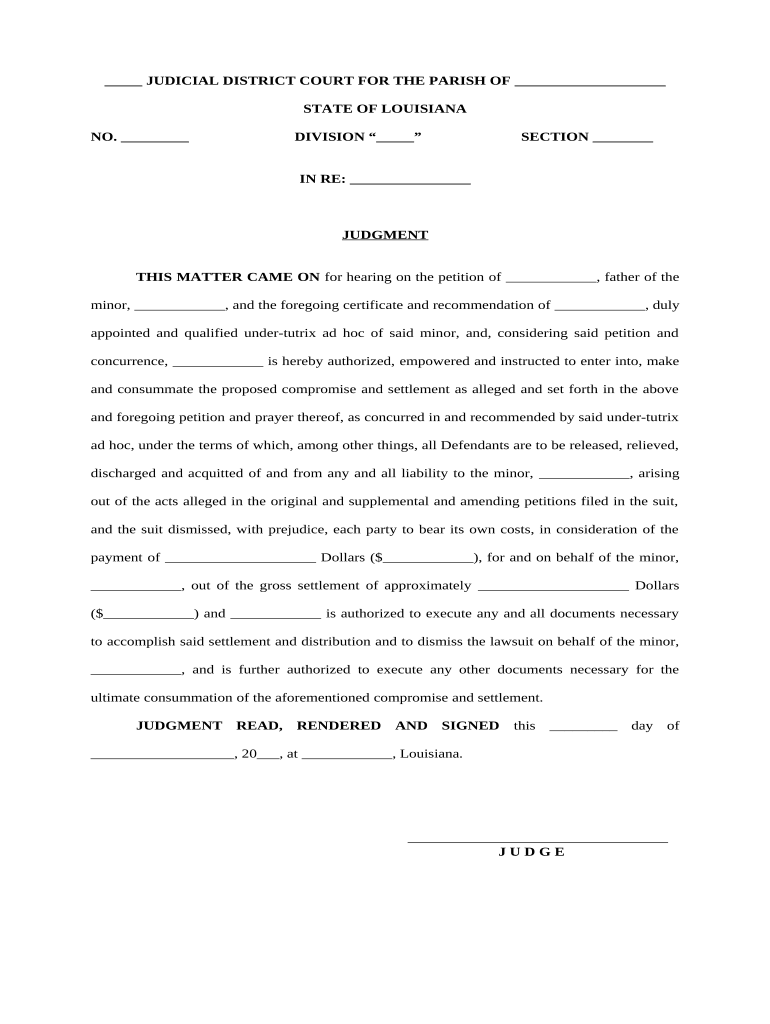
Judgment text

Clear statement of decision and relief granted, including specific awards, who owes what, and any non‑monetary directives or conditions of performance.

Monetary detail

Itemizes principal, interest, costs, and statutory fees separately so enforcement officers can calculate amounts due for execution or garnishment.

Interest calculation

States applicable post‑judgment interest rate and computation method to avoid disputes over accrual and to support precise enforcement amounts.

Execution language

Directs clerk to issue writs or executory process and specifies property or income remedies available under Louisiana procedure for collection.

Authentication

Includes judge or clerk signature, entry stamp, and date of filing; these elements confirm entry and trigger appeal and enforcement timelines.

Step-by-step: completing and filing a Judgment Louisiana

Follow these steps in order to minimize rejections and preserve enforcement and appeal rights.

  • 01
    Gather records: Collect pleadings, orders, and case number for reference.
  • 02
    Draft judgment: Populate caption, amounts, and enforcement language accurately.
  • 03
    Clerk entry: File with the clerk for official entry and obtain the stamped date.
  • 04
    Record lien if needed: Record in the parish mortgage or recorder office to create a public lien.

Configuring an online workflow for a Judgment Louisiana

Set up a digital workflow that captures signatures, audit trails, and returns stamped copies for your records.

File upload Upload final PDF with all exhibit references and case identifiers.
Field placement Add signature, date, and initials fields where required for parties or attorneys.
Signing order Specify sequential or parallel signer order depending on court or counsel needs.
Authentication Choose email, SMS code, or stronger methods for signer verification.
Return copies Configure automatic distribution of completed PDF and audit report to stakeholders.

Typical eSubmission flow for a judgment document

Digital preparation and signing reduce physical handling while preserving the audit history required for enforcement and recording.

  • Prepare document: Finalize judgment text and attach necessary exhibits.
  • Place fields: Insert signature, date, and identification fields for signers.
  • Collect signatures: Signers authenticate and execute the document electronically.
  • File and record: File with the court and record lien if applicable.

Technical needs and supported formats for eFiling and eSigning

Ensure your platform accepts court-ready PDF/A or standard PDF and supports audit trails for legal events.

  • File formats: PDF, DOCX accepted
  • Integrations: Microsoft 365, Google Workspace, NetSuite
  • Storage: Box, Google Drive, AWS

Critical timing considerations for Judgments in Louisiana

Time-sensitive actions include the entry date, appeal window, transcription for lien priority, and execution deadlines for post‑judgment remedies.

Judgment entry date:

Date the clerk stamps — starts appeal and enforcement timelines.

Appeal period:

Varies by proceeding; commonly 30 days from entry in many civil matters.

Recording for lien:

Record promptly to establish priority against subsequent creditors.

Execution timeline:

Judgment enforcement actions proceed per court rules after entry.

Renewal periods:

Statutory renewal rules may apply; verify with counsel and court clerks.

Common mistakes that delay or invalidate a judgment

  • Using informal or abbreviated party names that differ from pleadings, causing mismatched docketing and indexing errors.
  • Incorrect or missing docket number that prevents the clerk from associating the judgment with the case file and entry records.
  • Omitting itemized amounts, interest rates, or execution language so enforcement officers cannot calculate or act on the judgment.
  • Failing to record a judgment lien promptly, which can reduce priority against subsequent encumbrances or purchasers.

Risks and legal consequences of errors in a Louisiana judgment

Loss of priority: Failing to record lien can forfeit priority against later claims.
Appeal default: Missing appeal deadlines can bar appellate relief.
Execution delays: Incomplete execution language delays collection.
Clerical rejection: Clerk may refuse entry for technical defects.
Title complications: Unrecorded or misindexed judgments disrupt real estate closings.
Increased costs: Corrections and re-filings add attorney and court fees.

How organizations use electronic workflows for judgments

These brief examples show real organizations streamlining document execution and recordkeeping while preserving legal formalities.

Optica Ventures (Brian Fitzgibbons)

Optica centralized judgment paperwork to reduce manual handling and clerical errors.

  • They automated field placement and signatures for consistency.
  • As a result, the team captured complete audit trails, sped internal review, and ensured filed judgments matched the court’s expected entry format and indexing requirements.

Martin Properties (Tim Martin)

Martin Properties used online signing to finalize judgments supporting property liens.

  • The landlord authenticated signers remotely.
  • This process allowed faster transcription into public records, reduced in-person notarization needs where permitted, and provided stamped PDFs to title agents for quicker closings.

Comparing eSignature vendors for Judgment Louisiana workflows

Vendor pricing and features vary; the table below highlights starting price, trial availability, bulk send capability, audit trail, HIPAA compliance, and envelope caps for common providers.

signNow DocuSign Adobe Sign PandaDoc HelloSign
Starting Price $8/user/mo $15/user/mo $14/user/mo $19/user/mo $15/user/mo
Free Trial 7-day free trial, no card Varies by vendor Varies by vendor Varies by vendor Varies by vendor
Bulk Send Yes (Premium plan) Varies by plan Varies by plan Varies by plan Varies by plan
Audit Trail Yes Yes Yes Yes Yes
HIPAA Compliant Yes Yes Yes No No
Envelope Cap No cap 100 envelopes/user/year Varies Varies Varies

Key milestones from judgment entry to enforcement

Sequential milestones show the typical lifecycle: entry, service and notice, appeal window, then enforcement or recording events.

01

Judgment Entry

Clerk files and stamps the judgment, establishing official entry date.

02

Notice and Service

Ensure affected parties receive notice as required by court rules.

03

Appeal Period

Appellate deadlines run from the entry date; missing them limits review options.

04

Enforcement / Recording

Record for lien priority and pursue executions after appeal timelines lapse.

Security and compliance considerations for digitally handling judgments

Encryption: TLS 1.2/1.3 in transit; AES-256 at rest
Certifications: ISO 27001 and SOC 2 Type II available
HIPAA: BAA required to protect PHI
ESIGN / UETA: Meets legal e-signature frameworks
21 CFR Part 11: Controls for regulated FDA records
Accessibility: WCAG 2.0 Level AA compliant

Frequently asked questions about Judgment Louisiana and eSigning

Answers address common legal, procedural, and technical questions about preparing, signing, filing, and recording judgments in Louisiana.


Need help? Contact support

be ready to get more
Join over 28 million airSlate SignNow users