Parties
List full legal names and contact information for landlord and tenant, including unit number and mailing address; mismatched names can lead to service challenges or disputes over notice validity.
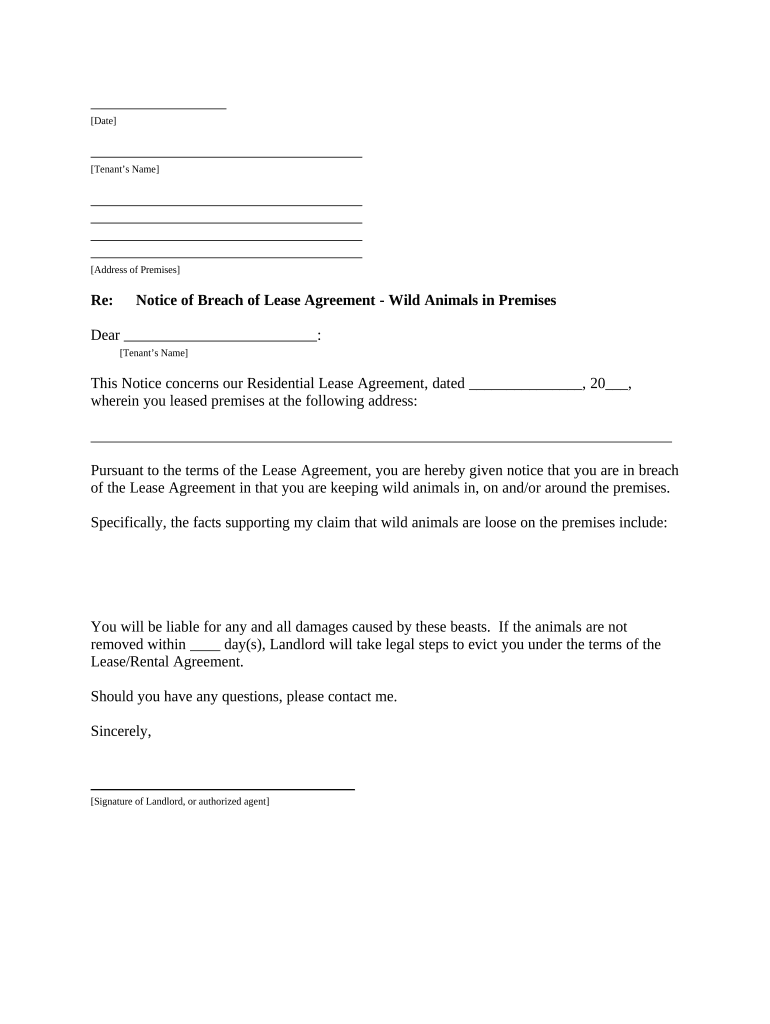
A properly drafted Landlord Tenant Notice clarifies obligations, creates official timelines, and preserves documentary evidence that courts accept for eviction or other remedies. Well-formed notices limit ambiguity, help meet statutory service and cure requirements, and reduce the chance of procedural dismissal.

Typical users include landlords, property managers, on-site leasing staff, and attorneys preparing notices for lease enforcement or tenant remediation.
A manager responsible for routine tenant communications and lease compliance. They use Landlord Tenant Notices to document rent demands, repair requests, or lease violations and maintain copies for the tenant file and potential court proceedings; accuracy reduces legal exposure.
Tenant advocates, attorneys, or legal aid staff review notices to confirm statutory sufficiency, advise tenants on cure rights, and preserve defense records. They track service method and dates to challenge improperly served notices in court where appropriate.
| Workflow Field or Setting Name | Configuration |
|---|---|
| Signature field (name and date) | Required; signer name and date |
| Signer authentication method (OTP, KBA) | Email OTP; SMS or KBA optional |
| Conditional fields and automatic calculations | Add cure period calculations, late fees |
| Template identifier and naming convention | Use 'Landlord Tenant Notice' template |
| Retention and audit trail retention settings | Save PDF plus audit trail metadata |
Common platform capabilities for eSubmission and distribution when using a document signing service.
List full legal names and contact information for landlord and tenant, including unit number and mailing address; mismatched names can lead to service challenges or disputes over notice validity.
State the date the notice is issued and the specific date by which the tenant must act; use MM/DD/YYYY to avoid ambiguity and calculate deadlines accurately under state law.
Cite the exact lease provision or statutory section being violated and provide a concise factual summary of the conduct or omission that constitutes the breach.
Specify required corrective action, payment amounts, and precise deadlines; define how compliance is verified and whether partial compliance affects termination.
Record the statutory delivery method used—personal, certified mail, posting, or other—and include the postal receipt, affidavit, or digital audit trail as evidence.
Attach or reference supporting documents such as ledgers, photos, prior warnings, and signed acknowledgment; preserve an unaltered signed copy with audit metadata.
Save the completed Landlord Tenant Notice as a flattened PDF/A for archival purposes and as a searchable PDF to preserve text for discovery and court submission; include the audit trail as a separate PDF.
Include the certificate of completion or audit report showing timestamps, IP addresses, and signer authentication method alongside the signed document to document the chain of custody.
Attach lease excerpts, photos of damage, rent ledger entries, and prior correspondence to substantiate claims made in the notice and make a self-contained evidentiary packet.
Store in an encrypted document repository with access controls and retention labels consistent with legal hold and privacy obligations, preserving originals for the retention period.
Martin Properties used signNow to serve and archive landlord notices across multiple rental units, eliminating in-person delivery and reducing paperwork.
Optica Ventures implemented e-signature workflows to send rent demand and cure notices from property management software, improving record consistency across portfolios.
Typically 3–5 calendar days to pay or vacate; state law varies.
Often 10 days to cure; some jurisdictions require longer notices.
Used for repeated breaches; usually 30–60 days depending on state.
Standard 30-day notice in many states; check local statutes.
Notice aligns with lease terms; early termination may require cause or fee.
Prepare accurate facts, statute citations, and dates.
Deliver by required method and record proof.
Wait statutory timeframe before next steps.
Proceed only after cure failure; attach proof.
| Criteria | Electronic Signature | Digital Signature |
|---|---|---|
| Definition | broad, intent-based | pki-based cryptographic |
| Technology | any electronic process | x.509, pki certificates |
| Non-repudiation | audit trail evidence | strong cryptographic non-repudiation |
| Legal acceptance | accepted under esign/ueta | accepted; stronger for regulated use |
| signNow | DocuSign | Adobe Sign | PandaDoc | HelloSign | |
|---|---|---|---|---|---|
| Starting Price | $8 per user per month (annual billing) | $15 per user per month (annual billing) | $14 per user per month (annual billing) | $19 per user per month (annual billing) | $15 per user per month (annual billing) |
| Free Trial | 7-day free trial, no credit card required | Trial terms vary by vendor and plan | Trial terms vary by vendor and plan | Trial terms vary by vendor and plan | Trial terms vary by vendor and plan |
| Bulk Send | Bulk send available on plan tiers | Bulk send available on plan tiers | Bulk send available on plan tiers | Bulk send available on plan tiers | Bulk send not available on some tiers |
| Audit Trail | Comprehensive audit trail with timestamps and IP | Comprehensive audit trail with timestamps and IP | Comprehensive audit trail with timestamps and IP | Comprehensive audit trail with timestamps and IP | Comprehensive audit trail with timestamps and IP |
| HIPAA Compliant | HIPAA compliance available with BAA | HIPAA compliance available with BAA | HIPAA compliance available with BAA | HIPAA BAA not available with plan | HIPAA BAA not available with plan |