Establishing secure connection…Loading editor…Preparing document…

Warning Letter

This template is fully customizable. Edit the text, fill out the fields, and send it for signature. Give it a try!
Warning Letter

What a Warning Letter Is and When Organizations Use It

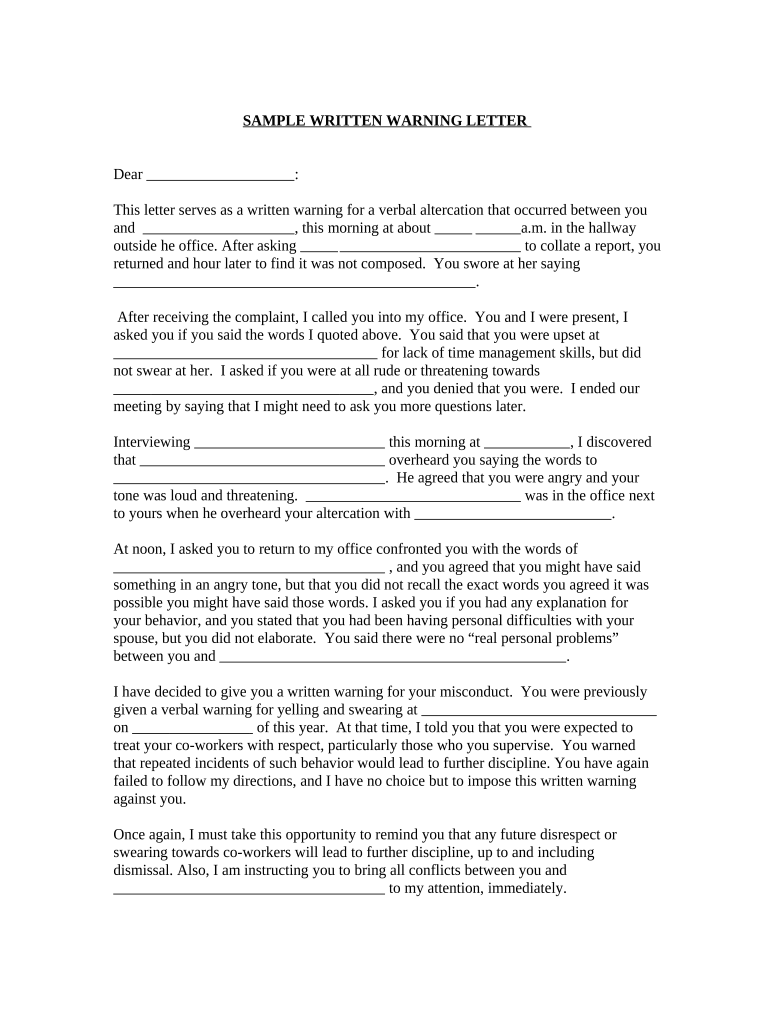
A Warning Letter is a formal written notice used by employers or administrators to document performance issues, policy violations, or misconduct and to set expectations for correction. It records dates, specific incidents, the policies or rules violated, corrective actions required, and consequences for failure to improve. Warning Letters typically become part of the personnel file and are used in progressive discipline, internal investigations, or to support later employment decisions. When issued electronically, they must meet e-signature legal standards under ESIGN and applicable state UETA frameworks to preserve admissibility and enforceability.

Why a Clear Warning Letter Matters

A well-drafted Warning Letter documents expectations, helps the recipient understand required changes, and creates a record that demonstrates consistent application of policies.

Why a Clear Warning Letter Matters

Typical Issuers and Roles Responsible for Warning Letters

Human resources, direct supervisors, school administrators, and compliance officers commonly issue Warning Letters to document and address noncompliance or poor performance.

  • Human resources: manages documentation, policy interpretation, and retention within personnel files.
  • Supervisors: identify incidents, collect evidence, and deliver the Warning Letter with supporting details.
  • Compliance/legal: reviews language for regulatory risk and consistency with collective bargaining agreements.

Essential Parts of a Professional Warning Letter

Include clear, objective, and actionable sections so the letter can be relied upon for internal reviews and external proceedings; the following components are standard.

Header

Include organization name, issuance date, recipient name, and position. Accurate header information links the letter to HR records and confirms origin for later review or appeals.
Incident Details

Describe specific dates, times, locations, observed conduct, and witness names where applicable. Factual, chronological reporting reduces ambiguity and strengthens evidentiary value.

Policy Reference

Cite the exact handbook section, policy title, or rule that was violated and the version date so the recipient can review the governing standard.

Corrective Action

Specify measurable expectations, training or support, exact deadlines, and how improvement will be assessed to give the recipient a clear path to compliance.

Consequences

State progressive discipline steps and potential outcomes for failure to improve, including possible termination, consistent with internal policy and any bargaining agreements.

Signatures

Provide lines for manager signature, employee acknowledgment, and date. Note and document any refusal to sign and record witness attestations if applicable.

Security and Compliance Essentials for Electronic Warning Letters

Encryption: TLS 1.2/1.3 in transit; AES-256 at rest.
Audit Trail: Timestamp, IP, signer actions recorded.
HIPAA Compliance: BAA required for protected health information.
ESIGN / UETA: Electronic signature legal framework in U.S.
Access Controls: SSO and role-based permissions available.
Record Retention: Secure storage with configurable retention.

Step-by-Step: Create, Review, and Issue a Warning Letter

Follow a consistent sequence—gather facts, draft, review, deliver, and file—to ensure the Warning Letter is accurate and aligned with internal policies.

  • 01
    Gather Facts: Collect incident reports, emails, and witness statements.
  • 02
    Draft Letter: Write objective, policy-linked descriptions and corrective steps.
  • 03
    Review: Have HR or legal review language for compliance.
  • 04
    Deliver & Record: Provide to employee, obtain acknowledgment, and file copy.

Typical Routing for a Warning Letter

A standard workflow includes draft creation, internal approvals, secure delivery, signer acknowledgment, and archival to preserve auditability and chain of custody.

  • Create Draft: Prepare the letter with specific incident details.
  • Internal Review: HR or counsel checks for policy consistency.
  • Issue: Deliver in person or via a secure electronic method.
  • Archive: Store signed copy in personnel records securely.

Configuring an Electronic Warning Letter Workflow

Configure fields, approval routing, signer authentication, and archival rules so electronic issuance complies with company policy and legal requirements.

Field Configuration
Approval Routing Manager then HR sequential approval.
Authentication Email link or SMS code verification.
Signature Fields Signature, date, and acknowledgment checkboxes.
Archive Settings Encrypted storage with retention rules.

Delivery Channels, File Formats, and Integration Points

Use delivery and authentication methods that match the document's sensitivity and regulatory obligations, ensuring recipients can access records reliably.

  • Formats: PDF and Word (DOCX) supported.
  • Integrations: Connects with HRIS and cloud storage.
  • Authentication: Email, SMS, or stronger verification.

Typical Timeframes to Include and Track

Track issuance dates, response deadlines, improvement periods, and review checkpoints so the process is transparent and defensible.

Issue Date:

Date the letter is provided to the employee; start of response period.

Response Deadline:

Employee typically given 3–10 business days to respond, per policy.

Improvement Period:

Define measurable period (e.g., 30–90 days) for performance improvement.

Follow-up Review:

Schedule midpoint meeting to assess progress and provide feedback.

File Retention:

Retain signed letter per company retention policy and legal requirements.

Common Preparation Pitfalls to Avoid

  • Vague language can lead to disputes; avoid generalized criticisms and cite specific policies, dates, and facts to reduce ambiguity and legal exposure.
  • Failing to follow progressive discipline or inconsistent treatment of employees increases risk of discrimination claims and damages employer credibility in disputes.
  • Not documenting accommodations, training, or performance support can weaken defenses in disability or FMLA reasonable accommodation disputes and lead to legal claims.
  • Allowing unsigned or unacknowledged letters without witness notes reduces evidentiary value in arbitration or litigation settings and complicates records review.

Potential Legal Risks from Improper Warning Letters

Discrimination Claims: Increased litigation risk.
Wrongful Termination: Potential damages awarded.
Unemployment Appeals: Appeals may succeed.
Regulatory Complaints: Agency investigations possible.
Collective Bargaining: Union grievance risk.
Recordkeeping Penalties: Failing retention can violate law.

FAQs: Legal Validity, Signing, and Common Issues

Answers to frequent questions about electronic signing, notarization, recordkeeping, and dispute mitigation for Warning Letters in U.S. workplaces.


Need help? Contact support

Pricing and Feature Snapshot for eSignature Platforms

Comparison of starting price and basic feature availability for common eSignature vendors to assist with platform selection when issuing Warning Letters and similar HR documents.

signNow DocuSign Adobe Sign PandaDoc HelloSign
Starting Price $8/user/mo $15/user/mo $14/user/mo $19/user/mo $15/user/mo
Free Trial 7-day free trial Varied Varied Varied Varied
Bulk Send Yes Yes Yes Yes No
Audit Trail Yes Yes Yes Yes Yes
HIPAA Compliant Yes Yes Yes No No
Envelope Cap No cap 100 envelopes/user/year Varies Varies Varies
be ready to get more
Join over 28 million airSlate SignNow users