Establishing secure connection… Loading editor… Preparing document…
Navigation

Fill and Sign the Law Handbook Form

Fill and Sign the Law Handbook Form

How it works

Open the document and fill out all its fields.
Apply your legally-binding eSignature.
Save and invite other recipients to sign it.

Rate template

4.4
37 votes
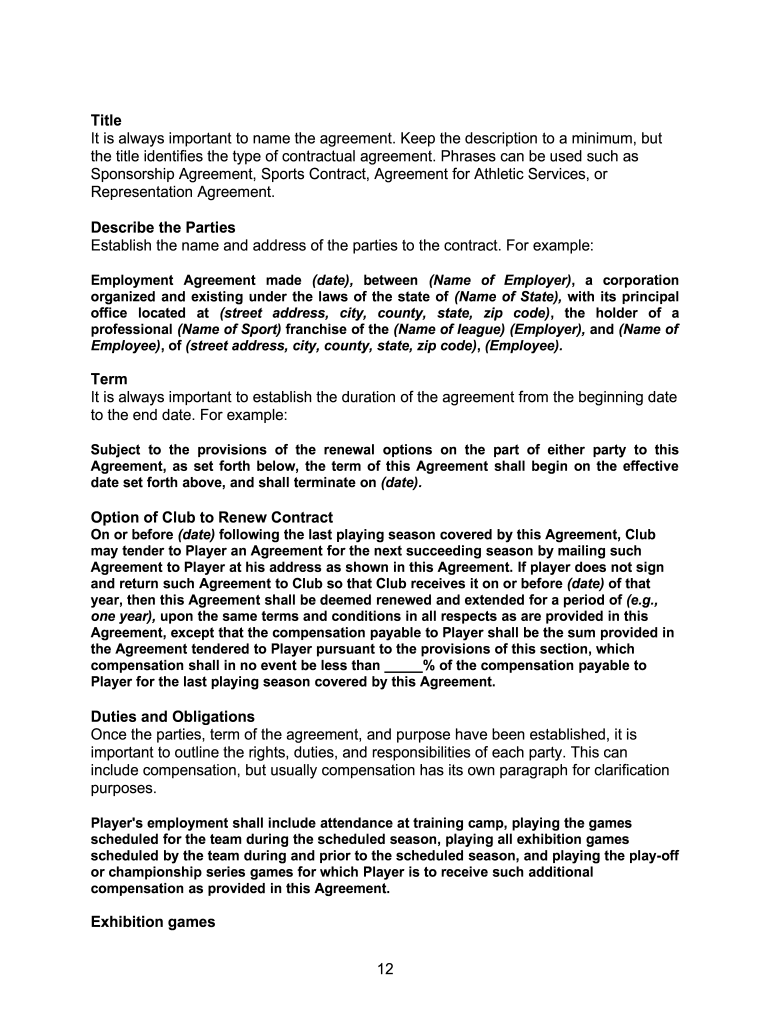
Sports Law Handbook (For Coaches and Administrators) William H. Glover, J.D. Dedication To my Dad who taught me (by example) how to have the drive and courage to succeed and t o my Mother who taught me not to run over people in the process . Thank you! Copyright©2009 By Author: William H. Glover Jr. J.D. All rights reserved. Except as permitted under the US Copyright Act 1976, no part of this publication may be reproduced, distributed or transmitte d in any form or by any means or stored in a data base or retrieval system, without the prior writt en permission of the author. TABLE OF CONTENTS Page No. I. SPORTS CONTRACTS 4 Sports Agents and Contracts The Occupation of “Athlete” 4 Matters to be considered in drafting contract for employment o f athlete 5 General Contract Law Principles 6 Agreement Competent Parties Assent or Consent Supported by Consideration Made for a Lawful Objective In the Form Required by Law Interpretation of a Contract Categories of Contracts Team Contracts versus Individual Contracts 10 The Professional Services (Standard Player) Contract 10 Endorsement Contracts 10 Appearance Contracts 11 Drafting the Sports Contract 11 Drafting Suggestions for a Sports Contract Damages and Remedies for Breach of Contract 15 NCAA Contracts and Amateurism 17 Evolution of Amateurism Other NCAA Contract Issues Letter of Intent Health Club Contracts 19 II. TORT LAW AND WAIVERS 20 Negligence 21 Contributory Negligence versus Comparative Negligence 22 Gross Negligence 22 Spectator Injuries 22 Malpractice in Sports 24 Sports Officials 24 1 Workers Compensation25 Insurance 25 Waivers and Releases 26 Drafting Suggestions Minors and Waivers Commercial Misappropriation 29 Products Liability 29 III. SPORT CRIMES 30 Types of Crimes 30 Contact Sports 31 General Criminal Law Principles 31 SPORTS VIOLENCE 32 Illegitimate Sports Violence 32 Governmental Legislation 35 Internal League Controls: 35 Fans and Spectators 35 Sports Gambling 36 Sports Bribery and Game Fixing 36 IV. SPORTS AGENTS 38 Questions a Star College Player Might Ask about a Prospecti ve Agent 42 V. EMPLOYMENT LAW 44 Collective bargaining contracts 44 Family and Medical Leave Act 45 The Occupational Safety and Health Act of 1970 46 Workmen Compensation Statutes 46 Title VII of the Civil Rights Act of 1964 46 Pregnancy Discrimination Act Quid pro quo Hostile working environment harassment Age Discrimination in Employment Act (ADEA) 47 Americans with Disabilities Act 47 VI. ANTITRUST AND LABOR LAW ISSUES IN SPORTS 47 Sherman Antitrust Act 48 Clayton Act 48 National Labor Relations Board 49 Monopolizing 49 Baseball Exemption 50 VII. INTELLECTUAL PROPERTY RIGHTS 53 Trademarks and Service Marks Copyrights 54 2 Patents56 Trade Secrets 56 Remedies for Violation of Property Rights 56 Ambush Marketing 56 VIII. TITLE IX -- Other Women’s Issues 57 College Sports 59 Title IX Criticism 60 Grove City College v. Bell 60 Title IX Tests 61 Evolution of Title IX 61 Men and Title IX 64 Programs Funding for Men and Women 64 Contact Sports Exception 65 Football 65 Programs of Men Cut Due to Title IX 65 Women Competing on Male Teams 66 Men Competing on Teams with Women 66 Equity in Athletics Disclosure Act 66 Equal Pay Act of 1963, 29 U.S.C.A. § 206(b) 67 IX. DRUGS AND TESTING 67 Fourth Amendment 68 Fifth Amendment 68 NCAA Regulation 68 National Football League 69 The Olympic Games 69 International Olympic Committee Policies 69 X. INTERNATIONAL SPORTS ISSUES 71 Competition for and During the Olympic Games 71 The Olympic Movement 71 Ted Stevens Olympic and Amateur Sports Act 74 3 SPORTS LAW HANDBOOK (For Coaches and Sports Administrators) Copyright 2009 William H. Glover, Jr. All rights reserved I. SPORTS CONTRACTS Contracts in sports are no different than contracts in everyda y life. Professional athletes are compensated for their services with a paycheck just as anyon e else. This section examines the nature of personal services contracts of pro athlet es. However, even the amateur athlete deals with important contract-related issues. Amateur athletes often have to make tough choices about changing their status fro m amateur to professional given the dramatic increase in money that may be available t o be earned in their sports. Some professional athletes are paid a lot more money in one year than most people ever earns in their lifetimes. Sports Agents and Contracts Sports agents serve a valuable role in terms of securing and n egotiating contracts for the professional athlete. Lawyers who represent athletes ha ve generally been trained in the fundamentals of contracts and should be familiar with the current market value of their client relative to other athletes within the same sport. However, it should be noted that hiring a lawyer is not required (nor is an agent for that matter) to secure deals for the athlete. Some athletes do not wish to hire an agen t for a variety of reasons, including having to pay commissions or other fees associated with the representation. Since the athlete has unique talents, abilities, and ski lls, their contracts are categorized as personal services contracts. Technically, a personal service contract may not be assigned to some one else. An assignment is a transfer of rights that a party has under a con tract to another person. Why can’t a personal service contract be assigned? The talents o f an athlete are unique. For example, Peyton Manning could not assign his con tract to another player. His talents are so unique. The team owner would not ho nor such an assignment. No one can be legally forced to work for someone for whom t hey do not want to work. The Thirteenth Amendment to the U. S. Constitution provid es: Neither slavery nor involuntary servitude, except as a punishment for crime whereof the party shall have been duly convicted, shall exist within the United Stat es. This provision of the Constitution has been interpreted as including a prohibit ion against requiring someone to work for an employer for whom they do not wish to work. How then do team owners get away with trading players f rom one team to another, since this in effect is assigning a personal service contract? Any contract may be assigned with permission of the parties. The right to assign is part of a player’s contract. However, some players have enough bargaining power to put in a do not trade clause. 4 This keeps a team from assigning the player to a team for whom he does not want to play. Public Nature of Sports Contracts Though general contract principles apply in sports contracts, often such contracts are so important to the particular league or community, that each co mmunity has a vested financial and emotional interest in seeing their team perf orm well. Of course some sports do not receive the same sort of public exposure and gen erate the same widespread fan support. The Occupation of “Athlete” The occupation of professional athlete has become recognized a s one of the most financially rewarding professions. Sports sponsors often pay th ousands of dollars to an athlete to promote its product. A sports contract can have an impact on the lives of thousands of people. Today’s amateurs must face crucial issues such as whether to cont inue to compete as an amateur or be lured away by money to professional teams during their sophomore or junior year of college. College sports such as football, basketball, baseball, and hockey are often regarded as proving grounds for the major profession al leagues. Many athletes are urged to abandon amateur status to be compe nsated for their services as a professional. Contracts for the employment of athletes should always be in writing and should contain covenants by the athlete like promising to refrain from certain acts, such as participating in dangerous activities. Matters to be considered in drafting contract for employmen t of athlete The following is a checklist of matters to be considered in d rafting a contract for the employment of an athlete: •Names of parties. • Addresses of parties. • Statement of hiring. • Term of contract. • Duties and obligations of athlete. • Attendance at training camp. • Amount of compensation. • Times at which compensation payable. • Payment of bonus. • Effect of taking bonus or bet on outcome of game. • Board, lodging, and traveling expenses while traveling. • Compliance with rules of the athletic association and/or cl ub. • Covenant not to play for others during term of contract. • Covenant not to engage in related activities. 5 •Effect of not being in physical condition. • Effect of injuries. • Effect of temporary retirement from active sports. • Payment of fines imposed by athletic association or club. • Right of employer to assign the contract. • Right of employer to seek injunction to prevent playing fo r others. • Use of pictures for publicity purposes. • Arbitration or other method of settling disputes between parties. • Option to renew. • Termination of contract. • Grounds for termination. • Procedure for termination. • Incorporation of applicable rules and regulations of ath letic association into Contract. • State’s law to govern interpretation of contract. • Effective date of contract. • Date of execution of contract. General Contract Law Principles A contract is a legally binding agreement. A contract represen ts the meeting of the minds of the parties. Contracts in sports are subject to the sa me principles of contract formation as any other form of employment agreement. There six elements that are necessary to a binding and enfo rceable contract: • An agreement; • Between competent parties; • Based upon the genuine assent of the parties; • Supported by consideration; • Made for a lawful objective; • In the form required by law. Most sports contracts are express contracts. An express contract is a contract in which the agreement of the parties is evidenced by their words, w hether spoken or written. There are virtually no more implied contracts in the sports i ndustry. An implied contract is a contract in which the agreement is not evidenced by writ ten or spoken words, but by the acts and conduct of the parties. 1 Agreement 1 For example, if you left your watch to be repaired and nothing wa s said with regard to how much you would be charged, you would be obligated to pay the reasonable value of the serv ices, even though no specific agreement had ever been made. Of course, implied contracts are sometimes har d to prove. 6 It is essential to a contract that there be an offer and, while the offer is still in existence, it must be accepted without qualification. Once an offer is made, the person to whom it is made can respond in four ways: •Accept; • Reject (this automatically terminates the offer); • Counteroffer (again, the offer is automatically terminate d); • Nothing (the offer then terminates after a reasonable time). Offers may be terminated in any one of the following wa ys: • Revocation of the offer by the person making it (the offere e); • Counteroffer by offeree; • Rejection of offer by offeree; • Lapse of time; • Death or disability of either party; or • Performance of the contract becomes illegal after the offe r is made.2 Competent Parties An issue can arise with regard to the legal “capacity” aspect of a minor signing a contract. Sports such as gymnastics, swimming, and tennis ofte n involve contractual issues regarding minors. Satisfying this element may require the signature of a parent or guardian. Even though minors may enter into contractual a rrangements, minors hold the ability to void such contracts at their option. However, if the contract is voided, the other party generally must be placed in the same position as prior to entering into the agreement, or at least at no worse position. Assent or Consent The consent or assent of a party to an agreement must be gen uine and voluntary. This assent will not be genuine or voluntary in certain cases of mistake, deception or undue pressure or duress. The agreement of parties may be affected b y the fact that one or both of them made a mistake. A unilateral mistake is a mistake made by one party to the agreement. A mistake that is unknown to the other party usually does not affect the enforceability of the agreement. A unilateral mistake of one party that the other party know s about may make the contract voidable by the party that is adversely affected by the mistake. A unilateral mistake regarding a fact does not affect the contract. For example, if a coach orders water-resistant parkas for his football team thinking that this means waterproof, he cannot get out of the contract unless the sale was made wit h some sort of misrepresentation as to the meaning of those words. 2 For example, if there is an offer made to sell alcoholic beverages to a store, but a city ordinance is passed prohibiting the sale of alcoholic beverages before the offer i s accepted, the offer is terminated. 7 If both parties to an agreement make the same mistake regarding a key factual matter, the agreement is void. For example, a contract is void if both parties mistakenly b elieve that the contract can be performed when, in fact, it is impo ssible to perform it.3 A person who has the ability and the opportunity to read a document before signing it is contractually bound by the terms of the document even if th e person signed it without reading it. The signer cannot avoid liability based on the argument that no explanation was given to him of the terms of the contract. Even if a p erson is unable to read or understand the terms of the agreement, he is still bound by the terms of the agreement since he should have tried to obtain an explanation of t he agreement. The exception to this rule is that if the other party knows, or has reason t o know, that the signer cannot read nor has a limited education, some Courts would hold tha t the other contracting party should have read the document to the other party or e xplained the terms. If a party relies on the explanation of another party as to the contents of the agreement, the contract may be voided under two circumstances: (i) the party was justified in relying on the explanation of the other party; and (ii) the expla nation was fraudulent. The party making the explanatory statements does not have to be a l awyer, but can be any person who handles the agreement on a regular basis and th erefore has a greater knowledge of the content than the other person. Supported by Consideration Consideration is what the promisor (person making promise) demands and receives as the price for the promise. The promisor is the person making the promise, and the promisee is the person to whom the promise is made. Consideration consists of something to which the promisor is not otherwise entitled. I t is not necessary to use the word consideration in a contract. Consideration is the price paid for the promise . When thinking of consideration, think in terms of legal value a s opposed to economic value. While economic value (e.g., money) is the most common form of con sideration, consideration does not have to involve money. Made for a Lawful Objective The fourth element of a contract is that it must be made fo r a lawful objective. Courts will not enforce contracts that are illegal or violate pu blic policy. Such contracts are considered void. For example, a gambling contract would be i llegal in many states. If the illegal agreement has not been performed, neither p arty can recover damages from the other or require performance of the agreement. If the agreement has been performed, neither party can sue the other for damages or have the agreement set aside. 3 Suppose Smith promises over lunch to sell Jones an antique Mercedes i n Smith's garage. Assume both parties believe the automobile is in Smith's garage. However, the car had be en destroyed by fire an hour before the agreement and Smith had not learned of this. Since this fact wa s unknown to both parties, there is a mutual mistake as to the possibility of performing the contract. The agreemen t is therefore void. 8 Assume Smith was not licensed to act as a sports agent. However, Jones asks Smith to help him procure a contract with a professional football team. Jones promises to pay Smith $10,000.00 if Smith can get him a NFL contract. Jon es pays Smith $1,000.00 in advance. Smith successfully negotiates a contract for Jones with an NFL team. However, Jones refuses to pay the remaining $9,000.00. Smit h sues Jones. A Court would most likely rule in favor of Jones as to the unpaid commission since the state’s sports agent licensing statute was violated by Smith’s actin g as a sports agent without a license. The agreement to pay him a commission was therefore void and can not be enforced. Suppose Jones then claims that Smith should not be entitled to keep the $1,000.00 advance he had received. The Court would most li kely hold that although Smith had no right to the commission, he had been paid an d the Court would not aid either party to the illegal contract. Therefore, Jones cou ld not recover from Smith the part of the commission that had already been paid. In the Form Required by Law As a general rule, contracts may be either oral or written. However, the law requires a written agreement in specific situations. Most states have statu tes that require the following types of contracts to be in writing or they wi ll be unenforceable: • An agreement that cannot be performed within one year aft er the agreement is made; • Contracts involving the sale of land; • The promise to answer for the debt of another person; 4 • A promise by the executor or administrator of an estate of a d eceased person to use personal funds to pay a debt of the estate; • A promise made in consideration of marriage must be in writing (e.g., a prenuptial agreement); and • A contract provides for the sale of goods with a price of $5 00.00 or more. Interpretation of a Contract If there is a dispute as to the interpretation of a contra ct, Courts seek to enforce the intent of the parties to the contract. The intent which will be enforced is what a reasonable person would believe that the parties intended. Sometimes the provisions of a contract are contradictory. In such a situation, a Court wi ll try to reconcile the provisions and eliminate the conflict. However, if this canno t be done, the Court will declare that there is no contract. For example, John makes a co ntract to sell 100 acres of land to Joe. One paragraph of the contract states that the purchase price is $100,000.00. Another paragraph states that the purchase p rice is $1,100.00 per acre, which would produce a total price of $110,000.00. Which a mount would be binding? Neither amount would be binding if the conflict in the terms could not be reconciled by parol evidence. 5 4 For example, an oral promise by the president of Acme Company to pay the debt owed by Acme to First National Bank would not be enforceable unless in writing. 5 Parol evidence is oral evidence, such as testimony i n a court, as opposed to written evidence. 9 In some cases, a conflict can be solved by considering the form of the conflicting terms. If a contract is partly printed or typewritten and partly hand written, the handwritten part would prevail if it conflicted with the typewritten or prin ted part. If there is a conflict between the printed part and a typewritten part, the type written part would prevail. If there is a conflict between an amount or quantity expressed both in words and figures, as on a check, the amount or quantity expressed in words preva ils. For example, if a check is written for $1,000.00, yet the check states it i s for One Hundred and 00/100 Dollars, the words would prevail over the figures. A contract is ambiguous when it is uncertain what the intent of the parties wa s and the contract is capable of more than one reasonable interpretatio n. Sometimes ambiguous terms can be explained by the admission of parol evidence. Al so, Courts abide by the rule that an ambiguous contract is interpreted against the party who drafted it. In other words, the party who did not draft the contract will be gi ven the benefit of the doubt so to speak. Categories of Contracts Sports contracts can be divided into three general catego ries: • professional services contracts (sometimes called standard player co ntracts) • endorsement contracts, and • Appearance contracts. Team Contracts versus Individual Contracts If a professional athlete is part of a team, usually the at hlete receives a standard Player’s contract. The only difference between his contract a nd other members of the team are usually salary, bonuses, and the option to renegoti ate. The Professional Services (Standard Player) Contract The standard player contract (SPK) is usually in a “boilerplate” form. Boilerplate is standard wording that can be reused over and over without ch ange. Whether the athlete is involved in a league with a players association or not, the contract usually offered to the athlete and other athletes are all the same other than the salary and bonus. There can be addendums to the SPK. Newly formed leagues often model their own contracts afte r one of the Big Four (NFL, MLB, NBA and NHL) in order to recognize issues relevant to team owners and athletes. Some start-up leagues, however, have taken a new er approach to professional services contracts by establishing minimal salaries for the athle tes in that sport and rewarding the team and athlete on a per game basis with i ncentives. The now defunct Xtreme Football League (XFL), for example, offered modest sa laries to its players. Such wages were comparable to wages of the average U.S. worker. T his is primarily due to the fact that the league owned all of the teams rather than each team serving as a franchise for the league. None of the Big Four sports l eagues are run by a single entity. Each team is a franchise and competes for players. That is a p rimary reason for the escalation of player salaries. 10 Endorsement Contracts Unlike the professional services contract, the endorsement contract does not involve an employer-employee relationship. Rather, it is one of contracto r- independent contractor. 6 An endorsement contract is one that grants the sponsor the right to use (i.e., license) the athlete’s name, image, or likeness in connection with advertising the sponsor’s products or services. In most professional sports, the leagues proh ibit individual players from endorsing alcoholic beverages or tobacco products. Also, the NFL recently established a policy that players may not endorse certain nutrit ional supplements. There are no set rules for an endorsement agreement other than that they be legal. The more an sponsor feels that the athlete can assist in the sales of the particular product, the greater the likelihood of more money. Appearance Contracts An appearance contract compensates the athlete for appearin g at a public function, sports camp, golf tournament, etc. Drafting the Sports Contract All professional services contracts have important common clauses. Accord ing to the standard player’s contract of the NFLPA, MLBPA NBPA, and NHLPA,7 all contract provisions have been established, except for salary and bonuse s. Additionally, the players associations have group licensing arrangements in which players are compensated by licensing their names and likenesses in group package deals to trading card companies and video games. It is important to remember that when drafting a contract, it is often a good policy to be a pessimist: Think of what can go wrong. Though most contracts be gin as a beneficial relationship between the parties, it is well known that o ver time attitudes can change. Therefore, the contract drafter should use exceptional care to ensure that policies and procedures are provided to address situations and legal issues that might arise when something goes wrong. Good contract drafters protect their cl ient in the event such a situation might occur. Drafting Suggestions for a Sports Contract The following clauses are pretty standard. 6 An independent contractor is a person or business who performs services for another person pursuant to an agreement and is not subject to the other's control or the manner a nd means of performing the services. An independent contractor is distinguished from an employee, who wor ks regularly for an employer. The exact nature of the independent contractor's relationship with the hiring p arty is important since an independent contractor pays their own Social Security, income taxes without payroll deductio n, has no retirement or health plan rights, and often is not entitled to worker's compensation coverage. 7 I.e., National Football League Players Association, Major League B aseball Players Association, National Basketball Players Association and National Hockey League Playe rs Association 11 Title It is always important to name the agreement. Keep the description to a minimum, but the title identifies the type of contractual agreement. Phrases can be used such as Sponsorship Agreement, Sports Contract, Agreement for Athlet ic Services, or Representation Agreement. Describe the Parties Establish the name and address of the parties to the contra ct. For example: Employment Agreement made (date), between (Name of Employer) , a corporation organized and existing under the laws of the state o f (Name of State), with its principal office located at (street address, city, county, state, zip code) , the holder of a professional (Name of Sport) franchise of the (Name of league) (Employer), and (Name of Employee) , of (street address, city, county, state, zip code) , (Employee). Term It is always important to establish the duration of the ag reement from the beginning date to the end date. For example: Subject to the provisions of the renewal options on the part of either party to this Agreement, as set forth below, the term of this Agr eement shall begin on the effective date set forth above, and shall terminate on (date). Option of Club to Renew Contract On or before (date) following the last playing season covered by this Agreement, Club may tender to Player an Agreement for the next succ eeding season by mailing such Agreement to Player at his address as shown in this Agreement. If player does not sign and return such Agreement to Club so that Club rece ives it on or before (date) of that year, then this Agreement shall be deemed renewed a nd extended for a period of (e.g., one year), upon the same terms and conditions in all respects as are provided in this Agreement, except that the compensation payable to Player shall be the sum provided in the Agreement tendered to Player pursuant to the pr ovisions of this section, which compensation shall in no event be less than _____% of the compensation payable to Player for the last playing season covered by this Agreement. Duties and Obligations Once the parties, term of the agreement, and purpose have be en established, it is important to outline the rights, duties, and responsibili ties of each party. This can include compensation, but usually compensation has its own paragraph for clarification purposes. Player's employment shall include attendance at tra ining camp, playing the games scheduled for the team during the scheduled season, playing all exhibition games scheduled by the team during and prior to the sched uled season, and playing the play-off or championship series games for which Player is to receive such additional compensation as provided in this Agreement. Exhibition games 12 Exhibition games shall not be played on the (number) day prior to the opening of a team's regular season schedule or on a day prior to a regularly scheduled game. Exhibition games during the regular season shall no t exceed (number). For the purpose of this section, invitational games shall not be co nsidered as exhibition games. Compensation This is often referred to as legal consideration. An addendum attached to the contract is often helpful when using standard league contracts. The addendum could state increased salary, bonuses, and other incentives. Board, lodging, and travel expenses Club shall pay the reasonable board and lodging exp enses of player incurred while playing in games for club in other than the home ci ty of club. Club shall also pay all proper and necessary traveling expenses of player a nd his meals en-route to and from games. Exclusivity Due to the personal and unique nature of the sports contract, most employers and sponsors require an exclusive arrangement . It is c ommon for a sponsor in this paragraph to require the athlete to use the product s or services exclusively at all times, especially in public, or the endorser may have the right to terminate the agreement as a breach of contract or failure to use “best efforts.” Participation in other sports Player and Club recognize that Player's participatio n in other sports may impair or destroy his ability and skill as a (indicate sport) player. Accordingly, player agrees, from and after the execution of this Agreement, and for the duration of this agreement, not to engage or participate in any other sport or activit y involving a substantial risk of personal injury, including, but not limited to, aut omobile or motorcycle racing, fencing, parachuting or skydiving, boxing, wrestling, karate , judo, skiing, or ice hockey. Confidentiality A confidentiality clause is often considered valuable to bo th the team and the athlete. Players unions have somewhat undermined such a clause with resp ect to athletes under contract while represented by a players union by making sa laries public. In nonunion contracts, confidentiality is an important considerat ion for the sponsor and the athlete to prevent similarly situated athletes from comparin g their agreements. This will undoubtedly create concern for a party to the contract if th e terms are revealed. Termination If one party does not live up to its end of the bargain , he or she may be released from the agreement. Topics covered in many termination clauses includ e: • One party’s refusal to keep the terms of the agreement confi dential, • The athlete’s voluntary discontinuation of participation in the sport, • Cases in which the athlete is found guilty of a crime or is found to have been a part of unethical or immoral conduct (sometimes called a morals clause). • Participating in dangerous activities (e.g., skydiving, motocro ss racing). 13 Grounds for Termination By Player •If club defaults in the payments to player provided for i n this agreement or fails to perform any other material obligation agreed to be perform ed by club under this agreement, player shall notify club in writing of the fact s constituting such default or failure. • If club shall not cause such default or failure to be reme died within (number) days after receipt of such written notice, player shall have th e right, by a further written notice to club to terminate this agreement. • On termination of this agreement by player, all obligations of both parties under this agreement shall cease on the date of termination, except the obligation of club to pay player's compensation to such date of termination . Non-assignment It is important to establish that such an agreement is a perso nal services contract and therefore is non-assignable. The rights of each party under this Agreement are p ersonal to that party and may not be assigned or transferred to any other person, firm, corporation, or other entity without the prior, express, and written consent of the other pa rty. Alternative Dispute Resolution (ADR) The traditional method of resolving a breach of contract issue is through litigation. Alternative dispute resolution may be more effective in to re solving disputes by mediation or arbitration. Most collective bargaining agreement s address issues related to arbitration and/or mediation. Arbitration is a process in which the disputing parties choose a neutral third person, or arbitrator, who hears bot h sides of the dispute and then renders a decision. Mediation is a process by which parti es in a dispute negotiate a settlement of their claims against each other through the assistance of a trained, neutral mediator. It is a non-adversarial process. Mediation is entirely voluntary and non- binding. The mediator has no power to neither render a decision nor force the parties to accept a settlement. The mediator generally does not give an opinion or render an award, and typically does not even have any knowledge of t he case prior to mediation. The big difference between mediation and arbitration is that a mediator helps the parties to fashion their own settlement, while an arbitrator deci des the issue. An arbitrator is more like a judge than a mediator. The parties go into arb itration knowing that they will be bound by the decision. The parties go into mediation knowing that nothing will be decided unless and until they agree to it. Arbitration, however, is unlike litigation in that the parties choose the arbitrator, the proceedings are conducte d in a private manner, and the rules of evidence and procedure are informal. Also, i n arbitration, the arbitrators tend to be experts in the issues they are called on to decid e. Arbitration has been the widest used ADR process in the business world, and would b e especially desirable where the parties do not want to litigate an issue, but do want a binding decision. They can go into arbitration knowing that they can get a qui ck, and relatively inexpensive 14 decision, which they agree they will be bound by. Mediation offers no guarantee of a decision. Most arbitration is binding. However, it can be non-binding if that is what the parties desire. That kind of defeats the purpose of arbitration t hough. In any event, in both binding and non-binding arbitration, the arbitrator rende rs a decision much like a judge. It is not uncommon to find arbitration provisions in business contracts. An example of such a provision is as follows: Any dispute under this Agreement shall be required to be re solved by binding arbitration of the parties hereto. If the parties cannot agree on a n arbitrator, each party shall select one arbitrator and both arbitrators shall then select a thi rd. The third arbitrator so selected shall arbitrate said dispute. The arbitration shall be governed by the rules of the American Arbitration Association then in force and effect Governing Law Since many sports contracts affect parties from different stat es, agreeing upon the controlling law ahead of time can save jurisdictional issues from becoming problematic. This Agreement shall be governed by, construed, and enforced in accordance with the laws of the State of (Name of State). Merger Merger is a legal term that essentially means that any oth er prior oral or written agreements or statements are null and void, and that thi s contract constitutes the final and complete agreement between the parties. This Agreement shall constitute the entire agreemen t between the parties and any prior understanding or representation of any kind precedi ng the date of this Agreement shall not be binding upon either party except to the exte nt incorporated in this Agreement. Signature Line Since many parties require possession of an original copy of th e contract, signing in blue ink can avoid issues as to which contract is the original. Sometimes it is best to have the parties initial each page at the bottom to avo id later substitution of pages. DAMAGES AND REMEDIES FOR BREACH OF CONTRACT A contracting party may be entitled to damages if the oth er party breaches a contract. Generally, damages are the sum of money necessary to put a p arty in the same or equivalent financial position as the party would have be en had the contract been performed. A party may recover compensatory damages for any actual loss that the party can prove with reasonable certainty. An example would be in a si tuation where the plaintiff 15 has paid $10,000.00 for a lawn tractor, but the defendant refuses to deliver the tractor. The compensatory damages would be $10,000.00. Punitive damages are designed to punish. A Court uses punitive damag es to make an example of a defendant in order to keep others from doing a similar wrong. Punitive damages are rare in a breach of contract case. Consequential damages would arise in a situation where the failure to d eliver the tractor caused the plaintiff to have to rent a tractor to cut the field. The amount of rent would be consequential damages. A non-breaching party has a duty to mitigate damages. In other words, a non-breaching party has the duty to take reasonable steps to minimize dama ges. The failure to mitigate damages may cause the victim to only be allowed to recover damages that would have resulted if mitigated. If Acme College refused t o play a game it contracted to play with Southwestern State, and there was another school that could be substituted, like Northeastern State, the court would not award loss ga te receipts to Southwestern State if they just sat on their hands and refused to try t o get another team to fill that date. Damages would be the difference in probable gat e receipts for an Acme College game and a game with Northeastern State. An appropriate remedy for a breach may be rescission of the contract. This places the parties in the position they would have been had the co ntract never been entered into. For example, money is returned to the buyer and the buyer re turns the merchandise to the seller. Specific performance is an action to compel a party who breached a contract to pe rform the contract as promised. The subject matter of the contract must be unique, or an action for damages would be the proper remedy. Actions for specific performance are usually allowed with regard to: •A contract involving the sale of particular real estate; and • A contract for sale of a particular business. Specific performance is not allowed regarding a contract for t he sale of personal property unless the property is unique in some way like an a ntique, coin collection, or art objects. Generally, a party cannot obtain specific performan ce of personal service contracts or employment contracts. This is because of possibly viol ating the Thirteenth Amendment regarding involuntary servitude. However, breach of a service or employment contract can subject the breaching party to a suit f or damages. A contract may state the amount of liquidated damages to be paid if the contract is breached. Upon a party's breach, the other party will recover this amount of damages whether actual damages are more or less than the liquidate d amount. Liquidated damages are damages specified in the contract itself and are often referred to as “agreed-upon” damages. For example, late delivery of jerseys t o a school or team might have a clause that each day late constitutes damages of $1 00 per day. Courts will 16 honor liquidated damage provisions if actual damages are hard to determine and the amount is not excessive when compared with probable damages. If the agreed-upon liquidated damage amount is unreasonable, the Court will hold the liquidated damage clause to be void as a penalty. In such situations, you have to prove the actual damages if the clause were declared to be void. NCAA Contracts and Amateurism A sample policy on amateurism and the NCAA is as follows: As a member of the NCAA, State University requires that all of its student-athletes be amateurs in their sport. You are a professional if you: 1. Are paid (in any form) or accept the promise of pay for playing in an athletics contest; 2. Sign a contract or verbally commit with an agent or a pro fessional sports organization; 3. Ask that your name be placed on a draft list (Note: in basketball, once you become a student-athlete at an NCAA school, you may e nter a professional league's draft one time without jeopardizing your eligibi lity provided you are not drafted by any team in that league and you declare your i ntention in writing to return to college within 30 days after the draft; 4. Use your athletics skill for pay in any form (for example, TV commercials, demonstrations); 5. Play on a professional athletics team; or 6. Participate on an amateur sports team and receive any sal ary, incentive payment, award, gratuity, educational expenses or expense al lowance (other than playing apparel, equipment and actual and ne cessary travel, and room and board expenses). Though the National Collegiate Athletic Association (NC AA) is considered a nonprofit organization, its billion-dollar television contract and it s rules and policies affect the sports industry in numerous ways and often present a conflict b etween the concepts of amateurism and professionalism. The NCAA was originally established to address safety issues i nvolved in the sport of football. The organization has grown to become the largest amateur organization in the United States related to the regulation of athletes. Membership in the NCAA is Divided into Division III, Division II and Division I, the largest division and the one that offers the most scholarships to athletes. Each sport has its own rules and limits the number of scholarships in a given sport. Sports such as football and ba sketball are characterized 17 as “revenue” sports while soccer, gymnastics, track and field, and other sports are considered “non-revenue sports.” Membership in the NCAA is entirely voluntary, and some colleges or universities have chosen not to become a member of this organization. However, more than 1,200 schools are now members. Sharing in revenues generated by the NCAA is similar to a shareholder distribution plan. This “sharing of the wealth ” is driven by television contracts with the organization for post-season football b owl championships and the contract with network television for the NCAA Division I Men’s Basketball Tournament. Recognizing that the professional sports industry and the min or leagues are now competitors in a sense for players, the NCAA has recently modi fied its rules regarding amateurism to allow a professional athlete to participate i n a college or university sports program if the athlete has remaining eligibility, and the participation is in a different sport than the player’s professional sport. Thus, a 27-year-old foot ball quarterback who played professionally as a minor league baseball player ma y still be able to compete as an amateur in football for a college or university. It wi ll be interesting to see if the NCAA changes its position further on “amateurism” in the near fu ture. Evolution of Amateurism An amateur athlete used to be defined as someone who pa rticipated purely for the love of the sport and did not expect compensation for athletic performance. For numerous years, the United States Olympic Committee (USOC) prevented prof essional athletes from participating in the Olympic Games just as the NCAA do es not allow professional athletes to participate in college as amateurs within th at particular sport. The USOC has modified its nonprofessional agenda, however, and actually endorses professionals to participate in its Olympic events. However, the NCAA continue s to refuse to allow athletes to be paid for their services as athletes other than scholarships. Other NCAA Contract Issues Numerous rules and regulations surround the athlete that si gns an NCAA approved letter of intent. Athletes agree to rules that regula te transferring to another institution, being randomly tested for performance-enhancing drugs, and earning a minimum number of credit hours in their studies. These and other ru les are important aspects of the contractual relationship between the NCAA and the a thlete. The NCAA and USOC have agreed to examine ways to ensure that talented amateur athletes who have remaining collegiate eligibility may actually earn a stipend from an Olympic national governing body such as United States Swimming and still reta in amateur status. Letter of Intent Division I, Division II and NAIA 8 athletes are the beneficiaries of athletic scholarships (more specifically referred to as grants-in-aid). They sign an agreement with the college or university in the form of a letter of intent, which is a binding agreement between the athlete and an institution. This agreement provides that in exchange for the athlete’s 8 National Association of Intercollegiate Athletics 18 services in their sport, they will have tuition, room and board, and books paid for by the institution. However, no financial compensation may be award ed to athletes in exchange for their athletic talents in that particular sport. There are questions, however, as to the validity of such ag reements if a letter of intent were challenged in court. It appears that such an agreement need not be signed as a prerequisite to participation in NCAA-governed sports, though the NCAA manual does refer to the letter of intent program. The National Let ter of Intent Program is actually not administered by the NCAA but rather through the College C ommissioners Association (CCA). The CCA has administered this program for 30 years and has no reported lawsuits against it. However, hundreds of appeals are file d each year with respect to letters of intent, particularly when prospective athletes si gn to play with a college or university and the coach who recruited them is no longer emplo yed at the college when the athlete later enrolls in school. He or she may desire s to transfer to another school. Many letters of intent are signed by high school seniors who may not have reached the age of 18. Therefore, the legal capacity of the minor mi ght be taken into consideration if he or she desires to void this agreement Health Club Contracts Most states now regulate the terms of a health club contract in some form or another. Many states have limits on the length of health club cont racts. Many states cap the length of a health club contract to no more than three years. Many states also allow the member to void a health club contract within three business d ays of signing the contract. Due to the extremely competitive nature of health club contracts and the temptation for fraud, health club regulations often are found within a particular state’s consumer protection laws and may include a mandatory warning o n the contract in bold lettering such as: YOU, THE BUYER, MAY CANCEL THIS TRANSACTION AT ANY T IME PRIOR TO MIDNIGHT OF THE THIRD BUSINESS DAY AFTER THE DATE OF THIS TRANSACTION. SEE THE ATTACHED NOTICE OF CANCELLATIO N FORM FOR AN EXPLANATION OF THIS RIGHT . Links to Sports Contracts on the Website of U.S. Legal For ms, Inc. Representation Agreement Between Sports Agent and Athlet e http://www.uslegalforms.com/us/US-01702BG.htm Employment Contract Between College and Coach of College Sports Team http://www.uslegalforms.com/us/US-01710BG.htm License Agreement For Use of Land for Sports Playing Field http://www.uslegalforms.com/us/US-01723BG.htm License Granting Use of Land for Playing Baseball, Softball or Soccer 19 http://www.uslegalforms.com/us/US-01244BG.htm II. TORT LAW AND WAIVERS Conduct that harms other people or their property is general ly called a tort. It is a private wrong against a person for which the person may recover damages. The injured party may sue the wrongdoer to recover damages to compensate him for the harm or loss caused. The conduct that is a tort may also be a crime. A crime is a wrong arising from a violation of a public duty. A tort is a wrong arising from the violation of a private duty. Again, however, a crime can also constitute a tort. For e xample, assault is a tort, but it is also a crime. A person who is assaulted may bring ch arges against the assailant and have him prosecuted criminally and may also sue the assailant for damages under tort law. An employee's theft of his empl oyer's property that was entrusted to the employee constitutes the crime of embezzlement as well as the tort of conversion. There are three types of torts: intentional torts; negligen ce; and strict liability. An intentional tort is a civil wrong that occurs when the wrongdoer engages in intentional conduct that results in damages to another. Striking anoth er person in a fight is an intentional act that would be the tort of battery. Stri king a person accidentally would not be an intentional tort since there was not intent to strike the person. This may, however, be a negligent act. Careless conduct that results in damage to another is negligence. Generally, liability because of a tort only arises where t he defendant either intended to cause harm to the plaintiff or in situations where the d efendant is negligent. However, in some areas, liability can arise even when there is no inten tion to cause harm or negligence. For example, in most states, when a contractor u ses dynamite which causes debris to be thrown onto the land of another, causin g damages such as broken windows, the landowner may recover damages from the contract or even though the contractor may not have been negligent and did not inte nd to cause any harm. This is called strict liability or absolute liability. Basically, society is saying that the activity is so dangerous to the public that there must be liability. H owever, society is not going so far as to outlaw the activity. Products liability is major area of sports tort law. Participants use all diff erent types of sports-related equipment. Products liability refers to the li ability of any or all parties along the chain of manufacture of any product for damage ca used by that product. This includes the manufacturer of component parts, an assembling manufacturer, the wholesaler, and the retail store owner. Product liability su its may be brought by the purchaser of the product or by someone to whom the product was loaned. Products liability claims can be based on negligence, strict liabili ty, or breach of warranty of fitness. 9 In a strict liability theory of liability, the degree o f care exercised by the 9 Under the Uniform Commercial Code (UCC), which has been adopted in some form by almost all states, there are implied warranties in every sales transact ion that the goods sold are fit for the ordinary purposes for which such goods are to be used. 20 manufacturer is irrelevant. If the product is proven to be defective, the manufacturer may be held liable for the harm resulting from the defect . Negligence Negligence is the failure to follow the degree of care th at would be followed by a reasonably prudent person in order to avoid foreseeable ha rm. A person can be negligent if he or she acts with less care than a reasonab le person would use under similar circumstances. Ben drove a car on a country road at 35 miles an hour. The maximu m speed limit was 45 miles an hour. He struck and killed a cow that was crossing t he road. The owner of the cow sued Ben for the value of the cow. Ben raised the defense that since he was not driving above the speed limit, there could be no li ability for negligence. Was this defense valid? No. A person must at all times act in the ma nner in which a reasonable person would act under the circumstances. The fact that Ben was dri ving within the speed limit was only one of the circumstances to consider. The weather or the condition of the road may have made it unreasonable to drive at 35 miles an hour. Driving slower than the speed limit does not in and of itself prove tha t the driver was acting reasonably. The reasonable person standard varies in accordance with the si tuation. Generally, when a jury is involved, what is reasonable are what members o f the jury believed is reasonable. The degree of care required of a person is that which an ord inarily prudent person would exercise under similar circumstances. This does not necessa rily mean a degree of care that would have prevented the harm from occurring. This degree of care varies. For example, if one is engaged in a service involving skill (su ch as a medical doctor) the care must be measured in light of what an ordinarily prudent skilled person (e.g., doctor) would be. The question the jury seeks to determine is what care and skill would reasonably be expected under the circumstances involved in th e case. Plaintiff must prove that: •The defendant owed a duty of care to the plaintiff; • The defendant breached that duty to the plaintiff; • The conduct of defendant was unreasonable; • The defendant was the proximate cause of the breach of duty; and • There is evidence of damages. If the plaintiff fails in proving any of these points, the plaintiff’s claim should not succeed. In order for someone to be legally responsible for damages, it is necessary to show that the wrongful act was the cause of the harm. The legal term is that the act must be the proximate cause of the harm. 21 The final element of negligence is damages. A plaintiff may recover monetary damages to compensate the plaintiff for economic losses such as lost wages and medical expenses. A plaintiff may also recover non-economic losses such as for pain and suffering. Punitive damages may also be appropriate. Puniti ve damages are designed to punish the defendant for his wrongdoing and are gen erally only appropriate if the plaintiff can prove gross negligence or willful misconduct. Contributory Negligence versus Comparative Negligence If the negligence of the plaintiff is partially responsib le for his harm, his recovery from the defendant may be reduced or barred. This is called contributory or comparative negligence. In a small minority of states, the contributory ne gligence rule states that if the plaintiff contributes to his harm, he cannot recover f rom the defendant. In most states, this rule has been rejected because it has been regard ed as unjust in situations where the plaintiff's negligence was slight in comparison to the defendant's negligence. Comparative negligence provides that there should be a comparin g of the negligence of the plaintiff and the defendant. This is the rule foll owed in most states. The negligence of the plaintiff would not bar recovery in these states, but would only reduce the plaintiff's recovery to the extent that the harm was caused by plaintiff. For example, if the jury decides that the plaintiff has sustained damages of $100,000.00, but that his own negligence was one-fourth the cause of the damage, th e plaintiff would only be allowed to recover $75,000.00. 10 Assumption of risk is a defense which a defendant can raise which basically states that the plaintiff has knowingly assumed the risk of the harm th at was caused. A fan hit by a basketball at a basketball game has assumed the risk of getti ng hit because it is a known danger that basketballs sometimes go into the stands because of a bad pass or if a player misses a pass. Gross Negligence What happens when sports participants break the rules so b adly that it appears the sole purpose of a player was to injure another player intenti onally during a game?. This level of recklessness is difficult to prove. However, if the plaintif f is successful, the plaintiff may recover punitive damages for the outrageous conduct of the defendant in addition to the general damages (e.g., medical bills and loss of wa ges). Spectator Injuries While most sports torts involve personal injuries caused by part icipants against each other, a spectator to a sporting event might be injured. S ome examples are foul balls, deflected hockey pucks, and flying debris (at a Nascar event). In such an event, who is responsible for the spectator’s injuries? Does the owner o f a stadium have a duty to warn or protect spectators from foul balls or other foreseea ble injuries? American courts have refused to allow recovery for injuries to spectato rs caused by the open and 10 Some states combine the contributory and comparative negligenc e rules and refuse to allow the plaintiff to recover anything if his negligence is more than 50% of the cause of the harm. 22 obvious rules of the game, particularly when it comes to foul balls. On the other hand, what about other sports, such as golf, hockey, and footbal l when an activity on the field might impact the fans in the stands (e.g. fights between spectators)? Does an owner of a stadium owe a duty to spectators to prevent all foreseeab le injuries, or does common sense impose some duties on the spectators themselves? Do citie s and counties have to warn recreational swimmers that diving into shallow water could expose them to a risk of danger? It is wise to post signs that warn of poten tial dangers but to warn of all possible dangers are clearly not possible in the sports context . If a sign is at issue, the adequacy of the posting of the sign is usually the focus of the analysis. In 2002, a 13-year-old girl died after she was hit in th e head by a hockey puck that shot over the glass during the Columbus Blue Jackets NHL hockey ga me in March 2002. She died two days after she was hit. The ticket stubs ha d warnings about the dangers due to flying pucks. It is unlikely that such warnings provide an absolute defense to death from flying pucks. When large crowds gather for sporting events, there is a grea ter likelihood of injuries to spectators. Balancing fun, safety, and security have been an i ssue for organizers of events for many years. A person who operates a place of public amusement or ente rtainment must exercise reasonable care with regard to the construction, maintenance, and management of his buildings or structures and his premises, having regard to the ch aracter of entertainment given and the customary conduct of persons att ending such entertainment. The operator must employ sufficient personn el to maintain the premises in a reasonably safe condition. He or she must use ordinary care to maintain the floors and aisles along which patrons are expected to pass in a re asonably safe condition for their use; and this principle has been applied in cases where personal injury resulted from a slippery floor, aisle, ramp or walkway, defective carpet , or the presence of an object the floor or in the aisle. Res ipsa loquitur is a Latin term meaning the thing speaks for itself . It is a doctrine of law that one is presumed to be negligent if he/she had e xclusive control of whatever caused the injury even though there is no specific evidence o f an act of negligence, and the accident would not have happened without negligence . The traditional elements needed to prove negligence through the doctrine of res ipsa loquitur include: • The harm would not ordinarily have occurred without someone's negligence; • The instrumentality of the harm was under the exclusive contro l of the defendant at the time of the likely negligent act; and • The plaintiff did not contribute to the harm by his own negligence. The res ipsa loquitur doctrine has been applied in actions for injuries caused b y the falling of various objects in theaters or other public pl aces of amusement or exhibition, including: 23 •The fall of an object or substance from the ceiling; • The striking of a traveler on the public streets by a baseba ll which came over a fence surrounding a baseball park. • The striking of a fisherman in the eye by his or her fishing companion while the latter was casting. In some cases involving defective seats or the collapse of a se at, bleachers, grandstands, a balcony, or the like, it has been held that the doctrine of res ipsa loquitur was applicable, or at least that such a happening warran ted the inference that the plaintiff's injury was caused by the negligence of the defe ndant. Since the doctrine of res ipsa loquitur generally is limited to those cases where it appears that the instrumentality which caused the injury was under the sole and exclusive control and management of the defendant, the court s have, as a general rule, refused to apply the doctrine where injury resulted from the p ushing, crowding, or jostling of other patrons. Wrongful Death When somebody dies in consequences of a wrongful act a perso n, either by negligence or by a deliberate act, such a death is called wrongful death. This is the civil equivalent of the criminal charge of one of the forms of homicide, in cluding murder. Should a sports participant be held liable for the death of anot her athlete or a spectator? Virtually all sports involve an activity and an aspect of risk that could lead to the death of a participant. It is important for architects and administrators to provide protective screening and appropriate warnings for participants and spect ators related to such concerns. What about fights? What about slugging someone i n the face with a hockey stick? 11 Malpractice in Sports Malpractice is a failure by an physician or other professional to use the care and skill that other members of their profession would use under simila r circumstances. When an accountant, doctor, attorney, or some other professional contracts to perform services, there is a duty to exercise skill and care as is common within the community for persons performing similar services. Failure to fulfill that duty is malp ractice. What about team physicians and trainers. What if a trainer or doctor emplo yed by a team rather than the player recommends that the injured player participate? To wh om does the medical practitioner owe a duty of care, the player or the team? Sometimes this decision is not clear cut. Malpractice is a broad category and could involve anyt hing from an improper diagnosis to the prescription of an inappropriate medication. 12 Sports Officials Another area of sports torts involves the officials of game s or other sports contests. Officials in sports can greatly affect the outcome of the sports contest. Professional sports such as football, basketball, and hockey have incorporat ed the use of the 11 Sports Law at p. 69 by Adam Epstein, Delmar Leaning (2003) 12 Id. at p. 76 24 television replay to ensure that the often subjective regulation of the sports contest remains as objective as possible. Sports officials, however, are often subject to harassment, intimidation, and sometimes violent, physical or verbal abuse from fans, players, and coaches. Whether at the professional or amateur level, sports officials are often the targets of hostile emotions due to the extreme competitiveness in the sports arena. Due to numerous lawsuits against sports officials fo r alleged intentional misconduct, states have been forced to enact laws that prote ct officials and provide immunity from such lawsuits. Immunity from civil suits only applies to unintentional, negligent acts by the officials. This affords the sports of ficial some protection against litigation. 13 Workers Compensation For most kinds of employment, state workers' compensation statutes govern compensation for injuries. The statutes provide that the injured employee is entitled to compensation for accidents occurring in the course of employment . Every State has some form of workers' compensation legislation. The statutes vary widely from State to State. When an employee is covered by a workers' compensation sta tute, and when the injury is job connected, the employee's remedy is limited to what is provided in the worker's compensation statute. Compensation for injuries to an athlete is a prime subject for any collective bargaining agreement in professional sports that involve a players associat ion or union When players are injured from an activity arising out of and in t he course of their employment, the private agreeme

Practical advice on finishing your ‘Law Handbook’ online

Are you fed up with the inconvenience of managing paperwork? Look no further than airSlate SignNow, the premier eSignature solution for individuals and enterprises. Bid farewell to the lengthy process of printing and scanning files. With airSlate SignNow, you can effortlessly fill out and sign documents online. Make use of the powerful features integrated into this intuitive and budget-friendly platform to transform your document management approach. Whether you need to approve forms or collect electronic signatures, airSlate SignNow manages everything efficiently, with just a few clicks.

Follow this detailed guide:

  1. Log into your account or register for a complimentary trial with our service.
  2. Click +Create to upload a file from your device, cloud storage, or our form repository.
  3. Open your ‘Law Handbook’ in the editor.
  4. Click Me (Fill Out Now) to finalize the document on your part.
  5. Add and assign fillable fields for others (if necessary).
  6. Proceed with the Send Invite settings to solicit eSignatures from others.
  7. Download, print your version, or convert it into a reusable template.

No need to worry if you require collaboration with your colleagues on your Law Handbook or send it for notarization—our platform provides everything you need to achieve these tasks. Create an account with airSlate SignNow today and take your document management to the next level!

Here is a list of the most common customer questions. If you can’t find an answer to your question, please don’t hesitate to reach out to us.

Need help? Contact Support

The best way to complete and sign your law handbook form

Save time on document management with airSlate SignNow and get your law handbook form eSigned quickly from anywhere with our fully compliant eSignature tool.

How to Sign a PDF Online How to Sign a PDF Online

How to fill out and sign documents online

Previously, dealing with paperwork took pretty much time and effort. But with airSlate SignNow, document management is easy and fast. Our robust and user-friendly eSignature solution lets you easily complete and eSign your law handbook form online from any internet-connected device.

Follow the step-by-step guide to eSign your law handbook form template online:

  • 1.Register for a free trial with airSlate SignNow or log in to your account with password credentials or SSO authorization option.
  • 2.Click Upload or Create and add a form for eSigning from your device, the cloud, or our form library.
  • 3.Click on the file name to open it in the editor and use the left-side toolbar to fill out all the blank areas properly.
  • 4.Place the My Signature field where you need to eSign your form. Type your name, draw, or upload a picture of your regular signature.
  • 5.Click Save and Close to accomplish modifying your completed document.

As soon as your law handbook form template is ready, download it to your device, export it to the cloud, or invite other people to eSign it. With airSlate SignNow, the eSigning process only takes a couple of clicks. Use our powerful eSignature tool wherever you are to handle your paperwork effectively!

How to Sign a PDF Using Google Chrome How to Sign a PDF Using Google Chrome

How to complete and sign documents in Google Chrome

Completing and signing documents is easy with the airSlate SignNow extension for Google Chrome. Installing it to your browser is a quick and beneficial way to manage your forms online. Sign your law handbook form template with a legally-binding eSignature in a couple of clicks without switching between programs and tabs.

Follow the step-by-step guidelines to eSign your law handbook form template in Google Chrome:

  • 1.Go to the Chrome Web Store, locate the airSlate SignNow extension for Chrome, and install it to your browser.
  • 2.Right-click on the link to a form you need to sign and select Open in airSlate SignNow.
  • 3.Log in to your account with your password or Google/Facebook sign-in option. If you don’t have one, sign up for a free trial.
  • 4.Utilize the Edit & Sign menu on the left to complete your template, then drag and drop the My Signature field.
  • 5.Add an image of your handwritten signature, draw it, or simply type in your full name to eSign.
  • 6.Make sure all the details are correct and click Save and Close to finish modifying your form.

Now, you can save your law handbook form sample to your device or cloud storage, email the copy to other individuals, or invite them to eSign your document via an email request or a secure Signing Link. The airSlate SignNow extension for Google Chrome improves your document workflows with minimum time and effort. Try airSlate SignNow today!

How to Sign a PDF in Gmail How to Sign a PDF in Gmail How to Sign a PDF in Gmail

How to fill out and sign forms in Gmail

When you receive an email with the law handbook form for signing, there’s no need to print and scan a document or download and re-upload it to a different program. There’s a better solution if you use Gmail. Try the airSlate SignNow add-on to rapidly eSign any documents right from your inbox.

Follow the step-by-step guidelines to eSign your law handbook form in Gmail:

  • 1.Visit the Google Workplace Marketplace and look for a airSlate SignNow add-on for Gmail.
  • 2.Install the program with a corresponding button and grant the tool access to your Google account.
  • 3.Open an email containing an attached file that needs signing and use the S symbol on the right panel to launch the add-on.
  • 4.Log in to your airSlate SignNow account. Select Send to Sign to forward the file to other parties for approval or click Upload to open it in the editor.
  • 5.Drop the My Signature field where you need to eSign: type, draw, or upload your signature.

This eSigning process saves efforts and only takes a couple of clicks. Use the airSlate SignNow add-on for Gmail to update your law handbook form with fillable fields, sign documents legally, and invite other parties to eSign them al without leaving your mailbox. Enhance your signature workflows now!

How to Sign a PDF on a Mobile Device How to Sign a PDF on a Mobile Device How to Sign a PDF on a Mobile Device

How to complete and sign documents in a mobile browser

Need to quickly submit and sign your law handbook form on a smartphone while working on the go? airSlate SignNow can help without needing to set up extra software programs. Open our airSlate SignNow solution from any browser on your mobile device and add legally-binding eSignatures on the go, 24/7.

Follow the step-by-step guide to eSign your law handbook form in a browser:

  • 1.Open any browser on your device and follow the link www.signnow.com
  • 2.Create an account with a free trial or log in with your password credentials or SSO authentication.
  • 3.Click Upload or Create and pick a file that needs to be completed from a cloud, your device, or our form collection with ready-made templates.
  • 4.Open the form and fill out the blank fields with tools from Edit & Sign menu on the left.
  • 5.Place the My Signature field to the sample, then enter your name, draw, or add your signature.

In a few simple clicks, your law handbook form is completed from wherever you are. As soon as you're done with editing, you can save the document on your device, create a reusable template for it, email it to other individuals, or ask them to electronically sign it. Make your paperwork on the go quick and efficient with airSlate SignNow!

How to Sign a PDF on iPhone How to Sign a PDF on iPhone

How to complete and sign paperwork on iOS

In today’s corporate environment, tasks must be accomplished rapidly even when you’re away from your computer. Using the airSlate SignNow application, you can organize your paperwork and approve your law handbook form with a legally-binding eSignature right on your iPhone or iPad. Set it up on your device to conclude contracts and manage forms from anywhere 24/7.

Follow the step-by-step guide to eSign your law handbook form on iOS devices:

  • 1.Go to the App Store, search for the airSlate SignNow app by airSlate, and set it up on your device.
  • 2.Launch the application, tap Create to upload a form, and choose Myself.
  • 3.Opt for Signature at the bottom toolbar and simply draw your autograph with a finger or stylus to eSign the sample.
  • 4.Tap Done -> Save after signing the sample.
  • 5.Tap Save or utilize the Make Template option to re-use this paperwork later on.

This process is so easy your law handbook form is completed and signed within a few taps. The airSlate SignNow app works in the cloud so all the forms on your mobile device remain in your account and are available whenever you need them. Use airSlate SignNow for iOS to improve your document management and eSignature workflows!

How to Sign a PDF on Android How to Sign a PDF on Android

How to complete and sign forms on Android

With airSlate SignNow, it’s simple to sign your law handbook form on the go. Install its mobile application for Android OS on your device and start enhancing eSignature workflows right on your smartphone or tablet.

Follow the step-by-step guide to eSign your law handbook form on Android:

  • 1.Open Google Play, search for the airSlate SignNow app from airSlate, and install it on your device.
  • 2.Sign in to your account or register it with a free trial, then upload a file with a ➕ option on the bottom of you screen.
  • 3.Tap on the imported document and choose Open in Editor from the dropdown menu.
  • 4.Tap on Tools tab -> Signature, then draw or type your name to eSign the sample. Complete blank fields with other tools on the bottom if necessary.
  • 5.Utilize the ✔ button, then tap on the Save option to finish editing.

With an intuitive interface and total compliance with primary eSignature requirements, the airSlate SignNow app is the best tool for signing your law handbook form. It even works without internet and updates all record adjustments once your internet connection is restored and the tool is synced. Fill out and eSign documents, send them for eSigning, and create re-usable templates whenever you need and from anyplace with airSlate SignNow.

Sign up and try Law handbook form
  • Close deals faster
  • Improve productivity
  • Delight customers
  • Increase revenue
  • Save time & money
  • Reduce payment cycles