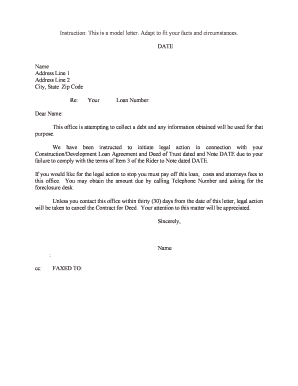
Legal Action Letter
What a Legal Action Letter Is and When it’s Used
Why a Clear, Dated Legal Action Letter Matters
A well‑drafted Legal Action Letter preserves evidence, gives the recipient a defined opportunity to cure or respond, and documents notice for later enforcement or litigation. It creates a clear timeline and reduces ambiguity about obligations and remedies.
Who Typically Prepares and Receives a Legal Action Letter
The Legal Action Letter is used by lawyers, business teams, and individuals seeking to document a claim or trigger contractual remedies.
- Corporate counsel and outside attorneys handling contract disputes and pre‑suit negotiations.
- Small business owners, landlords, and vendors pursuing overdue payments or contract performance.
- Individual claimants and consumer advocates asserting statutory rights or seeking cure before filing.
Stepwise Workflow to Draft and Deliver the Letter
-
01Draft the Notice: Assemble facts, cite contract, and state the remedy.
-
02Set the Deadline: Specify a clear cure or response period in days.
-
03Choose Delivery Method: Pick certified mail, process server, or e‑delivery with proof.
-
04Retain Evidence: Save delivery receipts, signed records, and audit trails.
Where to Send or File a Legal Action Letter
-
Direct to Counterparty: Send to the signatory or contractual notice address on file.
-
Counsel or Registered Agent: Deliver to counsel or the registered agent for corporate defendants.
-
Certified Mail: Use return receipt or restricted delivery for proof of physical delivery.
-
Electronic Delivery: Use an e‑delivery platform that captures timestamped audit trails.
Online Template Settings and Field Configuration
| Field | Configuration |
|---|---|
| Sender Information | Required text field; enforce full legal name |
| Recipient Information | Required text field; validate email and address |
| Demand Amount | Numeric field; currency format |
| Signature | Required eSignature field; capture timestamp |
Delivery and eSubmission Options for Legal Action Letters
Pick a delivery method that provides reproducible proof: physical mail with return receipt, process service, or an electronic signature platform that retains audit logs.
- File Formats: PDF, DOCX
- Authentication: Email, SMS code, or stronger MFA
- Integrations: CRM and document storage
When using an eSignature service, ensure it meets ESIGN/UETA standards and retains a tamper‑evident audit trail and delivery metadata.
Common eSignature Vendor Pricing and Feature Overview
| signNow | DocuSign | Adobe Sign | PandaDoc | HelloSign | |
|---|---|---|---|---|---|
| Starting Price | $8/user/mo | $15/user/mo | $14/user/mo | $19/user/mo | $15/user/mo |
| Free Trial | 7‑day free trial | Varies | Varies | Varies | Varies |
| Bulk Send | Yes | Yes | Yes | Yes | No |
| Audit Trail | Yes | Yes | Yes | Yes | Yes |
| HIPAA Compliant | Yes | Yes | Yes | No | No |
Primary Risks and Penalties from Improper Notices
Common Preparation Errors to Avoid
- Using vague language that fails to state the specific breach, remedy, or contractual clause relied upon, which invites dispute over intent.
- Mismatched party names or incorrect addresses that result in failed service or disputes about who received notice.
- Delivering by an untraceable method without a timestamped audit trail, making it difficult to prove the deadline was triggered.
- Omitting statutory or contractually required notice language, which can forfeit contract remedies or tolling protections.
Real‑world Examples of Digital Notice Workflows
Optica Ventures — COO
Optica digitized routine notices to customers for faster turnaround.
- The process reduced friction for external parties.
- The company found the interface easy to use for both staff and customers and appreciated the consistent record of delivery and execution.
Fertility Centers of Illinois — Founder
The center moved consent and notice letters online to centralize records.
- This ensured consistent formatting and storage.
- Staff reported the API and platform reliability helped maintain compliance and allowed secure access to signed notices when needed for audits or patient inquiries.
Practical Tips for Clear, Enforceable Legal Action Letters
Common Timeline Elements and Deadlines to Include
Demand Response Period:
A specific number of days (commonly 14–30 days) to cure or respond
Effective Date:
Date the letter is sent and from which deadlines are calculated
Method of Delivery Deadline:
Allow extra days for postal delivery when using mail
Reservation of Rights:
State the date litigation may be initiated if no cure within deadline
Record Retention Reminder:
Retain records per retention schedule after delivery
Frequently Asked Questions About Legal Action Letters
-
Is an emailed letter legally binding?
Yes, an emailed Legal Action Letter can be legally effective if it demonstrates intent and attribution; for consumer‑facing records, follow ESIGN disclosure requirements and ensure the sender obtained consent to electronic records (15 U.S.C. §7001). Retain reproducible records.
-
Can I eSign a Legal Action Letter?
Yes. An electronic signature meets ESIGN/UETA tests if signer intent, consent to transact electronically, signer attribution, and reliable record retention are present; stronger authentication reduces later challenges.
-
What if the recipient says they never received it?
Rely on verifiable delivery methods: certified mail return receipt, process server affidavit, or an eSignature platform audit trail showing delivery and access timestamps to rebut non‑receipt claims.
-
Do I need a notary or witness?
Not typically for a Legal Action Letter itself; notarization may help authentication but is not required by ESIGN/UETA for most notices. Some jurisdictions or specific statutory notices may have unique requirements—verify locally.
-
How do I revoke or withdraw a notice?
Send a written revocation using the same verifiable delivery method and retain proof; revocation does not undo actions already taken, and any settlement or withdrawal should be mutually executed and documented.
-
How long should I retain signed copies?
Keep signed letters and delivery evidence for the dispute lifecycle plus applicable legal retention periods—follow IRS, HIPAA, and state rules as applicable to the subject matter.