Testator ID
Full legal name, current address, and date of birth to identify the person executing the will and avoid ambiguity.
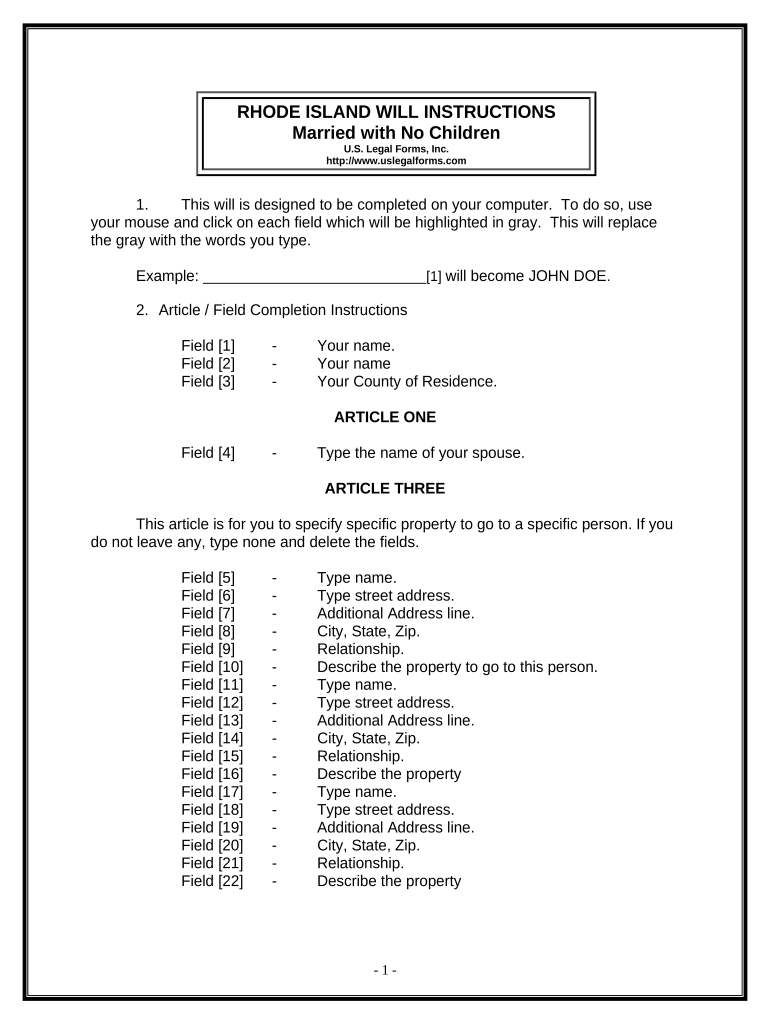
A will designed for married persons clarifies distribution between spouses, handles survivorship scenarios, and reduces disputes after death. It preserves testamentary intent, names an executor, and makes interim estate administration smoother.

The form suits many married testators but does not replace complex estate plans; consult counsel for tax or high-value estates.
Full legal name, current address, and date of birth to identify the person executing the will and avoid ambiguity.
Explicitly revokes prior wills and codicils so earlier testamentary documents do not conflict with the current instrument.
States that the surviving spouse receives the residuary estate or specifies alternate sharing percentages or contingent beneficiaries.
Lists particular gifts of money or property with clear identification of items and beneficiaries to avoid disputes.
Names a primary and, optionally, backup executor with powers to collect assets, pay debts, and file probate documents.
If applicable, nominates guardians for minor children and provides instructions for their care and financial oversight.
| Field | Configuration |
|---|---|
| Document Template | Select the married-person will template to populate spouse-specific clauses |
| Authentication | Flag witness and notary steps; require in-person verification where state law demands |
| Signature Method | Prefer wet-ink signatures and witnesses; note ESIGN exceptions for wills |
| Storage | Save a certified PDF and retain the signed original in a secure location |
When using eSignature platforms for related paperwork, retain the signed original will in physical form and document chain-of-custody for legal certainty.
Sign while of sound mind and competent; avoid coercion or undue influence.
Review after marriage, divorce, birth, death, or significant asset changes.
Attach a notarized affidavit to avoid witness testimony at probate.
Probate filing occurs after death; no pre-death statewide filing requirement.
Consider legal review for complex estates or tax implications.
| Criteria | Last Will (Married Person) | Joint Will | Living Trust |
|---|---|---|---|
| Primary purpose | distribute assets at death | mutual survivor plan | avoid probate |
| Revocability | revocable before death | often irrevocable after death | revocable while settlor alive |
| Probate required | often no | ||
| Typical use case | straightforward estates | simple mutual agreement | probate avoidance and asset management |
The testator is the married individual who creates and signs the will while competent. They must sign the document in the presence of the required number of witnesses to create a valid will under state law.
The executor is the person named to administer the estate after death, responsible for filing probate documents, collecting assets, paying debts, and distributing property according to the will.
A married testator names spouse as primary residue beneficiary and appoints a guardian for minor children
A spouse wants to provide for both current spouse and children from a prior marriage
| signNow | DocuSign | Adobe Sign | PandaDoc | HelloSign | |
|---|---|---|---|---|---|
| Starting Price | $8/user/mo | $15/user/mo | $14/user/mo | $19/user/mo | $15/user/mo |
| Free Trial | 7-day free trial | Varies by plan | Varies by plan | Varies by plan | Varies by plan |
| Bulk Send | Available (Business Premium) | Plan dependent | Plan dependent | Available | Plan dependent |
| Audit Trail | Yes | Yes | Yes | Yes | Yes |
| HIPAA Compliant | Yes | Yes | Yes | No | No |
| Envelope Cap | No cap | 100 envelopes/user/year | Varies by plan | Varies by plan | Varies by plan |