Establishing secure connection…Loading editor…Preparing document…

Louisiana Judgment Satisfaction Letter

This template is fully customizable. Edit the text, fill out the fields, and send it for signature. Give it a try!
Louisiana Judgment Satisfaction Letter

What a Louisiana Judgment Satisfaction Letter Is

A Louisiana Judgment Satisfaction Letter is a written instrument that records the creditor's acknowledgment that a court judgment has been paid, settled, or otherwise satisfied in full or in part. It serves as proof for the debtor and third parties that the judgment lien should be released or that credit reporting and public records be updated. In Louisiana's civil-law system, the satisfaction document is often used to remove a judgment from property records or to support a motion to cancel or amend a judgment docket entry.

Why a Proper Satisfaction Letter Matters

A clear, correctly executed satisfaction letter protects the debtor's credit and property rights, prevents duplicate collection activity, and creates a retrievable record for courts, registries, and lenders.

Why a Proper Satisfaction Letter Matters

Who Typically Prepares or Receives This Letter

Legal and financial professionals commonly prepare or request satisfaction letters when a judgment balance has been resolved.

  • Creditor or creditor's attorney — prepares and signs the satisfaction letter following payment or settlement.
  • Debtor or debtor's counsel — requests the letter to clear public records and credit reports.
  • Clerk of Court or title examiner — uses the letter to update docket and property records.

Each party should retain a signed copy as evidence; consider notarization or electronic notarization where permitted.

Core Parts of a Professional Satisfaction Letter

A well-structured satisfaction letter includes essential identification, transactional details, and clear signature and filing instructions so that third parties can act on it efficiently.

Caption

Court name, docket/case number, and parties' names as shown on the judgment.
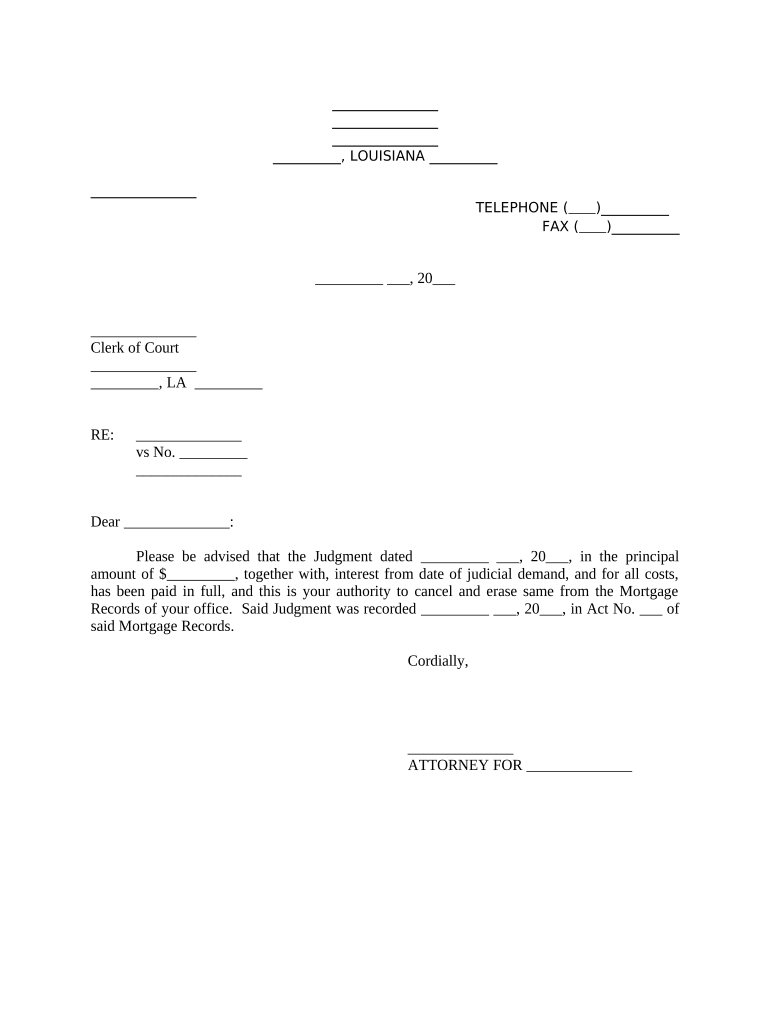
Satisfaction Statement

A concise sentence stating the judgment is paid, released, or partially satisfied, with any residual balance noted.

Payment Details

Date of payment, method, amount applied, and reference to receipt or agreement.

Effect Date

Date when the judgment was considered satisfied for recordkeeping and enforcement purposes.

Signature Block

Name, title, firm or company, printed name, signature and date of the authorized signer.

Filing Instructions

Where to record, any notary or witness needs, and distribution list for parties and registries.

Step-by-Step: Preparing and Filing the Letter

Follow these steps to prepare, sign, and submit a Louisiana judgment satisfaction so the court, registry, and relevant third parties update records.

  • 01
    1. Verify Judgment: Confirm docket number, judgment amount, and parties on the official court records.
  • 02
    2. Draft Letter: Populate caption, payment details, and satisfaction declaration using exact docket language.
  • 03
    3. Obtain Authorization: Have creditor or authorized attorney sign; notarize if required by recipient.
  • 04
    4. File and Distribute: Record with the court clerk, send copies to the debtor and title examiners as needed.

Where to Send and How the Process Flows

The satisfaction letter follows a short routing path from signer to court and interested third parties; each recipient updates its records on receipt.

  • Signer to Clerk: Deliver the signed letter to the court clerk for docketing and record annotation.
  • Clerk to Registry: Clerk may record the satisfaction on the judgment docket and send notice to registries.
  • Send to Debtor: Provide the debtor a signed copy for credit reporting and title matters.
  • Title Examiner: Title companies use the letter to clear liens on property searches and closings.

Digital Signing and eFiling Considerations

Electronic signing and eSubmission can accelerate processing if the court or registry accepts e-filed satisfaction instruments.

  • Accepted Formats: PDF or PDF/A files for court submission and recording.
  • Authentication: Email link, SMS code, or stronger identity verification for signer attribution.
  • Integrations: Connectors to cloud storage and court e-filing systems like PACER or state eFile where supported.

Confirm local clerk policies before e-submitting; preserve an audit trail and retain original signed or notarized copies per retention rules.

How to Customize an Online Satisfaction Letter Workflow

Configure an eSignature workflow that reflects the required signers, authentication level, and filing destinations to reduce rejections.

Field Configuration
Signer Order Creditor first, then notary (if required), then debtor copy
Authentication Email + SMS code or stronger as needed
Attachments Include proof of payment or receipt reference
Delivery Auto-send signed PDF to clerk and parties

Comparing eSignature Providers for Satisfaction Letters

Basic feature and price differences among common eSignature vendors to help select a platform that supports notarization, audit trails, and secure storage.

signNow DocuSign Adobe Sign PandaDoc HelloSign
Starting Price $8/user/mo $15/user/mo $14/user/mo $19/user/mo $15/user/mo
Free Trial 7-day free trial Yes, varies Yes, varies Yes, varies Yes, varies
Bulk Send Yes Yes Yes Yes No
Audit Trail Yes Yes Yes Yes Yes
HIPAA Compliant Yes Yes Yes No No

Required Information Elements at a Glance

Debtor Name: Full legal name
Creditor Name: Full legal or business name
Docket Number: Exact court case number
Payment Date: MM/DD/YYYY
Amount: Numeric and words
Signature: Authorized signer and date

Risks of an Incorrect or Missing Satisfaction Letter

Continued Liens: Judgment lien may remain enforceable
Title Delays: Real estate closings can be postponed
Credit Impact: Debtor credit reports may remain adverse
Duplicate Collections: Creditor actions could continue unnecessarily
Court Rejection: Clerk may refuse improper forms
Disputes: Creates grounds for costly litigation

Common Errors to Avoid When Preparing the Letter

  • Using an incorrect docket number or party name that does not match court records.
  • Failing to specify whether the satisfaction is full or partial, causing ambiguity.
  • Omitting signature authority or notary acknowledgement when required.
  • Not distributing copies to required parties, including the clerk and debtor.

Practical Tips for Accurate and Efficient Completion

Apply these best practices to reduce rejection risk and speed record updates across courts and title services.

Match Official Records
Confirm all names, docket numbers, and amounts directly from the court docket before drafting.
Be Explicit
State clearly whether satisfaction is full or partial and reference any related settlement agreement.
Preserve Audit Trail
Retain signed copies, proof of payment, and any notarization or RON evidence for future disputes.
Notify Interested Parties
Send the clerk, debtor, and title companies signed copies to speed downstream processing.

Real-World Uses of Judgment Satisfaction Letters

Examples illustrate typical scenarios where a satisfaction letter resolves title, credit, or enforcement issues.

Real Estate Closing

A debtor cleared a judgment before sale

  • Title company required proof
  • The signed satisfaction removed a lien and allowed closing to proceed without delay.

Bank Loan Release

Creditor accepted partial payment under settlement

  • Parties executed a conditional satisfaction
  • The document supported release of the bank's claim after final payment schedule completion.

Timelines and Expected Processing for Satisfaction Letters

Understand typical timeframes from execution to docket update so parties set realistic expectations and follow up effectively.

Execution to Filing:

1–7 business days depending on signer and notary availability

Clerk Docketing:

2–14 business days depending on parish workload

Title Clearing:

Variable — immediate to several weeks after recording

Credit Reporting:

30–60 days after documentation submitted to bureaus

RON Record Retention:

Audio-video and logs typically retained 5–10 years where permitted

Key Milestones from Payment to Public Record Update

Sequential milestones track the satisfaction from payment through public record changes.

01

Payment Posted

Creditor records payment and generates receipt documentation

02

Draft Satisfaction

Prepare letter referencing docket number and payment details

03

Sign and Notarize

Authorized signer signs; notarize or use RON if court accepts

04

File and Distribute

Submit to clerk, send copies to debtor and title examiners

Who Can Sign the Satisfaction Letter

Creditor Representative

An authorized officer, collections manager, or attorney for the creditor may sign the satisfaction letter. Confirm that the signer is listed in corporate records or has written authorization to bind the creditor.

Attorney of Record

The creditor's counsel may sign or file the satisfaction on behalf of the creditor. Include the attorney's contact information and bar number where appropriate for verification.

Frequently Asked Questions and Troubleshooting

Answers to common questions about validity, notarization, e-signing, and what to do if the clerk rejects a submission.


Need help? Contact support

be ready to get more
Join over 28 million airSlate SignNow users