Establishing secure connection…Loading editor…Preparing document…

Letter of Termination of Legal Representation

This template is fully customizable. Edit the text, fill out the fields, and send it for signature. Give it a try!
Letter of Termination of Legal Representation

What a Letter of Termination of Legal Representation Is

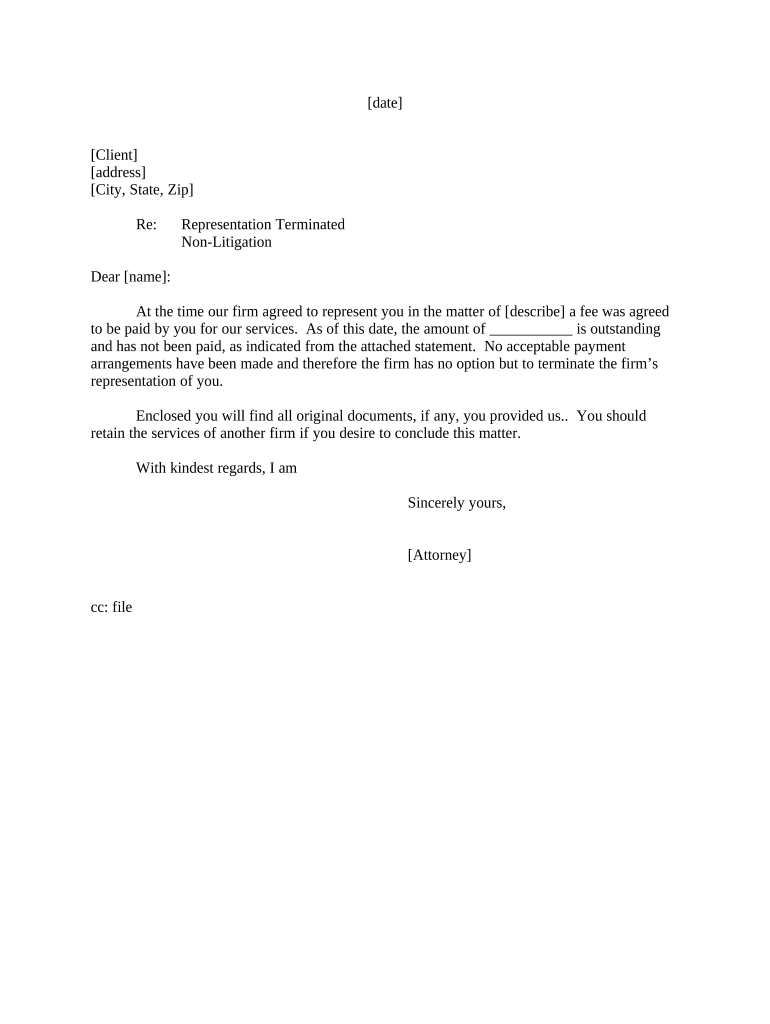
A Letter of Termination of Legal Representation is a formal written notice from either a client or an attorney that ends the attorney-client relationship for a specific matter. The letter states the effective date of termination, identifies the case or file by client name and case number, and sets out instructions for transfer or return of files and retention of records. In many situations the letter protects client rights, clarifies outstanding fees, and documents the parties’ intent; it can be delivered electronically or on paper under ESIGN (15 U.S.C. §7001) and UETA where applicable.

Why a Clear Termination Letter Matters

A concise termination letter reduces confusion, preserves privilege where appropriate, records effective date and outstanding obligations, and creates a documented trail for administrative or court needs. It helps both parties move forward with clarity about file transfer, final billing, and future communications.

Why a Clear Termination Letter Matters

Who Typically Prepares and Receives This Letter

Each recipient has different responsibilities on receipt: clients arrange new counsel and file transfers; attorneys finalize billing and preserve records; courts or opposing counsel act only when engaged by the case rules.

  • Client — individual or organization ending counsel and requesting file transfer or closure.
  • Attorney or law firm — withdrawing from a matter and informing the client and other stakeholders.
  • Opposing counsel or court clerk — when court notice or formal filing is required.

Representative Signatories and Their Roles

Individual Client

A private person who instructs termination, requests files, and confirms final invoices. The client must provide clear contact details and sign to authorize file transfer or new counsel communication.

Managing Attorney

An attorney or firm administrator who issues the withdrawal letter, documents the effective date, lists retained documents, and provides instructions for retrieving client files and closing the matter.

Essential Information to Include in the Letter

Client Full Name: Exact legal name as on ID
Attorney Name: Full attorney or firm name
Case Number: Court or internal matter ID
Effective Date: MM/DD/YYYY format
File Transfer Instructions: Return or send-to contact and method
Signature Block: Typed or handwritten signature and date

Risks and Legal Consequences of a Poorly Drafted Letter

Missed Deadlines: Court deadlines may be missed
Privilege Loss: Improper disclosure can waive privilege
Fee Disputes: Final billing misunderstandings may arise
Malpractice Exposure: Incomplete transition may raise claims
Court Rejection: Court may not accept inadequate notice
Service Failures: Failure to notify parties properly

Common Preparation Mistakes to Avoid

  • Using vague language about timing or scope that leaves unclear which matters are terminated and which remain open.
  • Failing to inventory or identify client files and outstanding work, causing disputes over what was transferred.
  • Neglecting to state billing or retainers status, which leads to unexpected final invoices or collection issues.
  • Assuming electronic delivery suffices without confirming consent or proof of receipt, especially when court rules require service.

Step-by-Step: How to Complete the Termination Letter

Follow these steps to create a clear, enforceable letter that documents termination and next steps.

  • 01
    Identify Parties: List client, attorney, and firm with contact details
  • 02
    Specify Matter: State case number and scope of representation
  • 03
    State Effective Date: Use MM/DD/YYYY and any transition period
  • 04
    Provide Instructions: Describe file transfer, billing, and post-termination contact

How to Configure an Online Termination Letter Workflow

Set up a repeatable digital workflow to generate, approve, and deliver termination letters securely.

Template Name Termination Letter Template
Authentication Email link or SMS code for signer identity
Approval Flow Attorney review before sending
Delivery Method Send via secure PDF or certified email
Retention Policy Automated archival for X years

Where to Send and How the Process Works

A termination letter can be delivered to different recipients depending on the matter; choose the method that creates reliable proof of delivery.

  • Client Delivery: Send directly to client and confirm receipt
  • Court Filing: File notice if court rules or orders require it
  • Opposing Counsel: Send copy when case context requires notice
  • File Transfer: Provide instructions for transfer to successor counsel

Digital Signing and Technical Requirements

For healthcare or sensitive matters, use platforms that support HIPAA (BAA) and audit trails; retain signed copies and event logs for compliance.

  • File Formats: PDF and DOCX are standard and preserve formatting
  • Authentication: Email link, SMS code, or stronger ID verification
  • Integrations: Connect to document management and case systems

Typical Timelines and Deadlines to Track

Plan timing carefully to preserve rights and give counterparties sufficient notice.

Notice Effective Date:

State effective date clearly; immediate or after a short transition period

File Transfer Window:

Allow reasonable time (usually 10–30 days) for file retrieval or delivery

Final Invoice Issuance:

Issue final billing within 30 days of termination

Court Notification:

File a notice of withdrawal if required by local rules immediately

Dispute Period:

Retain documentation for at least the statutory dispute period

Practical Tips for an Accurate, Defensible Letter

Use plain language, document decisions, and preserve evidence of delivery to reduce future disputes.

Be Specific About Scope
Clearly state which matters are ending and which, if any, continue; ambiguity about scopes causes later disagreement and potential malpractice exposure.
Document File Inventory
Attach or reference an inventory of physical and electronic files, including dates and formats, to avoid confusion about what is transferred or retained.
Confirm Receipt
Use a method that yields proof of delivery—registered or certified mail, email read receipts, or documented eSignature workflows—to show the client and other recipients received notice.
Preserve Privilege
Avoid disclosing privileged communications in the letter; if file transfer involves third parties, ensure authorization is in writing.

Representative Scenarios Where a Termination Letter Applies

These scenarios illustrate common reasons and practical outcomes when representation ends.

Civil Litigation Transition

A client hires new counsel mid-litigation

  • successor counsel requests file transfer
  • the withdrawing attorney issues a dated termination letter, provides a file inventory, and confirms court notice steps to preserve continuity and deadlines.

Fee Dispute Withdrawal

An attorney withdraws after unresolved fee disputes

  • attorney states effective date and final billing terms
  • the letter documents the outstanding balance, explains file hold procedures, and alerts the client to retain new counsel or request records.

Comparing eSignature Platforms for Sending Termination Letters

Basic vendor differences influence cost, compliance, and bulk delivery capabilities when sending termination letters or transferring client files electronically.

signNow DocuSign Adobe Sign PandaDoc HelloSign
Starting Price $8/user/mo $15/user/mo $14/user/mo $19/user/mo $15/user/mo
Free Trial 7-day free trial Varies by plan Varies by plan Varies by plan Varies by plan
Bulk Send Yes (plan dependent) Yes (plan dependent) Yes (plan dependent) Yes (plan dependent) Varies
Audit Trail Yes Yes Yes Yes Yes
HIPAA Compliant Yes Yes Yes No No

FAQs: Common Questions About Terminating Legal Representation

Answers to frequent practical and legal questions about drafting, delivering, and enforcing a termination letter.


Need help? Contact support

be ready to get more
Join over 28 million airSlate SignNow users