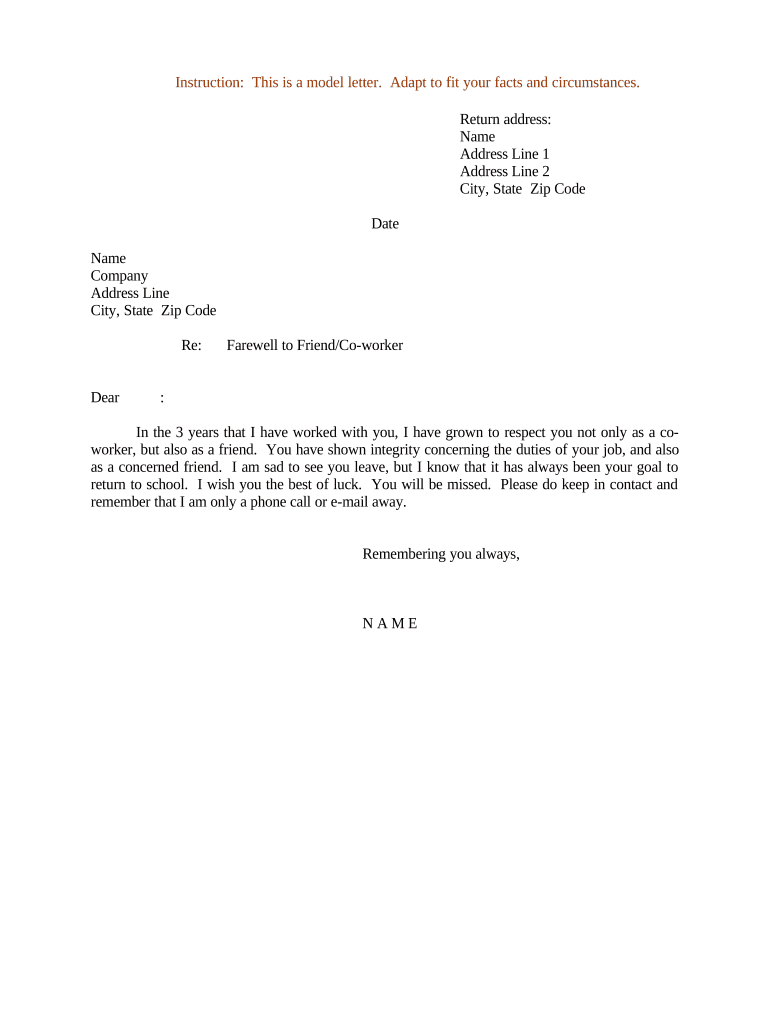
Letter of Farewell to Friend/Co-worker
What a Letter of Farewell to Friend/Co-worker Is
Why a Farewell Letter Matters
Writing a Letter of Farewell to Friend/Co-worker helps close professional relationships, communicates final logistics, and preserves goodwill. It creates a concise record of departure-related details for teammates and provides an opportunity to thank collaborators while directing contacts or next steps.
Who Typically Writes and Receives Farewell Letters
Common users of a Letter of Farewell to Friend/Co-worker include colleagues, team leads, HR representatives, and departing employees.
- Individual employee announcing departure and sharing contact details with colleagues.
- Managers sending team-focused farewell with handover notes and next steps.
- HR or internal communications posting a standard farewell on behalf of staff.
Typical Sender Profiles
Alex Morgan, Team Lead
Alex drafts a concise farewell noting last day, handover contact, and appreciation for team contributions. Message balances personal thanks with professional next steps, and is shared via email and the team messaging channel to ensure broad visibility.
Jamie Lee, HR Coordinator
Jamie prepares a standard farewell template to ensure consistency, confirms optional privacy choices, and advises managers on including contact preferences. HR archives the final message with personnel records when appropriate under company policy.
Potential Risks When Preparing a Farewell Letter
Common Preparation Mistakes to Avoid
- Writing overly personal content that is inappropriate for a broad workplace audience and may create discomfort among team members.
- Omitting logistical details such as final date, handover contacts, or preferred future communication channels, which complicates transitional tasks.
- Using inconsistent distribution methods that leave some stakeholders uninformed; choose email, team chat, or HR channel depending on audience.
- Including confidential performance feedback or sensitive personnel information that should remain in HR files and not in a public letter.
Step-by-Step: Prepare and Send a Farewell Letter
-
01Draft: Write a concise message with gratitude and final logistics.
-
02Review: Check for sensitive content and company policy compliance.
-
03Choose Channel: Select email, private message, or team announcement.
-
04Send: Distribute to intended recipients and archive a copy.
Where and How Farewell Letters Are Routed
-
Direct Email: Send to immediate team and personal contacts.
-
Team Channel: Post in group chat for broader visibility.
-
HR Copy: Provide a copy to HR for personnel records.
-
One-on-One: Share privately with mentors or key collaborators.
Setting Up a Digital Farewell Template
| Field | Configuration |
|---|---|
| Template Name | Create consistent subject and body for repeat use. |
| Required Fields | Mark last day, contact, and handover fields required. |
| Signer Options | Allow sender signature and optional recipient comments. |
| Delivery | Select email, Slack, or internal portal distribution. |
Platform Requirements for Digital Distribution
Delivering a Letter of Farewell to Friend/Co-worker digitally requires minimal platform capabilities for composition and controlled distribution.
- Supported Formats: PDF and DOCX for consistent layout
- Integrations: Connects with Google Workspace and Microsoft 365
- Access: Mobile and desktop access with offline editing
Key Milestones and Processing Stages
Draft Complete
Finalize message, proofread, and confirm logistics.
Manager Review
Manager or HR reviews for policy compliance.
Send/Publish
Distribute via chosen channels to intended recipients.
Archive Record
Save copy in HR personnel file and backup storage.
How a Farewell Letter Differs from Formal Notices
| Document Type | Farewell Letter | Resignation Letter |
|---|---|---|
| Purpose | express thanks | official notice |
| Tone | informal or professional | formal |
| Legal Effect | none | may trigger hr action |
| Required Signers | optional | employee signature required |
eSignature Vendor Overview for Farewell Letters
| signNow | DocuSign | Adobe Sign | PandaDoc | HelloSign | |
|---|---|---|---|---|---|
| Starting Price | $8/user/mo | $15/user/mo | $14/user/mo | $19/user/mo | $15/user/mo |
| Free Trial | 7-day free trial | Varies by plan | Varies by plan | Varies by plan | Varies by plan |
| Bulk Send | Yes | Yes | Yes | Yes | No |
| Audit Trail | Yes | Yes | Yes | Yes | Yes |
| HIPAA Compliant | Yes | Yes | Yes | No | No |
Frequently Asked Questions About Farewell Letters
-
Can a farewell letter be e-signed?
Yes. Under the ESIGN Act (15 U.S.C. §7001) and UETA, electronic signatures are legally valid when intent, consent, attribution, and record retention are satisfied. For farewell letters used only as social notices, a basic e-signature or typed name is typically sufficient.
-
Should I get HR approval first?
Check company policy. Many organizations require HR review for departure communications to ensure compliance with privacy, nondisparagement, and ongoing contact preferences. If the message references handover tasks or proprietary information, obtain manager and HR sign-off before distribution.
-
What content should I avoid including?
Avoid confidential personnel evaluations, client matters, medical or disciplinary information, and any statements that could be construed as defamatory. Keep tone professional; consult HR before discussing compensation, performance issues, or pending legal matters.
-
How long should I keep copies?
Retention varies by company policy. For general administrative records, retain copies for at least one year; if the letter relates to employment actions or contains financial information, retain per IRS guidance (IRC §6501(a)) for three years or as required.
-
Is notarization required or recommended?
Not typically required for farewell letters. Notarization may be useful if the letter documents an agreed transition or serves as evidence in a dispute; notarization and remote online notarization follow state rules and fees if used.
-
What are best distribution practices?
Select appropriate channels for audience — private email for individual notes, team channels for general announcements, and HR or manager circulation for formal notices. Archive a copy in HR files and ensure privacy settings match the intended recipient list.