Establishing secure connection…Loading editor…Preparing document…

Letter of Confirmation of Employment

This template is fully customizable. Edit the text, fill out the fields, and send it for signature. Give it a try!
Letter of Confirmation of Employment

What a Letter of Confirmation of Employment Is

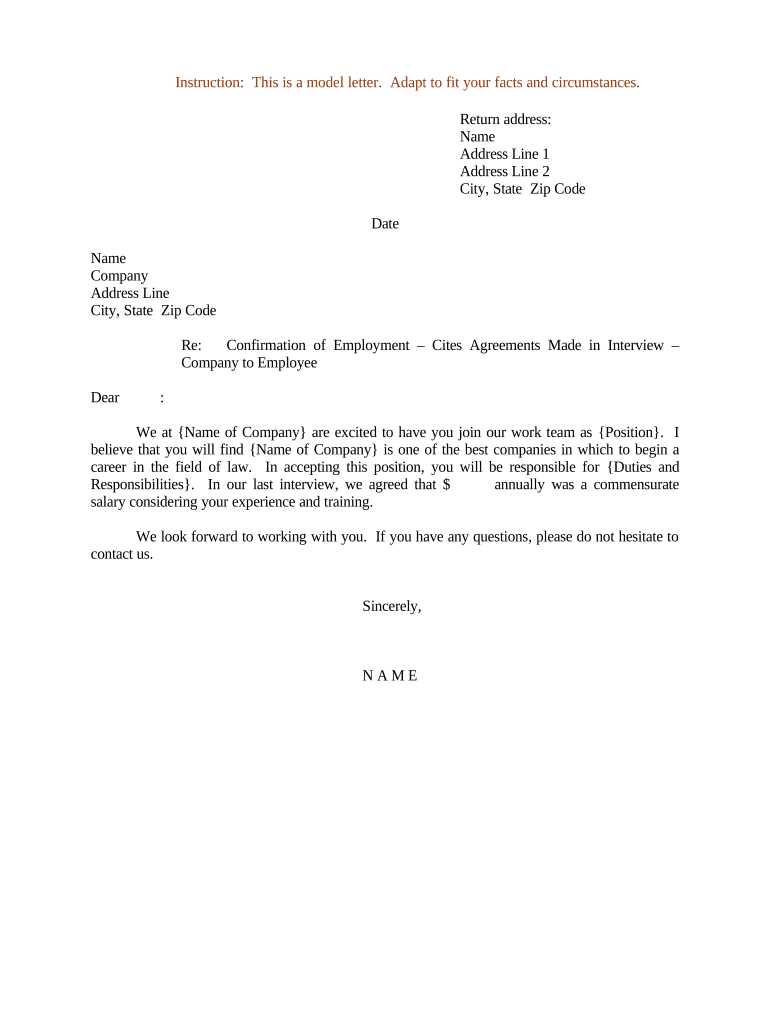
A Letter of Confirmation of Employment is a written statement from an employer verifying an individual's job title, employment status, start date, compensation, and other employment facts requested by a third party. Employers typically issue this document in response to mortgage, lease, visa, or background-check requests. The letter can be on company letterhead, signed by an authorized representative, and delivered as a physical copy or electronically. When used electronically, the letter must meet ESIGN and applicable state e-signature rules to be admissible as a valid record in interstate transactions.

Why this Letter Matters to Employers and Recipients

A clear, accurate Letter of Confirmation of Employment accelerates reviews by lenders, landlords, and government agencies by providing verifiable employment facts. It reduces follow-up requests, supports eligibility checks, and documents employment history for administrative or legal processes.

Why this Letter Matters to Employers and Recipients

Who Requests and Issues Employment Confirmation Letters

The letter supports multiple decision points; prepare it with accurate, current facts and clear signatory authority to avoid delays.

  • Lenders and mortgage underwriters requesting employment and income verification for loan approval.
  • HR or payroll teams issuing verification at employee or third-party request.
  • Immigration attorneys or agencies needing employment evidence for petitions and applications.

Core Elements to Include for a Professional Letter

A well-structured Letter of Confirmation of Employment is concise, factual, and includes verifiable contact and signature information to satisfy third-party reviewers.

Company Header

Use official letterhead or include the company name, address, phone number, and corporate email to show provenance of the verification and enable follow-up.
Employee Identity

Include the employee's full legal name, preferred name if different, and any employee or payroll ID to ensure the verifier can match records without ambiguity.

Employment Dates

State the hire date and, if applicable, the current employment status and any end date. Use MM/DD/YYYY format for clarity and legal consistency.

Job Details

Specify the employee's job title, primary duties in brief, and whether the position is full-time, part-time, exempt, or nonexempt for payroll or benefits context.

Compensation

Provide base salary or hourly rate and pay frequency. If requested, include year-to-date earnings or bonus structure with a statement of accuracy.

Authorized Signature

Include the name, title, and contact information of the person signing. Signed letters should identify signatory authority and, where required, include notarization or electronic signature metadata.

Essential Data Points to Verify Before Sending

Full Name: Exact as government ID
Hire Date: MM/DD/YYYY format
Job Title: Official current title
Employment Status: Full-time/part-time
Compensation: Salary or hourly rate
Signatory Info: Name, title, contact

How to Complete a Letter of Confirmation of Employment

Follow a short, repeatable sequence to produce an accurate, verifiable letter suitable for electronic delivery or paper printing.

  • 01
    Gather Records: Collect HR/payroll verification and approval.
  • 02
    Draft Letter: Use company template and fill fields.
  • 03
    Authorize Signatory: Have an authorized manager or HR sign.
  • 04
    Deliver Securely: Send via secure email or certified eSignature.

Configuring an Online Workflow for Employment Confirmations

Set up an efficient digital process to standardize letters, reduce errors, and capture an electronic audit trail for each issuance.

Field Configuration
Template Create a reusable template with locked mandatory fields
Signers Assign HR manager role and alternate approver
Authentication Enable email and optional SMS code for signer validation
Audit Trail Capture timestamps, IPs, and signer metadata

Typical Routing and Submission Steps

A reliable submission flow keeps the document traceable and reduces turnaround time for third-party verifications.

  • Initiate Request: HR or manager opens template and populates fields
  • Approve internally: Designated approver confirms accuracy
  • Sign and certify: Authorized signatory applies signature
  • Send to requester: Deliver signed letter with audit evidence

Digital Signing and File Format Considerations

Use a system that keeps the signed file and audit record together and can export a tamper-evident PDF for recipients and retention.

  • File Types: PDF or DOCX preferred for compatibility
  • Audit Trail: Timestamp, IP, and signer data required
  • Authentication: Email, SMS, or stronger methods

Timelines and Processing Expectations

Turnaround depends on internal approvals and requestor deadlines; plan ahead when letters support time-sensitive processes like loan closings or immigration filings.

Internal SLA:

2–5 business days typical for HR-issued confirmations

Lender Deadlines:

Provide letter aligned to loan underwriting schedules

Immigration Filings:

Issue prior to submission where employment evidence is required

Expedited Requests:

Same-day possible with manager approval

Record Retention:

Keep issuance record per retention rules

Common Mistakes to Avoid

  • Using informal job titles or abbreviations that do not match payroll records, causing verification failures and delays.
  • Omitting signatory contact details or failing to show the signatory's job title and authority to sign on the employer's behalf.
  • Providing approximate salary descriptions instead of precise figures and pay frequency, which triggers follow-up and potential reissuance.
  • Sending unsecured attachments or failing to preserve an audit trail when electronically signed, which can reduce evidentiary value.

Risks from Inaccurate or Misleading Letters

Verification Delays: Can postpone loans or leases
Regulatory Exposure: False statements may create liability
Immigration Impact: Incorrect letters may affect petitions
Employment Disputes: Conflicting records can trigger audits
Privacy Breach: Unauthorized data sharing risks HIPAA/FERPA
Reputational Harm: Repeated errors reduce trust

Real-World Examples of Employment Confirmation Use

Practical examples show how organizations use standardized letters to reduce processing time and preserve compliance.

Martin Properties — Real Estate

A property management company standardized employment letters to meet lender requests and speed approvals.

  • The template included salary, hire date, and an HR contact.
  • Tim Martin, Founder, noted that processing and executing documents online maintained compliance and improved turnaround for tenants and lenders alike.

Fertility Centers of Illinois — Healthcare

A healthcare provider used signed electronic confirmations for staff credentialing and benefits verification.

  • The approach combined secure templates with audit trails.
  • John Butler, Founder, praised the platform's responsiveness and compliance features when exchanging sensitive administrative documents.

Quick eSignature Pricing and Feature Snapshot for Employment Letters

Compare common pricing and capability criteria for platforms frequently used to sign and distribute employment confirmation letters; signNow is listed first per vendor comparison conventions.

signNow DocuSign Adobe Sign PandaDoc HelloSign
Starting Price $8/user/mo $15/user/mo $14/user/mo $19/user/mo $15/user/mo
Free Trial 7-day free trial Varies by vendor Varies by vendor Varies by vendor Varies by vendor
Bulk Send Yes Yes Yes Yes No
Audit Trail Yes Yes Yes Yes Yes
HIPAA Compliant Yes Yes Yes No No

Best Practices for Accurate, Acceptable Employment Confirmation Letters

Follow standard controls and documentation practices to maintain consistency, privacy, and acceptance by third parties.

Use a Standard Template
Maintain an approved company template that includes mandatory fields, reduces free-text variance, and shortens review times while ensuring consistent content for third-party acceptance.
Limit Sensitive Details
Avoid disclosing medical or other protected information unless explicitly authorized by the employee in writing; follow HIPAA and company privacy policies.
Retain Audit Records
Store the signed document plus the associated audit trail and metadata so you can reproduce who signed, when, and by what method if later questioned.
Confirm Signatory Authority
Ensure the signer is authorized by policy to make employment verifications, and document that authority in HR procedures to prevent disputes.

Frequently Asked Questions About Employment Confirmation Letters

Answers to common questions about acceptance, electronic signatures, notarization, and verification practices for Letters of Confirmation of Employment.


Need help? Contact support

be ready to get more
Join over 28 million airSlate SignNow users