Establishing secure connection…Loading editor…Preparing document…

Letter Regarding Notice of Deposition

This template is fully customizable. Edit the text, fill out the fields, and send it for signature. Give it a try!
Letter Regarding Notice of Deposition

What a Letter Regarding Notice of Deposition Is and when it’s used

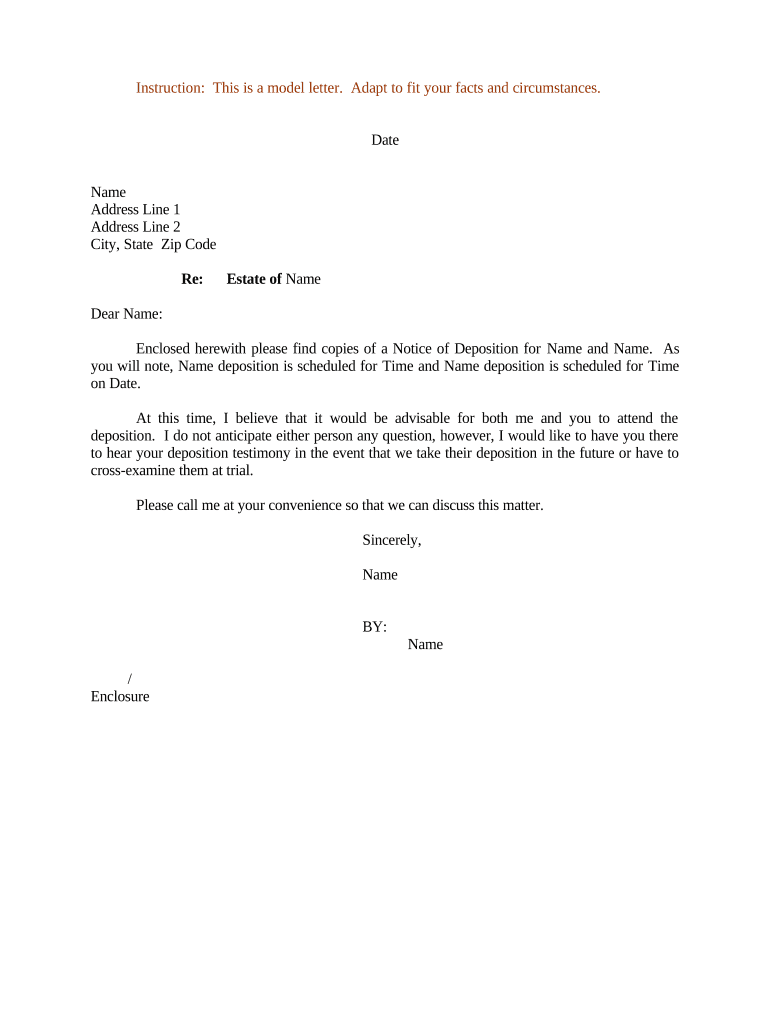
A Letter Regarding Notice of Deposition is a formal written notice used in civil litigation to inform a party or witness of a scheduled deposition. It states the case caption, the deponent’s name, the date, time, and location of the deposition, and any documents the deponent must bring. The notice can alert opposing counsel, third parties, or organizations and typically accompanies or follows a deposition subpoena when enforceable production or attendance is required. The document creates a clear record of the notice and is used to avoid disputes over timing, scope, and service method during discovery.

Why a clear deposition notice letter matters

A well-drafted letter clarifies logistics, documents scope, and preserves procedural rights; it reduces discovery disputes and gives the recipient required information for compliance under discovery rules.

Why a clear deposition notice letter matters

Who typically prepares or receives this letter

Recipients include opposing counsel and the deponent; accurate distribution records support motions to compel, motions for protective order, or sanctions hearings if compliance becomes contested.

  • Plaintiff or defense counsel — Issues notices, coordinates exhibits, and documents service for the record.
  • In-house legal teams — Issues notices for employee or corporate witness testimony and coordinates preservation holds.
  • Third-party witnesses or custodians — Receive notices and prepare responsive documents and availability information.

Essential elements to include in the letter

A professional notice letter contains a concise case caption, clear deposition logistics, exhibit and document requests, service details, and compliance language referencing applicable discovery rules.

Case Caption

Full court caption, docket number, and captioning that matches underlying case documents to avoid administrative confusion or misfiling.
Deponent Details

Full legal name, role or title, employer (if applicable), and any identifying information needed to confirm the intended witness.

Logistics

Specific date, start time, expected duration, physical or virtual location, and details for remote access or dial-in credentials when applicable.

Documents Requested

Clear exhibit list or categories of documents the deponent must bring, with format expectations and any authentication instructions.

Service Instructions

How the notice was or will be served (email, certified mail, process server), including address and contact for proof of service.

Compliance Note

Reference to governing discovery rules or local court rules and any instructions regarding confidentiality, redaction, or privilege assertions.

Required information to populate the letter

Docket Number: Exact case number
Court Name: Presiding court
Deponent Name: Full legal name
Date and Time: MM/DD/YYYY and time
Location: Address or virtual link
Service Method: How notice served

Step-by-step: preparing the notice letter

Follow a short checklist to create a defensible, complete deposition notice letter that aligns with local rules and preserves proof of service.

  • 01
    1. Confirm case details: Verify caption, docket number, and court.
  • 02
    2. Identify deponent: Use full legal name and employer information.
  • 03
    3. State logistics: Specify date, time, and location precisely.
  • 04
    4. Specify documents: List required exhibits or categories clearly.

Configuring a digital workflow for notices

When creating and sending the letter electronically, configure fields and authentication to create a reliable audit trail and proof of delivery.

Field Configuration
Notification method Email + delivery receipt
Authentication Email token or SMS code
Attachments allowed PDF exhibits; combined ZIP optional
Retention Preserve signed notice and audit log

Where to send and how distribution typically works

Deliver the notice to every party and the deponent using methods that meet local rules and create verifiable proof of service.

  • Opposing Counsel: Send to counsel of record with proof of service.
  • Deponent: Deliver directly to witness or company representative.
  • Court Clerk: File only if local rules require filing a notice.
  • Third Parties: Use subpoenas or third-party service procedures as applicable.

Technical considerations for electronic delivery and signature

Use platforms that support exportable audit logs and durable copies to preserve evidence of service and access in case of discovery disputes.

  • File formats: PDF, DOCX supported
  • Integrations: CRM and cloud storage
  • Authentication: Email or SMS tokens

Timing and scheduling considerations

Timing requirements for deposition notices are governed by local rules and the Federal Rules of Civil Procedure; confirm applicable local deadlines and allow reasonable notice for the deponent.

Federal Rule:

FRCP 30(b)(1) requires reasonable notice

Local court rules:

Check district or state rules

Scheduling buffer:

Allow time for counsel to prepare

Subpoena timing:

Service and response varies by rule

Document lead time:

Request documents with adequate notice

Common mistakes to avoid when preparing a deposition notice letter

  • Sending incomplete case information that mismatches the docket and creates confusion at filing or service.
  • Failing to describe requested documents with sufficient specificity, causing disputes over relevance and scope.
  • Using informal service methods without preserving proof of delivery or failing to follow service rules.
  • Overlooking local court or state requirements for electronic service, resulting in invalid or contested service.

Potential consequences of improper or late notice

Sanctions: Court may impose fines or costs
Motion to Quash: Deponent may seek protective order
Contempt: Failure to obey valid subpoena
Excluded testimony: Court may limit evidence
Cost-shifting: Prevailing party may recover fees
Delay: Proceedings and deadlines can be extended

Typical eSignature vendor pricing and feature snapshot for deposition notices

Compare starting price and core capabilities relevant to sending, signing, and storing deposition notices; signNow is listed first for vendor comparison.

signNow DocuSign Adobe Sign PandaDoc HelloSign
Starting Price $8/user/mo $15/user/mo $14/user/mo $19/user/mo $15/user/mo
Free Trial 7-day free trial Varies Varies Yes, limited Yes, limited
Bulk Send Yes Yes Yes Yes No
Audit Trail Yes Yes Yes Yes Yes
HIPAA Compliant Yes Yes Yes No No

Real-world examples of deposition notice workflows

Examples show how teams use template letters and secure delivery to manage witnesses and documents efficiently.

Optica Ventures

Optica needed a repeatable notice process for investor-related depositions

  • They standardized a template and service log
  • The result improved scheduling consistency and reduced follow-up calls while preserving a clear audit trail for discovery.

Martin Properties

A regional property manager coordinated employee and broker testimony across multiple states

  • They used a single notice template with attachable exhibits
  • Centralized notices reduced local-rule errors and made preparing for depositions faster and more consistent.

Frequently asked questions about the Letter Regarding Notice of Deposition

Answers to practical questions about drafting, serving, and preserving deposition notice letters, with guidance on recordkeeping and electronic delivery.


Need help? Contact support

be ready to get more
Join over 28 million airSlate SignNow users