Letter Declining Monetary Gift
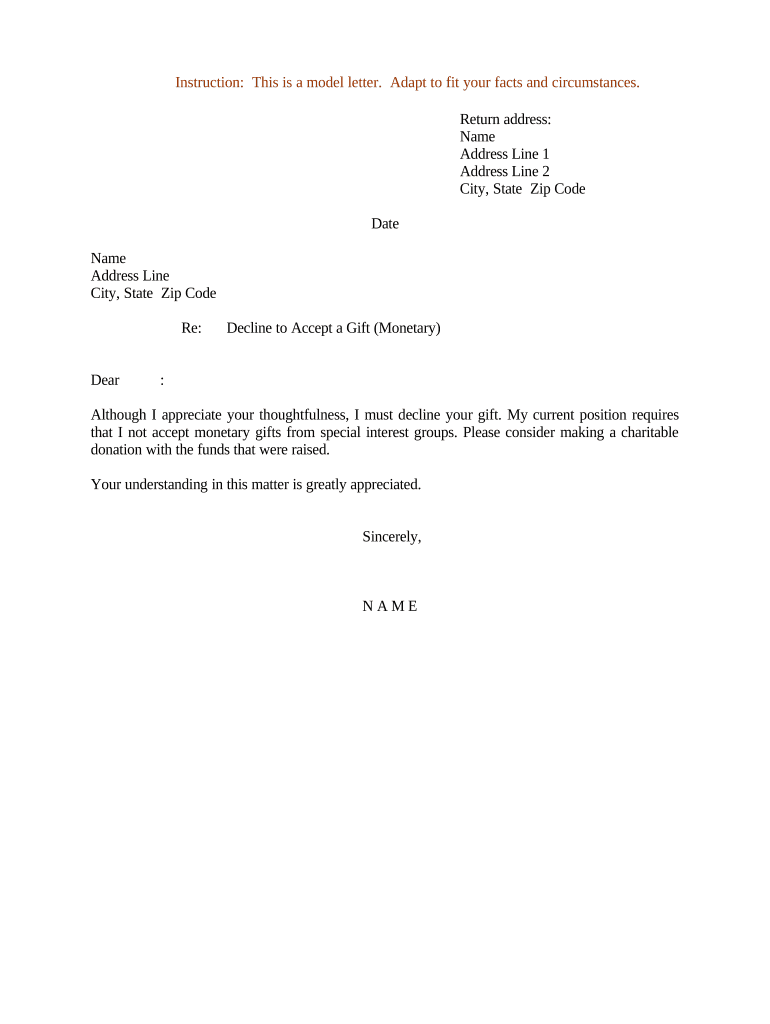
What a Letter Declining Monetary Gift Is and When It’s Used
Why a Clear Declination Letter Matters
A concise, dated declination protects both parties by documenting intent, preventing accidental acceptance, and reducing later disputes. It preserves records for tax and compliance reviews and clarifies whether funds should be returned, redirected, or held in escrow.

Who Typically Prepares or Receives This Letter
Practical users vary depending on context: personal gifts, institutional donations, or estate distributions.
- Individual recipients who prefer not to accept funds and want a written record of refusal and instructions.
- Nonprofit boards or gift officers who must decline restricted gifts incompatible with mission or policy.
- Executors, trustees, or legal counsel handling estate or fiduciary offers requiring formal refusal.
A formal letter reduces ambiguity and protects tax, fiduciary, and organizational compliance interests for all parties involved.
Step-by-Step: Drafting a Simple Declination Letter
-
01Open with ID: State the letter's purpose and identify donor and gift.
-
02State Declination: Say explicitly that you decline the monetary gift.
-
03Give Instructions: Specify return, redirection, or escrow handling.
-
04Sign and Date: Sign, add title if applicable, and keep a copy for records.
Typical Process Flow for Sending and Recording the Letter
-
Prepare Letter: Draft the declination with required details and disposition instructions.
-
Sign: Sign physically or electronically; record signer identity and method.
-
Deliver: Send by tracked mail, certified mail, or secure eDelivery to the donor.
-
File Record: Store a copy in both the recipient's records and the donor's acknowledgement file.
How to Configure an Electronic Workflow for Declination Letters
| Field | Configuration |
|---|---|
| Date Field | Use MM/DD/YYYY, auto-populate on signature. |
| Name Field | Require full legal name; enable validation. |
| Disposition Field | Make selection required: Return | Redirect | Escrow. |
| Signature Field | Require signer authentication and audit trail. |
Digital Delivery Options and Technical Considerations
Choose delivery methods that preserve intent, attribution, and record retention.
- Email with Read Receipt: Simple delivery, but weaker proof of identity.
- Certified Mail: Strong physical delivery proof, slower but reliable.
- eSignature Platform: Provides timestamped audit trail and secure storage.
Prefer solutions that capture signer identity, timestamp, and an unalterable audit record to reduce future disputes.
Timing Considerations and Recommended Response Windows
Immediate Acknowledgement:
Send the declination within 7–14 days of receiving the gift offer.
Return Funds Promptly:
If returning funds, do so within 30 days unless parties agree otherwise.
Record Retention:
Keep copies according to regulatory retention schedules noted below.
Tax-Year Coordination:
Coordinate disposition before year-end for clear tax reporting where relevant.
Escrow Hold Period:
Specify an escrow period or deadline in the letter if funds are held pending resolution.
Common Mistakes to Avoid When Preparing the Letter
- Vague language that fails to state an unequivocal declination can be interpreted as conditional acceptance.
- Omitting donor contact details or gift identifiers makes it hard to match the declination to a specific transfer.
- Failing to specify disposition instructions may create operational confusion or unintended acceptance by third parties.
- Not keeping a signed copy or audit log increases risk in tax audits or fiduciary disputes.
Potential Risks and Consequences of an Incorrect or Missing Letter
eSignature Vendor Comparison for Creating and Signing Declination Letters
| signNow | DocuSign | Adobe Sign | PandaDoc | HelloSign | |
|---|---|---|---|---|---|
| Starting Price | $8/user/mo | $15/user/mo | $14/user/mo | $19/user/mo | $15/user/mo |
| Free Trial | 7-day free trial | Varies by vendor | Varies by vendor | Varies by vendor | Varies by vendor |
| Bulk Send | Yes (Business Premium) | Yes | Yes | Yes | No |
| Audit Trail | Yes | Yes | Yes | Yes | Yes |
| HIPAA Compliant | Yes | Yes | Yes | No | No |
| Envelope Cap | No envelope cap | 100 envelopes/user/year cap | Varies by plan | Varies by plan | Varies by plan |
Real-World Examples of Declining a Monetary Gift
Individual Gift Declination
A recipient receives a personal check for $2,000 and wishes to decline.
- The letter states an unequivocal refusal and requests return of the check.
- The donor returns the check; both parties retain copies for tax records and the recipient notes no acceptance for the calendar year.
Nonprofit Restricted Gift Declination
A donor offers restricted funds incompatible with the nonprofit's mission.
- The board declines and offers redirection options.
- The donor agrees to redirect the gift to an alternative program; both parties document the change and update donation records.
Frequently Asked Questions About Declining Monetary Gifts
-
Can I decline a monetary gift in writing?
Yes. A clear dated declination documents your intent and helps prevent misunderstandings. For estate or fiduciary contexts, follow any court or trustee rules before refusing.
-
Is an electronic declination legally valid?
Yes in most U.S. contexts when ESIGN (15 U.S.C. ch. 96) or UETA standards apply; the signature must show intent, consent, attribution, and be retained.
-
Do I need a notary or witness?
Typically no for simple gift declinations. Notarization may be required for estate, deed, or power-of-attorney matters; check state-specific rules.
-
How long should I keep the letter?
Retain paperwork at least three years for IRS purposes; keep six years for healthcare-related records and longer if litigation risk exists.
-
What if the donor disputes the refusal?
Preserve all communication, proof of delivery, and the signed letter. Seek counsel if the dispute escalates to potential litigation or claims.
-
Can I redirect the gift instead of returning it?
Yes if you explicitly state the redirection option and obtain donor consent; record the agreement and update accounting entries accordingly.