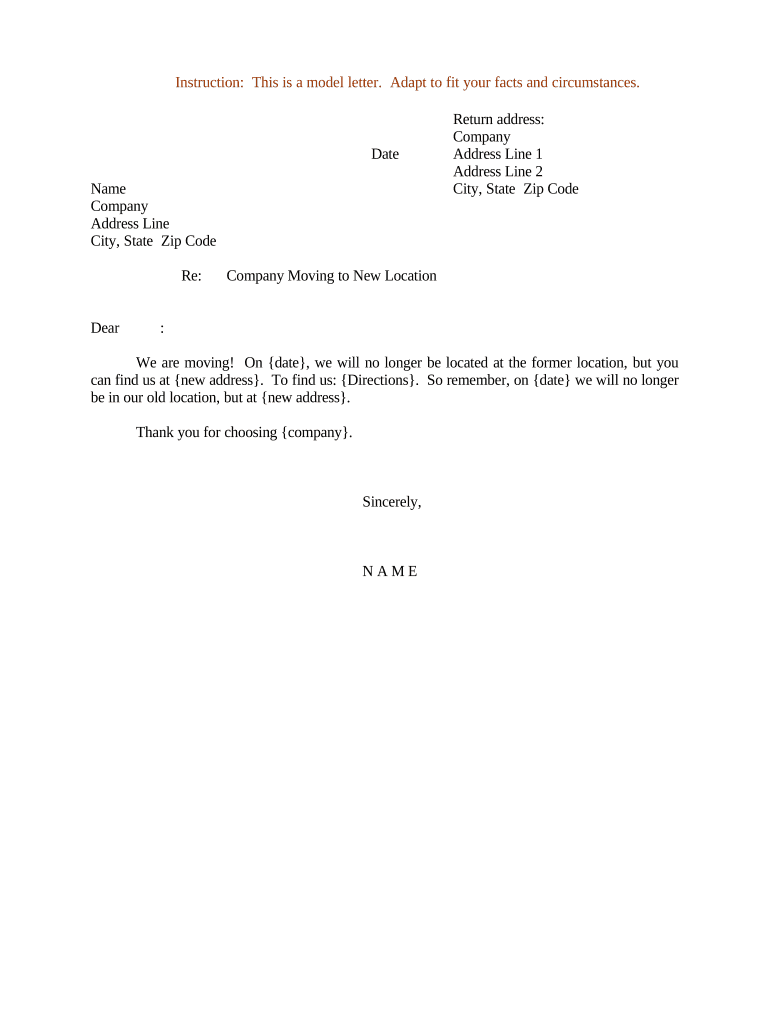
Letter Notifying Change of Address
What a Letter Notifying Change of Address Is
Why sending a formal address-change letter matters
A clear written notice reduces missed bills, lost mail, and legal notices; it creates a dated record showing you informed the necessary parties and helps establish responsibility for future communications.
Who commonly sends or receives these letters
Typical senders and recipients vary by context but include households, businesses, and legal agents.
- Individual movers notifying banks, utilities, and personal contacts about a new residential address.
- Small businesses updating vendors, customers, and tax or payroll agencies with a new business location.
- Authorized agents or attorneys notifying third parties on behalf of clients, using documented authority or power of attorney.
Primary signers and submitters
Individual Mover
A current resident or account holder signs to confirm their new mailing address; include government ID name matching and the effective date to ensure recipient systems update billing and legal records without mismatch.
Authorized Agent
A person acting under written authority (for example, power of attorney or corporate officer) can sign on behalf of a client or company; include proof of authority and the principal's full legal name to avoid rejection.
Step-by-step: preparing and sending the letter
-
01Gather details: Collect names, old and new addresses, account numbers, and ID as needed.
-
02Draft letter: State the change clearly, include effective date, and list affected accounts.
-
03Sign and date: Sign physically or electronically per recipient requirements.
-
04Send and document: Choose delivery method and keep proof of transmission or receipt.
Where to send the letter and how it’s processed
-
Government Agencies: Follow agency-specific procedures (DMV, IRS, USCIS) and include required forms when applicable.
-
Financial Institutions: Send to the address on statements or use online account settings for faster processing.
-
Utilities and Services: Update accounts directly via their customer portal or by registered mail for a dated record.
-
Private Contacts: Email or postal mail is usually sufficient; keep a copy for your records.
How to customize and send the letter online
| Field | Configuration |
|---|---|
| Upload Template | Import DOCX or PDF and standardize placeholder fields. |
| Add Signature Fields | Place signature, date, and account reference fields where required. |
| Authentication | Select signer verification level (email, SMS code, or stronger as needed). |
| Send & Archive | Route to recipients and store signed copies for compliance. |
Digital signing and delivery platforms: setup basics
Choose a platform that supports the document formats you use and offers reliable audit trails.
- Supported Formats: PDF, DOCX, HTML, and Excel input/output for templates and signed exports.
- Integrations: Connectors for Google Workspace, Microsoft 365, Salesforce, and NetSuite streamline recipient updates.
- Authentication Options: Email, SMS, and stronger methods like KBA or SSO depending on recipient requirements.
Practical tips for accurate and efficient notices
Common mistakes people make when preparing the letter
- Using informal or incomplete addresses that omit apartment or unit numbers, which leads to undelivered mail and delays in updating recipient systems.
- Failing to include account or reference numbers, causing recipients to be unable to match the notice to the correct account or customer record.
- Not documenting proof of delivery—sending unsigned or untraceable mail makes it difficult to prove the change was communicated in case of dispute.
- Assuming every recipient accepts electronic notices; some agencies or institutions require signed paper forms, notarization, or their own online form submission.
Risks and potential consequences of an incorrect or missing notice
Real-world examples of use
Household Move
The homeowner sent a dated letter and retained the delivery receipt to prevent utility shutoff after moving
- The utility matched the account using the provided customer number
- Retaining proof avoided a late-payment fee dispute when an invoice was initially routed to the old address, allowing a quick remediation with documented evidence.
Small Business Update
A business submitted an address-change letter to its payroll provider and tax preparer before relocation
- The payroll provider required the account number for verification
- Early notification prevented misrouted W-2 forms and ensured year-end tax documents were mailed to the new address without reissue.
Recommended timelines and deadlines
USPS Change of Address:
Submit at least two weeks before move for forwarding to begin; confirm identity verification requirements with USPS
Financial Accounts:
Notify banks and creditors immediately to avoid returned statements or billing issues
DMV and Licensing:
Update vehicle and driver records within the state-specified period—many states require update within 10–30 days
Voter Registration:
Update before registration or early voting deadlines to ensure ballot delivery
Tax Authorities:
File IRS Form 8822 when necessary or update practitioner details to ensure tax notices reach you
Notarization and witness authentication steps
Confirm Requirement
Verify whether the recipient specifically requires notarization or witnesses before obtaining authentication.
Select Notary Type
Choose in-person notary or RON depending on whether the recipient accepts remote notarization.
Prepare ID
Signer provides government-issued photo ID for identity proofing per notary or RON rules.
RON Proofing
For RON, complete identity proofing steps such as KBA or credential analysis as required.
Audio-Video Session
If remote, ensure audio-video recording is allowed and retained per state rules.
Sign in Presence
Sign in the notary's physical presence or during the live RON session to validate acknowledgment.
Notary Journal
Notary records the act in the journal; retention periods may apply.
Attach Acknowledgement
Include the notary acknowledgement or certificate with the notice before submission.
How a change-of-address letter compares to an official USPS COA
| Criteria | Change Letter | USPS COA |
|---|---|---|
| Formality | informal written notice | official postal forwarding |
| Proof Required | receipt or signed copy | identity verification |
| Delivery | direct to recipients | usps-managed forwarding |
| Typical Use | update accounts and contacts | forward mail for a limited time |
How to save and export the signed notice
PDF / PDF-A
Export signed letters as PDF or PDF/A for reliable long-term preservation; embed signatures and include the completion certificate to preserve audit data.
DOCX Templates
Keep editable DOCX templates for future moves; convert the final signed copy to PDF for archival to prevent accidental changes.
Signed Certificate
Store the audit trail or certificate of completion with the document to show signer identity, timestamps, and IP or authentication method used.
Secure Storage
Archive in encrypted cloud storage with access controls and retention policies to meet regulatory or company recordkeeping requirements.
eSignature pricing and capability comparison for sending address-change letters
| signNow | DocuSign | Adobe Sign | PandaDoc | HelloSign | |
|---|---|---|---|---|---|
| Starting Price | $8/user/mo | $15/user/mo | $14/user/mo | $19/user/mo | $15/user/mo |
| Free Trial | 7-day free trial | Varies | Varies | Varies | Varies |
| Bulk Send | Yes | Varies | Varies | Varies | Varies |
| Audit Trail | Yes | Yes | Yes | Yes | Yes |
| HIPAA Compliant | Yes | Varies | Varies | Varies | Varies |
| Envelope Cap | No cap | 100 envelopes/user/year | Varies | Varies | Varies |
Frequently asked questions about change-of-address letters
-
Do I need to notarize this letter?
Most recipients do not require notarization for a routine address update. However, for legal filings, title records, or some institutional updates (for example, deeds or certain financial account changes), notarization or agency-specific forms may be required.
-
Is an electronic signature valid?
Yes—electronic signatures are legally effective under the federal ESIGN Act (15 U.S.C. ch. 96) and UETA where adopted. Verify recipient acceptance and provide required consumer disclosures for covered consumer-facing transactions.
-
How do I prove I notified someone?
Keep copies of the sent letter, delivery receipts, email confirmations, or signed electronic certificates. A recorded delivery receipt or an audit trail with timestamp and signer authentication provides the strongest proof.
-
What if mail still goes to the old address?
Submit or confirm a USPS change-of-address, verify forwarding status, and contact senders directly with a dated notice and proof of your forwarding request to resolve misrouted mail.
-
Can an agent sign on my behalf?
Yes if you have provided written authorization or power of attorney. Attach the document proving authority and ensure the receiving party accepts agent-signed notices under their policy.
-
How long before the change becomes effective?
Effectiveness depends on recipient processing time. For USPS forwarding, submit at least two weeks before move; for agencies and banks, expect variable processing—follow up if urgent.