Establishing secure connection…Loading editor…Preparing document…

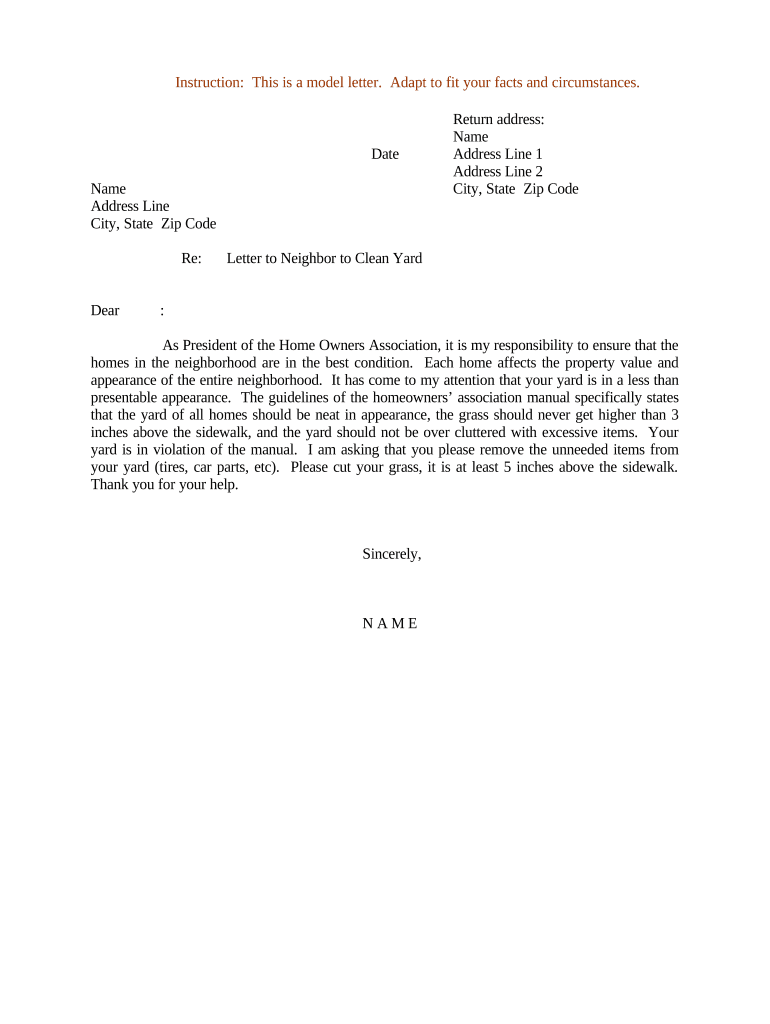
Letter to Neighbor to Clean Yard

This template is fully customizable. Edit the text, fill out the fields, and send it for signature. Give it a try!
Letter to Neighbor to Clean Yard

What the Letter to Neighbor to Clean Yard Is and When to Use It

A Letter to Neighbor to Clean Yard is a written, factual request asking an adjacent property owner to address yard issues such as overgrown grass, debris, abandoned vehicles, or pest-generating conditions. It serves as a courteous first step that documents your concerns, the dates observed, and any local code references you rely on. Use this letter before contacting code enforcement, an HOA board, or a lawyer; it creates a record of notice and gives the neighbor an opportunity to remedy the problem voluntarily.

Why a Formal Letter Helps Resolve Yard Issues

A clear, dated letter documents your concern, sets reasonable expectations, and often prompts voluntary compliance without escalation.

Why a Formal Letter Helps Resolve Yard Issues

Who Typically Sends or Receives This Letter

Typical senders include homeowners, renters, HOA representatives, and small multiunit landlords documenting nuisance conditions.

  • Homeowners notifying adjacent property owners about code or nuisance concerns in a neighborly tone
  • HOA managers issuing formal notices when common-area or private-lot standards are not met
  • Tenants or property managers informing an owner about safety or sanitation issues affecting habitability

Recipients should be given a reasonable cure period and clear contact details for follow-up to encourage voluntary correction.

Step-by-Step: Preparing and Sending the Letter

Follow these sequential steps to produce a clear, documented request that preserves evidence and reduces the chance of dispute.

  • 01
    Describe the problem: State observed conditions, dates, and specific locations concisely.
  • 02
    Reference standards: Cite local code or HOA rule if known and relevant.
  • 03
    Request action: State what you want done and offer a reasonable cure period.
  • 04
    Deliver and document: Send via certified mail, hand delivery with signature, or a verifiable electronic method.

Essential Information to Include

Sender contact: Phone and email
Recipient identity: Owner name or 'Occupant'
Exact address: Street, city, ZIP
Observed dates: MM/DD/YYYY format
Specific issues: Concise description
Desired deadline: Reasonable cure date

Common Mistakes That Reduce Effectiveness

  • Using emotional or accusatory language that escalates defensiveness rather than prompting action
  • Failing to include dates, locations, or photos that corroborate the condition being reported
  • Delivering the letter without proof of receipt, making later enforcement harder to substantiate
  • Requesting immediate action without offering a reasonable cure period or suggested next steps

Potential Consequences If the Letter Is Incorrect or Misused

No legal effect: Letter alone may not compel action
Escalation: May prompt code enforcement or HOA fines
Defamation risk: Avoid false statements about the neighbor
Court costs: Incorrect process may increase litigation expense
Retaliation: Neighbor disputes may follow
Data exposure: Handle personal data carefully to avoid privacy issues

Real-World Examples of How the Letter Resolves Issues

Two concise examples show typical outcomes when a clear letter precedes formal enforcement.

Neighbor cleans yard

A homeowner documented persistent standing water and sent a dated letter with photos.

  • Neighbor repaired drainage within two weeks.
  • The record allowed the homeowner to notify the county if untreated, but the issue was resolved without code enforcement involvement.

HOA enforces standard

An HOA representative sent a standardized notice citing community rules and a 14-day cure period.

  • Owner arranged debris removal.
  • The formal notice and follow-up photos enabled the HOA to avoid fines and preserve records showing reasonable notice was given.

Where to Send or File the Letter and Next Steps

Choose delivery and filing methods that create verifiable proof of notice and support escalation if needed.

  • Hand delivery: Leave a signed copy and get a dated receipt or signature.
  • Certified mail: Provides USPS tracking and proof of delivery.
  • Email with read receipt: Use when recipient previously agreed to electronic contact.
  • Code enforcement/HOA: File a copy with local authorities if uncorrected.

Digital Delivery and File Format Considerations

Use common, tamper-resistant formats and platforms that produce an audit trail and preserve attachments such as photos.

  • Formats: PDF or DOCX preferred
  • Integrations: Salesforce, Google Workspace, Microsoft 365
  • Audit trail: Timestamp and delivery proof

How to Customize and Send the Letter Online

Configure fields and delivery options so recipients can sign or acknowledge receipt and you retain reliable evidence.

Document template Create reusable letter template
Signature field Add signer name and date fields
Attachment area Include photos and location info
Delivery method Choose certified email or signed link
Audit settings Enable IP, timestamp, and access logs

Practical Tips to Improve Clarity and Compliance

Adopt these practices to increase the likelihood of voluntary correction and to preserve enforceable records.

Use neutral, factual language
Focus on observable facts, dates, and impacts rather than conjecture or insults; neutral wording reduces escalation and strengthens the record if authorities become involved. Avoid legal conclusions unless you are a licensed attorney.
Attach evidence
Include clear photos, video timestamps, and concise captions describing what each attachment shows; these corroborating items make your claim easier to verify for HOAs or municipal inspectors.
Provide a reasonable deadline
State a specific, reasonable cure period (commonly 7–30 days depending on the issue) and explain follow-up steps if unaddressed; a clear timeline supports proportional enforcement action if needed.
Keep copies and logs
Retain signed receipts, tracking numbers, emails, and an internal log of dates and communications; consistent documentation is essential if you later need to involve local code enforcement or pursue civil remedies.

Who May Sign or Send the Letter

Homeowner / Occupant

A homeowner or occupant may sign the letter to document a neighborhood concern; include contact information and, if representing others, a brief statement of authority.

Authorized Representative

HOA managers, property managers, or legal representatives may sign on behalf of an entity; include position/title and evidence of authorization to avoid challenges to standing.

Sample eSignature Pricing Comparison for Sending the Letter

Platforms vary by pricing model and features such as bulk send, audit trail, and HIPAA support. signNow is listed first for comparison.

signNow DocuSign Adobe Sign PandaDoc HelloSign
Starting Price $8/user/mo $15/user/mo $14/user/mo $19/user/mo $15/user/mo
Free Trial 7-day free trial Varies by vendor Varies by vendor Varies by vendor Varies by vendor
Bulk Send Yes Yes Yes Yes No
Audit Trail Yes Yes Yes Yes Yes
HIPAA Compliant Yes Yes Yes No No

Frequently Asked Questions About the Letter and Next Steps

Answers to common questions about effectiveness, legal weight, electronic delivery, and escalation steps for unresolved yard issues.


Need help? Contact support

be ready to get more
Join over 28 million airSlate SignNow users