Establishing secure connection…Loading editor…Preparing document…

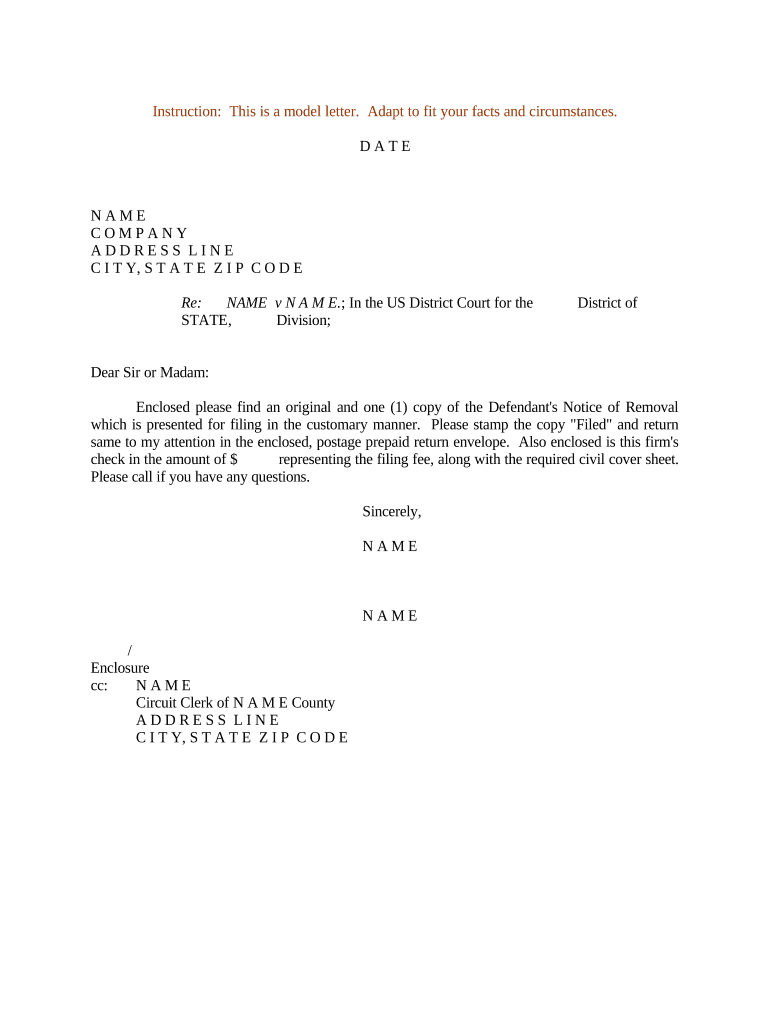
Letter Regarding Defendant's Notice of Removal

This template is fully customizable. Edit the text, fill out the fields, and send it for signature. Give it a try!
Letter Regarding Defendant's Notice of Removal

What the Letter Regarding Defendant's Notice of Removal Is

A Letter Regarding Defendant's Notice of Removal is a formal, written communication used by a party or counsel to acknowledge that a defendant has filed a notice removing a case from state court to federal court. The letter outlines the removal date, case identifiers, the grounds asserted by the defendant, and any immediate procedural responses such as a motion to remand, jurisdictional objections, or requests for additional time. It is typically sent to opposing counsel and filed with the state court clerk to preserve record and deadline calculations during the transition.

Why this letter matters for case management

This letter documents the removal event, preserves procedural deadlines, and notifies interested parties of the federal filing. Clear documentation reduces confusion about jurisdictional status and supports any timely motions to remand, motions to dismiss, or discovery scheduling adjustments.

Why this letter matters for case management

Who prepares and receives this letter

Typical users include attorneys for plaintiffs and defendants, pro se litigants, and court clerks maintaining the state docket.

  • Plaintiff's counsel documenting removal, preserving service records, and outlining intended procedural responses.
  • Defendant's counsel confirming filing and providing federal case number and docket details.
  • Pro se parties notifying opposing party and creating a clear paper trail for deadlines.

Essential parts of a professional removal-notice letter

Core components of a professional Letter Regarding Defendant's Notice of Removal ensure clarity about parties, dates, jurisdiction, action requested, attachments, and proper service of the notice.

Caption

Include full case caption and file number exactly as it appears in state court; this links the letter to the underlying docket and avoids confusion during transfer.
Removal Date

Specify the date the defendant filed the notice of removal in federal court and the date it was served on the opposing party; tie these dates to any deadline calculations.

Federal Docket

Provide the federal court name, case number, assigned judge if known, and the electronic filing receipt or acknowledgment to confirm the removal was successfully accepted.

Grounds Stated

Summarize the legal basis asserted by the defendant for removal (federal question or diversity), citing the statute or jurisdictional theory used and noting whether subject-matter jurisdiction appears satisfied.

Requested Action

State any immediate request, such as a motion to remand, a request for briefing schedule, consent to transfer, or a proposal for agreed case management dates.

Attachments

Attach a copy of the federal notice of removal, the state-court complaint, the removal filing receipt, and any service proofs or related exhibits and correspondence.

Security and compliance considerations when sending the letter

Encryption: TLS 1.2/1.3 in transit; AES-256 at rest
Authentication: Email, SMS, or MFA options
Audit Trail: Time stamps, IP, and action log
HIPAA BAA: Available with Business Associate Agreement
ESIGN/UETA: ESIGN and UETA legal compliance
Storage: Redundant AES-256 backups; ISO 27001 certified

Step-by-step: drafting and sharing the letter

Follow these steps to prepare and send the letter to opposing counsel and to preserve the record for state and federal dockets.

  • 01
    Confirm Removal: Verify federal docket number and filing receipt before drafting.
  • 02
    Prepare Letter: Use exact case caption, dates, and concise statement of facts.
  • 03
    Attach Documents: Include removal notice, complaint, and proof of service.
  • 04
    Serve and File: Serve opposing counsel and file with state clerk to preserve record.

Recommended digital workflow settings for online completion

Recommended email workflow settings and field placements for completing and sharing the letter electronically securely.

Field Configuration
Sender Email Use counsel firm email; include reply-to instructions.
Recipient Opposing counsel email and state court clerk address.
Attachments Upload PDF of removal notice and complaint; combine files.
Authentication Email link with optional SMS code for higher assurance.
Retention Enable audit trail and save PDF/A copy for records.

Where to send and how to file the letter

Clear routing steps for serving the letter, filing with the state clerk, notifying the federal clerk if required, and updating case calendars.

  • Prepare: Draft letter with caption, dates, and attachments.
  • Serve: Email opposing counsel and mail per local rules if required.
  • File State: File a copy with the state court clerk to preserve record.
  • Update Dockets: Enter federal docket number in case management systems.

Typical timing and processing expectations

Typical timing and expectations for drafting, serving, filing, and responding to removal notices to help parties meet procedural obligations.

Draft Immediately:

Prepare letter same day removal is discovered to preserve records and deadlines.

Serve Opposing Counsel:

Email and mail per local rule; do not rely solely on e-mail in contested cases.

File with State Clerk:

File a copy with the state clerk promptly to maintain an accurate state docket.

Monitor Federal Docket:

Confirm federal filing acceptance; note electronic receipt for proof.

Watch Remand Deadlines:

Timelines for motions vary by jurisdiction; check local rules promptly.

Common mistakes to avoid

  • Failing to attach the federal removal notice or filing receipt, which can create ambiguity and hinder proof of removal.
  • Using incorrect case caption or docket numbers; mismatches between state and federal captions delay clerical processing and can confuse calendaring.
  • Relying exclusively on email service without following local rules for service and filing, especially where certified mail or CM/ECF requires separate steps.
  • Missing jurisdictional details such as citizenship facts for diversity cases, leaving parties unprepared for remand briefing or jurisdictional challenges.

Consequences of an incorrect or incomplete letter

Remand: Case may be returned to state court.
Fees and Costs: Court may award costs under 28 U.S.C. §1447(c)
Sanctions: Possible sanctions for procedural violations.
Missed Deadlines: Waiver of defenses or rights.
Confidentiality Risk: Public filing may expose sensitive info.
Evidence Issues: Loss of timely service proof harms records.

Frequently asked questions about the Letter Regarding Defendant's Notice of Removal

Answers to common questions about signing, filing, and correcting removal-notice letters and about when electronic methods are acceptable.


Need help? Contact support

be ready to get more
Join over 28 million airSlate SignNow users