Establishing secure connection…Loading editor…Preparing document…

Return of Check Missing Signature Letter

This template is fully customizable. Edit the text, fill out the fields, and send it for signature. Give it a try!
Return of Check Missing Signature Letter

What a Return of Check Missing Signature Letter Is

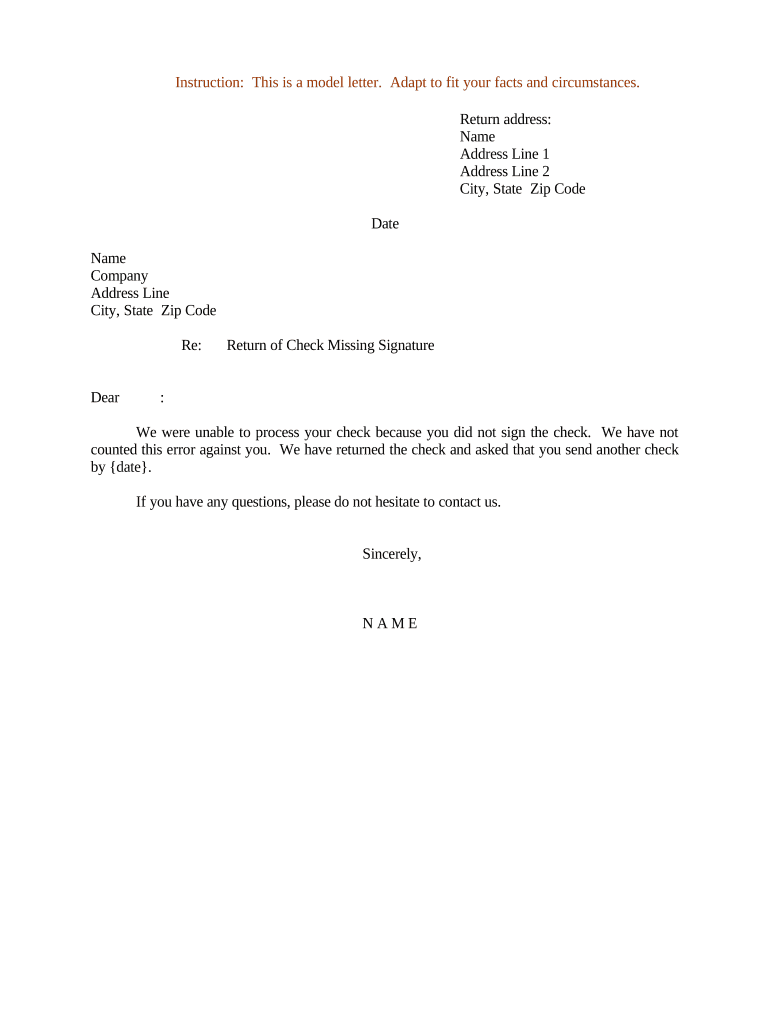
A Return of Check Missing Signature Letter is a formal written notice sent by the recipient, payee, or their agent to a payer, bank, or intermediary when a negotiable instrument (a check) arrives without the required signature. The letter documents the missing signature, identifies the check by number, date, amount, and payor, and requests corrective action such as returning the check, reissuing a signed check, or providing documentation authorizing acceptance. It creates a clear paper and digital trail for accounting, dispute resolution, and bank processing.

Why use a formal return letter for unsigned checks

A concise, documented letter protects accounting accuracy, reduces reconciliation delays, and preserves evidence for banks and auditors; it clarifies the remedial steps requested and the timeline for resolution.

Why use a formal return letter for unsigned checks

Who prepares and receives this letter

Typical senders include accounts payable, accounts receivable, payroll teams, small-business owners, and authorized agents who discover an unsigned check.

  • Accounts payable teams — corporate AP staff notifying vendors or banks of unsigned payments and requesting reissue or endorsement.
  • Payroll administrators — HR or payroll teams returning unsigned employee payroll checks to ensure correct payee endorsement.
  • Bank operations staff — branch or clearing units flagging missing signature during deposit or presentment procedures.

Recipients are commonly the original payer, the issuing bank, or an intermediary; copies are often kept in the payer and payee files for audit and legal purposes.

Essential parts of an effective return letter

A professional letter follows a consistent structure so recipients can act quickly: clear header, identification details, explanation, requested remedy, deadlines, and signature or authorized contact.

Header

Company name, contact information, and date at the top to identify the sender and create a record.
Check Details

Include check number, issue date, amount, and payer name so the instrument is unambiguously identified.

Problem Statement

A short explanation that the signature is missing and why acceptance is not possible as presented.

Requested Action

State whether you want the check returned, reissued with signature, or an authorization letter from the payer.

Deadlines

Provide a reasonable response deadline and any consequences for inaction to prompt timely resolution.

Record Clause

Note that a copy will be retained for accounting and dispute purposes, and provide a contact for questions.

Step-by-step: preparing and sending the letter

Follow a clear sequence to document the issue, notify the right parties, and preserve evidence for accounting and audit trails.

  • 01
    Inspect the Check: Confirm the signature is absent and photograph the front/back for records.
  • 02
    Record Details: Log check number, date, amount, and payer in your reconciliation system.
  • 03
    Draft Letter: Complete the letter fields and state requested remedy and deadline.
  • 04
    Send and Archive: Send via chosen channel and save a dated copy in accounting records.

Configure your online workflow for missing-signature checks

Set up digital templates and routing rules so accounts staff can issue standardized letters quickly and capture audit metadata.

Field Configuration
Template Prebuilt letter template with placeholders for check details
Routing Auto-route to payer and internal approver on creation
Authentication Use email + optional SMS code for recipient verification
Retention Automatic archival in PDF/A or company records repository

Delivery channels and technical considerations

Choose secure, auditable channels aligned with your compliance needs and the payer's capabilities.

  • Email: Fast delivery; include read receipt and attach scanned check images
  • Secure Portal: Preferred for sensitive banking correspondence and document exchange
  • Postal Mail: Send certified mail when original instrument return is required

Configure the channel in your workflow to capture timestamps, recipient acknowledgment, and an immutable copy for the audit trail.

Typical routing: who gets the letter and in what order

A standard routing reduces confusion; include internal and external recipients and keep clear copies for reconciliation.

  • Internal Accounting: Document the issue and update ledger entries
  • Payer Notification: Send the letter to the payer's accounts payable contact
  • Issuing Bank: Notify the bank if deposit or presentment has occurred
  • Internal Archive: Store the dated letter and supporting images in records

Response timing and processing expectations

Set clear, reasonable deadlines and note that bank and payer processing windows may extend resolution times.

Initial Notice:

Send immediately upon discovery to preserve evidence

Response Request:

Ask for action within 7–14 days to prompt timely reissue

Bank Holds:

Expect bank processing to take several business days

Follow-up:

Send one follow-up after 7–10 days if no response

Escalation:

Escalate to legal or bank dispute teams after 30 days

Risks of not addressing an unsigned check promptly

Stale Payment: Funds may become stale-dated
Bank Rejection: Check could be dishonored
Fees: NSF or return fees may apply
Reconciliation Delay: Ledger uncertainty and audit questions
Fraud Exposure: Unauthorized alteration risk increases
Legal Dispute: Potential for contract or payment disputes

Common mistakes to avoid when preparing the letter

  • Omitting precise check identifiers (number, date, amount) leads to processing delays and confusion at banks.
  • Failing to attach an image or scan of the physical check reduces the recipient's ability to verify the claim.
  • Using vague remedy language such as 'please correct' rather than specifying return, reissue, or authorization.
  • Not recording delivery and acknowledgment details in your accounting system undermines the audit trail.

eSignature vendor pricing and core feature snapshot

Compare starting prices and core features for common eSignature vendors; signNow appears first for direct comparison of pricing and features.

signNow DocuSign Adobe Sign PandaDoc HelloSign
Starting Price $8/user/mo $15/user/mo $14/user/mo $19/user/mo $15/user/mo
Free Trial 7-day free trial Verify Verify Verify Verify
Bulk Send Yes Yes Yes Yes No
Audit Trail Yes Yes Yes Yes Yes
HIPAA Compliant Yes Yes Yes No No

Real-world examples of handling unsigned checks

These examples show how organizations standardized letters to speed resolution and preserve accounting records.

Optica Ventures (COO)

Optica documented unsigned vendor checks in a standardized template to speed reissuance.

  • This reduced follow-up time and confusion during reconciliation.
  • "The interface is simple and easy-to-use for our team; more importantly, it is just as easy for our customers."

Martin Properties (Founder)

A property manager returned unsigned tenant checks and requested re-signed payments via a secure portal.

  • The process cut deposit errors and late fees.
  • "I can process and execute all of these documents online with 100% compliance and built-in security."

Typical signatories and authorized approvers

Accounts Payable Manager

Responsible for reconciling payments and initiating return letters; typically approves remedial actions and communicates with banks and vendors in writing.

Bank Operations Supervisor

Acts on behalf of the issuing bank when presentment issues arise; may coordinate return or re-presentation of the instrument and log the event in bank systems.

Frequently asked questions about return letters for unsigned checks

Practical answers to common questions help ensure your letter achieves the intended remediation without creating new issues.


Need help? Contact support

be ready to get more
Join over 28 million airSlate SignNow users