Establishing secure connection…Loading editor…Preparing document…

Letter of Appreciation for Referral

This template is fully customizable. Edit the text, fill out the fields, and send it for signature. Give it a try!
Letter of Appreciation for Referral

What a Letter of Appreciation for Referral Is and When to Use It

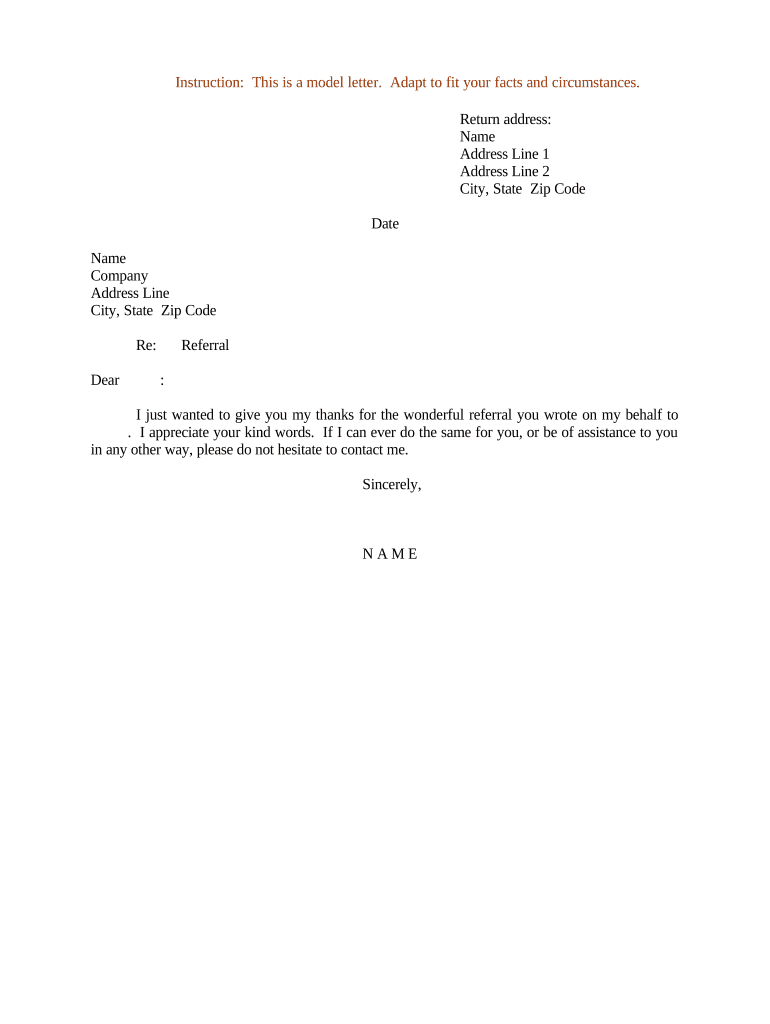
A Letter of Appreciation for Referral is a concise, written acknowledgement sent to an individual or organization that referred a client, candidate, or opportunity. It documents gratitude, records the referral source for internal tracking, and maintains a professional record of the interaction. The letter typically includes the referrer's name, the referred party, a brief description of the referral, a thank-you statement, and an authorizing signature. It is not usually a legally binding contract but serves as a formal business communication that supports relationship-building and internal crediting of referral activity.

Why a Formal Appreciation Letter Matters

A clear appreciation letter preserves the referral record, reinforces professional relationships, and helps assign internal credit for lead-generation or introductions. It also reduces ambiguity about who should receive referral recognition.

Why a Formal Appreciation Letter Matters

Who Typically Issues a Letter of Appreciation for Referral

Intended users include business development teams, referral partners, HR and recruiting staff, and administrative personnel who document and acknowledge referrals.

  • Sales and Business Development teams who track lead sources and commission credits.
  • Human Resources or Recruiting teams acknowledging employee or external candidate referrals.
  • Referral partners, affiliates, or professional contacts who generate introductions.

Essential Elements to Include in the Letter

A professional letter of appreciation for referral is brief and structured so it can be stored, searched, and used for reporting. Include identity, context, the referral outcome, and an explicit signature line.

Heading

Use a clear subject line or heading such as 'Letter of Appreciation for Referral' and include the date for tracking and retention purposes.
Opening Line

Begin with a direct thank-you sentence that names the referrer and states appreciation for the specific referral made.

Referral Details

Describe who was referred, the nature of the referral (client, candidate, opportunity), and the date or timeframe of the referral to avoid ambiguity.

Outcome Summary

Briefly note the result of the referral (e.g., introduced, engaged, hired) without disclosing confidential details about the referred party.

Signature Block

Include the sender's printed name, title, company, and a dated signature line; for electronic completion, capture signer identity and timestamp.

Internal Reference

Add an internal reference or tracking ID and distribution notes for accounting, commission, or reward processing.

Required Information to Record

Referrer Name: Full legal name
Referred Party: Name of the person or organization referred
Referral Date: MM/DD/YYYY
Sender Details: Company and sender name
Outcome Status: Captured outcome (closed, pending)
Internal ID: Tracking or reference number

Step-by-Step: Completing the Letter

Follow this simple sequence to ensure clarity, consistency, and proper recordkeeping when issuing an appreciation letter for a referral.

  • 01
    Prepare template: Open the approved letter template and confirm required fields.
  • 02
    Enter referral details: Populate referrer, referred party, date, and outcome fields.
  • 03
    Review for privacy: Verify no protected health information or other confidential data is disclosed.
  • 04
    Sign and send: Obtain signature, timestamp, and distribute copy to records.

Configuring an Online Workflow for the Letter

Set up a repeatable digital workflow to populate, approve, sign, and archive letters consistently across teams.

Field Configuration
Authentication method Email link or SMS code
Signature type Click-to-sign or drawn signature
Template saving Save reusable template in central library
Audit trail Enable timestamp and IP logging

Routing: Where to Send or File the Letter

A clear routing process ensures copies reach the referrer, internal records, and any compensation workflows promptly.

  • Send to referrer: Email the signed letter to the referrer with a courtesy copy.
  • Internal distribution: Route copy to sales ops, HR, or reward processing.
  • Archive copy: Store signed copy in the document management system.
  • Update CRM: Link the letter to the referral record in CRM.

Technical and Platform Considerations for Digital Completion

Confirm your platform supports common file formats, basic signer authentication, and an exportable audit trail before digitizing letters.

  • File formats: PDF and DOCX supported
  • Integrations: CRM and cloud storage compatible
  • Authentication: Email or SMS code

Choose a solution that records signer identity and timestamps, integrates with CRM for tracking, and meets applicable compliance needs such as ESIGN and UETA for legal enforceability.

Timing: Recommended Sending and Processing Windows

Establishing timing expectations helps preserve goodwill and ensures referral credit is processed in the correct reporting period.

Send promptly:

Issue the letter within 7 days of confirming the referral outcome.

Follow-up window:

If no response, follow up after 14 days to confirm receipt.

Compensation cycle:

Link the letter to the next commission or reward cycle per internal policy.

Archiving schedule:

Archive the signed letter within 30 days of issuance.

Retention checkpoint:

Review stored letters annually for records management.

Common Mistakes to Avoid

  • Using vague wording about the referral that makes internal crediting or reward eligibility unclear and leads to disputes.
  • Entering mismatched names or dates that prevent CRM linkage or cause administrative rejection of the referral record.
  • Including confidential client or patient information that may violate privacy rules such as HIPAA when referring healthcare matters.
  • Failing to capture a signed audit trail or timestamp when sending electronically, which complicates recordkeeping or dispute resolution.

Risks and Consequences of Errors

Privacy Violation: Disclosing PHI may trigger HIPAA consequences
Crediting Dispute: Missing data leads to reward or commission disputes
Record Loss: No signed copy hampers auditability
Reputational Harm: Inaccurate acknowledgment can damage relationships
Noncompliance: Consumer disclosures missing under ESIGN
Administrative Fees: Internal remediation costs and time lost

eSignature Pricing Comparison for Letter Workflows

Basic price and capability differences can affect per-letter cost and scale; signNow is listed first per vendor comparison guidelines.

signNow DocuSign Adobe Sign PandaDoc HelloSign
Starting Price $8/user/mo $15/user/mo $14/user/mo $19/user/mo $15/user/mo
Free Trial 7-day free trial Varies by vendor Varies by vendor Varies by vendor Varies by vendor
Bulk Send Yes (Premium tier) Yes Yes Yes Varies
Audit Trail Yes Yes Yes Yes Yes
HIPAA Compliant Yes Yes Yes No No

Practical Examples of How Organizations Use the Letter

Two concise scenarios illustrate typical wording and routing for different referral contexts.

Real Estate Referral

A listing agent thanks a mortgage broker for referring a buyer

  • Broker introduced buyer who closed escrow in 30 days
  • The agent attaches the referral letter to the transaction file, notifies sales ops for commission credit, and emails the signed copy to the broker.

Employee Referral

An HR manager acknowledges an employee referral that led to a successful hire

  • Employee referred a candidate who accepted an offer
  • HR attaches the appreciation letter to the new hire record, applies employee-referral bonus rules, and confirms payment scheduling.

Practical Tips for Clear, Compliant Letters

Use consistent wording and workflows to reduce disputes and support rapid processing across teams.

Be specific and concise
Name referrer and referred party, provide dates, and state the referral outcome. Precise language prevents ambiguity during crediting or audits.
Protect privacy
Exclude protected health information and sensitive details unless a HIPAA-compliant process and BAA are in place to handle PHI securely.
Capture signature metadata
When signing electronically, ensure the system records signer identity, timestamp, and an audit trail to support provenance and dispute resolution.
Link to internal systems
Store the signed letter in a document repository and link it to CRM or payroll systems for commission, reward, or reporting workflows.

Frequently Asked Questions About Letter Use and Compliance

Answers to common questions about legal validity, signing, privacy, storage, and corrections for Letters of Appreciation for Referral.


Need help? Contact support

be ready to get more
Join over 28 million airSlate SignNow users