Establishing secure connection…Loading editor…Preparing document…

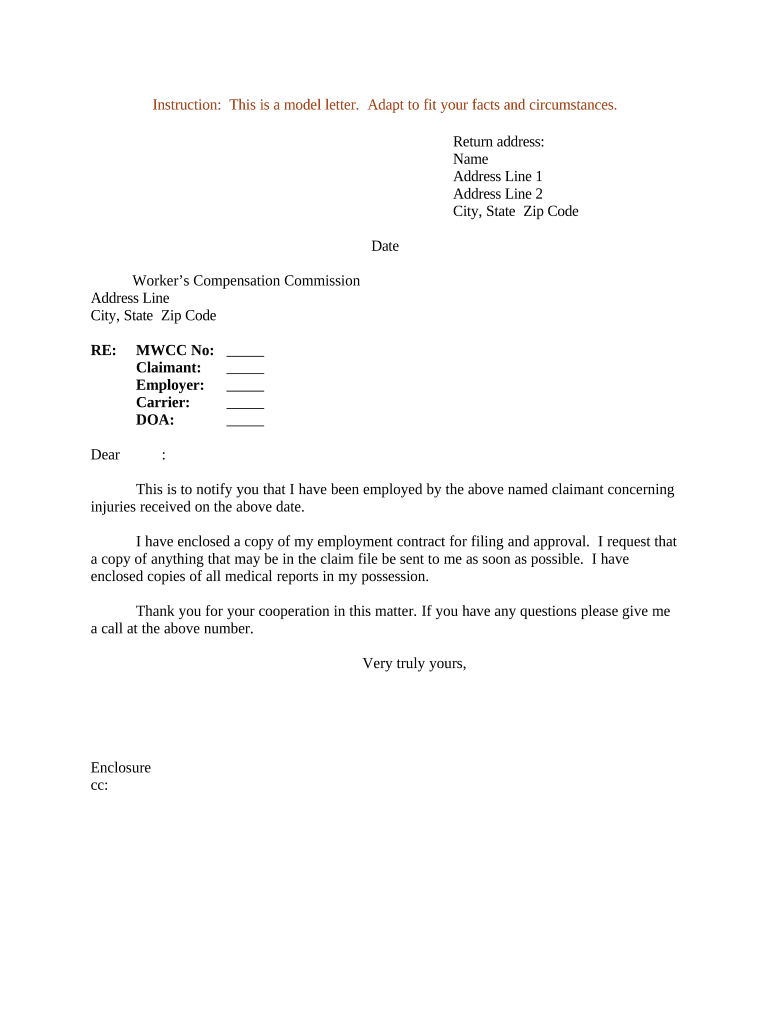
Letter to Worker’s Compensation Commission

This template is fully customizable. Edit the text, fill out the fields, and send it for signature. Give it a try!
Letter to Worker’s Compensation Commission

What a Letter to Worker’s Compensation Commission Is

A Letter to Worker’s Compensation Commission is a formal written communication submitted to a state workers' compensation board to report an injury, request a hearing, file an appeal, or provide documentary evidence related to a claim. It identifies the injured worker, employer, claim number, and the requested action, and it attaches supporting records such as medical reports, wage statements, and legal pleadings. The letter follows the commission’s filing rules and deadlines, may require notarization in some jurisdictions, and creates an official record for administrative review and case processing.

Why a Clear Letter Matters to Your Case

Use this letter to clearly state the relief or procedural step you seek, to ensure the commission has the necessary facts and documents, and to establish a formal, date-stamped record for appeals or enforcement. Clear letters reduce processing delays and evidentiary disputes.

Why a Clear Letter Matters to Your Case

Who Typically Submits These Letters

Injured workers, employers, attorneys, insurers, and medical providers commonly file a Letter to Worker’s Compensation Commission to report facts or request relief.

  • Injured worker: describes injury, treatment, time off, and requested benefits or hearings.
  • Employer: provides incident report, wage records, and position on compensability.
  • Attorney or representative: files appeals, legal arguments, and procedural motions on a claimant’s behalf.

Essential Parts of a Professional Letter

A professional Letter to Worker’s Compensation Commission is concise, factual, cites governing regulations when relevant, and organizes supporting exhibits so reviewers can locate evidence quickly during adjudication.

Header

Include date, commission name and address, claim or docket number, subject line, and sender contact details to ensure proper routing and a clear official record.
Identification

Identify the injured worker, employer, insurer, and claim number; include Social Security number or partial TIN only if required and consistent with privacy rules.

Statement of facts

Present a chronological, concise account of the injury, location, date and witnesses, treatment received, and any work restrictions supported by dates and sources.

Relief requested

Clearly state the action sought—benefit payment, medical authorization, hearing, or reconsideration—and cite specific statutory or regulatory authority when applicable.

Attachments

List and append supporting documents such as medical records, employer reports, wage statements, and authorization forms, labeling exhibits for easy reference during review.

Signature block

Include printed name, title, organization, mailing address, telephone, and signature; attorneys should include bar number and contact information for service.

Step-by-Step: Prepare and Submit the Letter

Follow these key steps to prepare a clear, complete Letter to Worker’s Compensation Commission that complies with administrative filing requirements.

  • 01
    Gather info: Collect claimant details, employer data, claim number, and medical records.
  • 02
    Draft facts: Write a concise chronological account with dates and witness names.
  • 03
    Attach exhibits: Label and paginate all supporting documents; include a cover exhibit list.
  • 04
    File and serve: Submit to commission per rules and serve opposing parties per procedure.

How to Configure an Online Submission Workflow

Set up an electronic submission workflow to place fillable fields, attach exhibits, and collect signatures or acknowledgements from parties.

Field Configuration
Claimant Name Required text field, autocomplete enabled for repeat filings.
Date of Injury Date field, enforce MM/DD/YYYY format with validation.
Attach Medical Records File upload field, accept PDF, max 25MB per file recommended.
Signature Signature field allowing typed, drawn, or certified electronic signature.

Where and How to Send Your Letter

Understand routing options: state commission e-filing portals, mailed certified copies, or in-person submissions depending on the commission’s procedures and case type.

  • Electronic Portal: File via the state commission’s online system when available.
  • Mail: Send certified mail with return receipt for proof of filing.
  • In Person: Deliver to the commission clerk during business hours; obtain a stamped receipt.
  • Counsel Filing: Attorney files electronically and serves all required parties under local rules.

Technical Considerations for eSubmission and eSignature

Preferred digital submission supports PDF/A, DOCX, and secure upload via the commission portal or a compliant eSignature provider.

  • File formats: PDF, PDF/A, DOCX accepted; prefer PDF for fidelity.
  • Integrations: Connects with case management and cloud storage systems.
  • Authentication: Email, SMS code, or advanced KBA options for signer verification.

Common Deadlines and Timing Expectations

Deadlines vary by state and claim stage; timely filing and adherence to appeal windows are essential to preserve rights and avoid denials.

Initial Notice:

Notify employer and commission promptly, often within 30 days of injury.

Claim Filing Deadline:

Submit claim per state statute; some states require filing within two years.

Medical Evidence Deadline:

Provide treating physician reports within the timeframe required by the commission.

Request Hearing:

Hearing requests often must be filed within 30–60 days after notice.

Appeal Window:

Administrative appeal deadlines vary; follow the commission’s specified timelines.

Common Mistakes That Cause Delays or Rejection

  • Failing to include the claim or docket number, which can result in misrouting and processing delays by the commission.
  • Attaching unsigned or unnumbered records that are hard to verify, creating questions about authenticity and chain of custody.
  • Using overly emotional or speculative language instead of factual chronology and documented evidence, weakening the credibility of the submission.
  • Omitting required consent or privacy authorizations for medical records, which can prevent the commission from reviewing key evidence.

Consequences of an Incorrect or Incomplete Letter

Missed Deadline: Claim may be denied.
Incomplete Evidence: Delays or unfavorable findings.
Incorrect Parties: Misrouting or rejection.
Privacy Violations: HIPAA breach risk.
False Statements: Fraud penalties possible.
Late Appeal: Limited or lost rights.

Required Information and Common Data Fields

Claimant Name: Full legal name as on ID.
Date of Injury: Enter as MM/DD/YYYY exact incident date.
Employer Details: Full employer name and address.
Claim Number: State-assigned claim or docket number.
Relief Requested: Specify benefit type or procedural action.
Attachments: List exhibits and include page counts.

Real-World Examples of Digital Letters in Practice

These brief examples show how organizations streamline administrative letters and maintain compliance when handling workers' compensation communications.

Martin Properties

Martin Properties needed a reliable way to submit administrative letters and collect signatures remotely.

  • Reduced turnaround and ensured compliance.
  • I can process and execute all of these documents online with 100% compliance and built-in security. Whether on mobile or working offline, I can get forms back to their necessary parties efficiently.

BIS

BIS sought stronger auditability and secure record retention for claim correspondence.

  • Improved internal control and auditability.
  • We felt most comfortable with airSlate SignNow given their SOC 2 certification and strict focus on ESIGN and UETA act compliance.

eSignature Pricing and Feature Comparison

Overview comparison of common eSignature plan features and starting prices to consider when preparing and submitting Letters to Worker’s Compensation Commission.

signNow DocuSign Adobe Sign PandaDoc HelloSign
Starting Price $8/user/mo $15/user/mo $14/user/mo $19/user/mo $15/user/mo
Free Trial 7-day free trial Varies Varies Varies Varies
Bulk Send Yes (Premium) Yes Yes Yes No
Audit Trail Yes Yes Yes Yes Yes
HIPAA Compliant Yes (BAA) Yes Yes No No
Envelope Cap No envelope cap 100 envelopes/user/year Varies Varies Varies

Frequently Asked Questions About Letters to the Commission

Answers to common procedural and technical questions encountered when preparing or submitting a Letter to Worker’s Compensation Commission.


Need help? Contact support

be ready to get more
Join over 28 million airSlate SignNow users