Establishing secure connection…Loading editor…Preparing document…

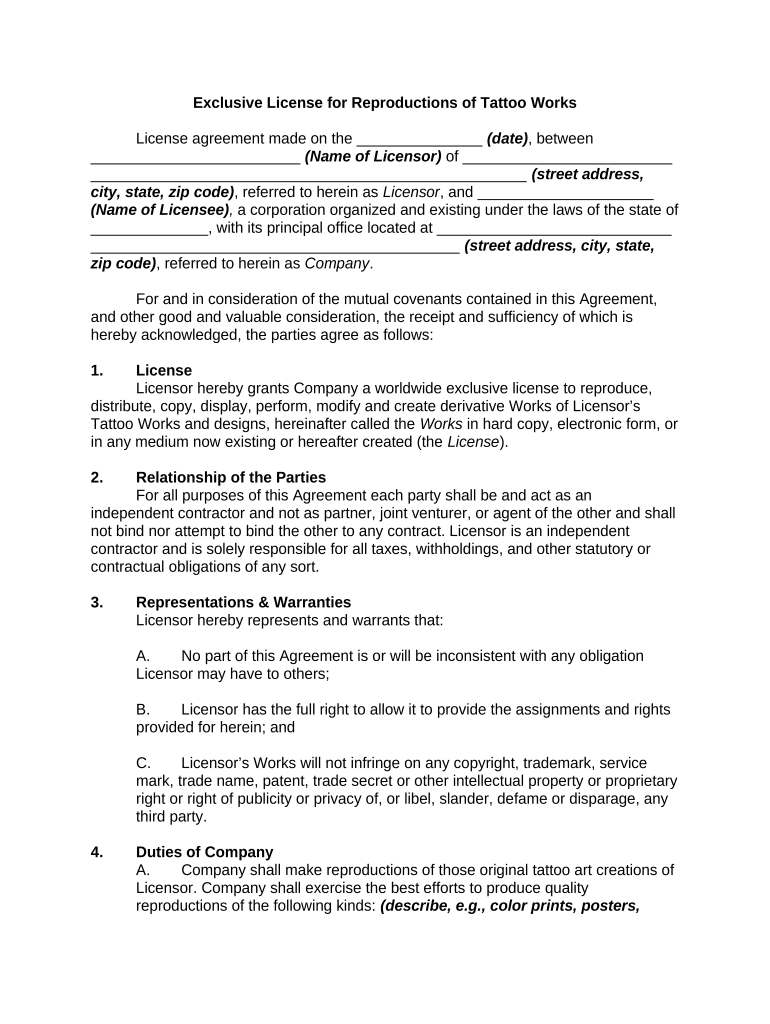
Exclusive License for Reproductions of Tattoo Works

This template is fully customizable. Edit the text, fill out the fields, and send it for signature. Give it a try!
Exclusive License for Reproductions of Tattoo Works

What this Exclusive License document is and covers

The Exclusive License for Reproductions of Tattoo Works is a written agreement in which a tattoo artist (licensor) grants another party (licensee) the exclusive right to reproduce and commercially use specified tattoo designs. It defines the scope of works, reproduction methods, exclusive territory, duration, payment or royalty terms, and permitted sublicensing. The agreement allocates ownership assertions, warranty disclaimers, and indemnities, and typically specifies governing law and dispute resolution. In the United States, electronic execution is generally enforceable under ESIGN and state UETA laws when the signature, consent, attribution, and record retention requirements are met.

Why an exclusive reproduction license matters

An exclusive reproduction license clarifies ownership and commercially enforceable reproduction rights, enables the artist or licensee to monetize designs, reduces the risk of unauthorized copies and disputes, and sets clear terms for royalties, sublicensing, and termination under applicable state and federal law.

Why an exclusive reproduction license matters

Who typically completes or signs this license

Typical parties include tattoo artists licensing designs, publishers or brands acquiring reproduction rights, and counsel coordinating terms.

  • Tattoo artists licensing original designs for commercial reproduction by manufacturers, publishers, or media partners.
  • Apparel and merchandise brands obtaining exclusive rights to reproduce tattoos on products and marketing materials.
  • Publishers, galleries, and digital platforms licensing artwork reproduction rights for editorial, promotional, or commercial use.

Core contract elements to include for clarity and enforcement

Core elements organize rights, payments, limits, and enforcement terms so parties understand exactly what reproductions are allowed, how royalties are calculated, and how disputes are resolved.

Parties

Identify licensor (artist) and licensee with full legal names, contact details, and authorized signatories. Include corporate entity details if a business is a party and clarify successors or assigns for enforcement.
Grant

Specify exclusive reproduction rights granted, formats (print, digital, merchandise), duration, territory, and whether sublicenses or transfers are permitted; clearly reserve any rights the licensor retains.

Scope

List each work covered by title, description, reference images, and file formats. Include examples, registration numbers, or exhibit attachments to minimize ambiguity about which designs are included.

Compensation

State fixed fees, royalty percentages, payment schedules, reporting requirements, audit rights, currency, taxes responsibility, late payment remedies, and whether advances or recoupable costs apply.

Warranties & Indemnity

Licensor warrants ownership or right to license the tattoos and discloses third‑party claims; licensee indemnifies against misuse, and both parties define limits on consequential damages and indemnity cap.

Termination

Describe termination triggers for breach, insolvency, or failure to pay; outline cure periods, post‑termination rights to existing stock, return or destruction of files, and survival of key clauses.

Step-by-step completion and execution workflow

Follow these sequential steps to complete, execute, and manage the Exclusive License for Reproductions of Tattoo Works from drafting to post‑execution administration.

  • 01
    Prepare: Draft agreement with exhibits and reference images attached.
  • 02
    Review: Have both parties and counsel review for IP and tax issues.
  • 03
    Sign: Execute via wet ink or compliant electronic signature with audit trail.
  • 04
    Record: Retain executed copies, register copyrights if needed, and monitor royalty reports.

Configure an electronic signing workflow

Configure an electronic workflow to collect signatures and supporting images securely while preserving an audit trail for the license agreement.

Field Recommended Value | Notes
Signature Method Email link | Use SMS OTP or PKI for higher assurance
Authentication Email verification | Add SMS or ID check for stronger proof
Attachments Reference images | Require high-resolution files as exhibits
Audit Trail Comprehensive | Record IP, timestamps, and signer certificate
Access Controls Role-based | Limit editing and require signer authentication

Where to send and store executed licenses

Typical routing and submission points for an executed exclusive license, including registration, distribution to parties, and repository steps.

  • To Parties: Deliver executed copies to licensor and licensee; retain originals.
  • Copyright Office: Optional register works with U.S. Copyright Office to preserve remedies.
  • Distributors: Send licenses to manufacturers or platforms relying on reproduction rights.
  • Repository: Store executed PDF and audit trail in secure records retention system.

Platform requirements for eSigning and secure recordkeeping

Choose a signing platform that supports ESIGN and UETA compliance, strong encryption, and audit trails for the Exclusive License for Reproductions of Tattoo Works.

  • Encryption: TLS 1.2/1.3 in transit; AES-256 at rest
  • Authentication: Email, SMS OTP, or KBA; optional 2FA
  • File Formats: PDF, DOCX, PNG, and source files accepted

Key dates and recurring deadlines to include

Key dates and recurring timelines to include in the license for payment, reporting, audits, termination notice, and record retention.

Effective Date:

Date when rights begin; use MM/DD/YYYY format.

Royalty Reporting:

Quarterly or monthly schedule; specify due date (for example, within 30 days of quarter end).

Audit Notice Period:

Specify notice period (commonly 30 days) and audit frequency.

Termination Notice:

Specify cure periods and written notice window (commonly 30–60 days).

Record Retention:

Specify retention for accounting records and original files; follow IRS and HIPAA retention as applicable.

Common mistakes to avoid when preparing the license

  • Failing to attach reference images or exhibit lists creates ambiguity about which tattoos are licensed, often leading to disputes over permitted reproductions and costly litigation.
  • Not clarifying whether the licensee may sublicense or sell reproduction rights can permit unintended third‑party use or block commercial opportunities.
  • Omitting reporting cadence, audit rights, or remedies for late royalties leads to collection difficulties and weak enforcement options.
  • Failing to address artist attribution, moral rights, or alterations to artwork can trigger reputational disputes and rights assertions under state or federal law.

Legal risks and potential consequences of defective agreements

Injunction: Court may enjoin reproductions
Statutory Damages: Possible if copyright registered timely
Contract Damages: Monetary damages for breach
Loss of Revenue: Unpaid royalties and accounting
Costs and Fees: Attorney fees if contract provides
Registration Timing: Register promptly to preserve remedies

Who should sign and what authority is required

Artist (Licensor)

The signatory for the licensor must be the original tattoo artist or an authorized owner of the artwork. If the work was created under employment or as work‑for‑hire, the copyright owner entity must execute the license to convey exclusive reproduction rights.

Licensee Representative

The licensee's signer should be an officer or authorized agent with capacity to bind the entity; include printed name, title, and, for large transactions, evidence of corporate authorization or board approval to prevent later challenges.

Real-world examples of exclusive reproduction licenses

Two common scenarios illustrate how exclusive reproduction licenses are structured in commerce and publishing.

Apparel Licensing Case

An independent tattoo artist grants an apparel company exclusive reproduction rights for a signature sleeve design to produce a limited clothing line.

  • Limited run, royalty per item.
  • The license specified territory, a one‑year term with renewal options, reporting and audit rights, and clear exhibit images; the parties used electronic signatures and preserved an audit trail for enforcement and recordkeeping.

Publishing Licensing Case

A niche magazine obtains an exclusive license to reproduce select tattoo art for a feature spread and related promotional merchandise.

  • Editorial and merch rights included.
  • The agreement required high‑resolution image delivery, attribution language, and a royalty schedule tied to ad revenue; the publisher registered the works with the Copyright Office before wide distribution to enable statutory remedies.

Typical eSignature pricing and capability comparison for executing the license

Baseline pricing and common capabilities among major eSignature providers helpful when selecting a platform to execute and manage Exclusive License for Reproductions of Tattoo Works.

signNow DocuSign Adobe Sign PandaDoc HelloSign
Starting Price $8/user/mo $15/user/mo $14/user/mo $19/user/mo $15/user/mo
Free Trial 7-day free trial Verify Verify Verify Verify
Bulk Send Yes Yes Yes Yes No
Audit Trail Yes Yes Yes Yes Yes
HIPAA Compliant Yes Yes Yes No No
Envelope Cap No cap 100 envelopes/user/year No cap No cap No cap

Frequently asked questions about licensing and execution

Answers to common questions about executing, enforcing, and managing an Exclusive License for Reproductions of Tattoo Works electronically and across states.


Need help? Contact support

be ready to get more
Join over 28 million airSlate SignNow users