Establishing secure connection…Loading editor…Preparing document…

Formal Notice of Intention to File Claim

This template is fully customizable. Edit the text, fill out the fields, and send it for signature. Give it a try!
Formal Notice of Intention to File Claim

What a Formal Notice of Intention to File Claim Is

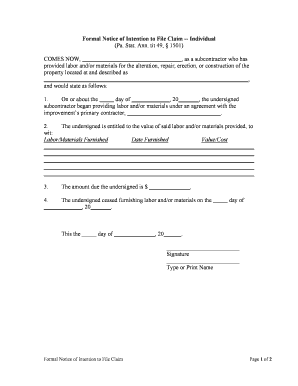
A Formal Notice of Intention to File Claim is a written declaration that a party intends to pursue a legal or administrative claim unless the recipient cures the alleged breach or otherwise resolves the dispute. It is commonly used in contractor, insurance, landlord‑tenant, and commercial contract contexts to preserve rights, trigger response periods, and document attempts at resolution. The notice typically states the basis of the claim, the relief requested, a deadline for response, and instructions for submitting evidence or payment. Proper formality and delivery affect enforceability and timing.

Why a Formal Notice Matters for Your Claim

A properly prepared notice preserves legal remedies, creates a written record of demand, and may be required by contract or statute before filing a suit.

Why a Formal Notice Matters for Your Claim

Who Typically Prepares or Receives These Notices

Parties who commonly prepare or review these notices include individual claimants, in-house legal teams, property managers, and claims administrators.

  • Individual claimants seeking payment or remedy from a business or insurer.
  • Claims administrators handling pre‑litigation dispute escalation and recordkeeping.
  • Contract managers enforcing cure or notice provisions under commercial contracts.

The recipient is often the party alleged to be liable, their counsel, or an insurance carrier depending on contract terms and governing law.

Representative People Who Sign or Review

Authorized Representative

An organization’s authorized representative or claims manager who can bind the entity should prepare or sign the notice. Include full name, title, company, and contact information. This person is responsible for coordinating responses and preserving internal audit trails for potential litigation.

Individual Claimant

An individual claimant or plaintiff signs when asserting personal damages or contractual breaches. The notice should include the claimant’s legal name, address, and preferred contact method; mismatches in identity or incomplete information can delay processing or lead to rejected filings.

Core Elements to Include in a Professional Notice

A complete notice follows a consistent structure so recipients can identify the claim, the requested remedy, and the deadline for response.

Header

Clear title and date at the top. Identify parties and reference the underlying contract, policy, or account number to avoid ambiguity.
Statement of Intent

Plain statement that the sender intends to file a claim if the issue is not cured by a specific deadline; avoid ambiguous or conditional phrasing.

Basis for Claim

Concise description of facts, breached provisions, or loss amounts. Attach supporting documents or cite specific contractual sections where applicable.

Requested Remedy

Specify precise relief sought (payment amount, corrective work, cure within X days) and any interest or costs claimed.

Deadline and Next Steps

Provide an explicit deadline in MM/DD/YYYY format and describe how responses should be delivered (mail, email, eSubmission).

Signature Block

Printed name, title, organization, contact details, and signature (electronic signature allowed if permitted by contract or law).

Step-by-Step: Preparing and Issuing the Notice

Follow these core steps to draft, approve, and serve a Formal Notice of Intention to File Claim.

  • 01
    Gather Evidence: Collect contracts, invoices, photos, and correspondence supporting your claim.
  • 02
    Draft Notice: Compose clear statement of intent, basis, remedy, and deadline.
  • 03
    Internal Review: Have counsel or claims staff verify legal sufficiency and deadlines.
  • 04
    Serve Notice: Deliver per contract or statute: certified mail, courier, or permitted eDelivery.

How to Configure an Online Notice Workflow

Set up an online workflow that captures required fields, attachments, and proof of delivery to streamline processing.

Field Configuration
Signature Type Electronic signature with audit trail
Authentication Email link or SMS code verification
Attachments Allow PDFs, images, and invoice files
Delivery Proof Capture timestamps, IP, and delivery receipts

Where and How to Submit the Notice

Choose a submission method consistent with contract terms or applicable statute to ensure valid service.

  • Certified Mail: Physical return receipt provides robust proof of service.
  • Commercial Courier: Use signature required delivery for chain of custody.
  • Email / eSubmission: Use allowed business emails and preserve delivery headers.
  • Platform Upload: Submit via a secure portal if specified by contract.

Technical Considerations for eSubmission and Signing

Confirm the recipient’s contractual or statutory acceptance of electronic delivery and signatures before eSubmitting.

  • File Formats: PDF and DOCX supported
  • Authentication: Email link, SMS, or stronger options
  • Audit Trail: Timestamps, IP, and event history

Retain exports and audit logs as part of the notice record; these are critical if the matter proceeds to arbitration or court.

Typical Deadlines and Response Windows

Deadlines vary by contract and jurisdiction; state statute and contractual cure periods dictate the required response timeframe.

Cure Period:

Commonly 10–30 days, varies by contract and statute

Response Deadline:

Set specific date; often 30 days after receipt

Filing Deadline:

Statute of limitations unaffected by notice unless tolling is specified

Preservation:

Retain records from service date until resolution

Extension Requests:

Recipient may request additional time; document in writing

Common Mistakes to Avoid When Preparing a Notice

  • Missing or incorrect recipient name or address that prevents proper service and delays the response timeline.
  • Vague description of the claim or relief sought that allows the recipient to dispute or ignore the notice.
  • Failure to follow contract-specified delivery method, which can render the notice procedurally defective.
  • Omitting supporting evidence or failing to attach key documents that substantiate the claimed amount or breach.

Consequences of an Improper or Late Notice

Forfeited Rights: May lose right to recovery
Claim Dismissal: Court may dismiss on procedural grounds
Increased Costs: Added fees and interest possible
Default Judgments: Poor service can invite default or counterclaims
Insurance Denial: Untimely notice may void coverage
Evidentiary Risks: Weak record harms credibility

How Formal Paper Notices Compare with Electronic Notices

Compare traditional paper service and electronic delivery to choose the method that best meets contractual and evidentiary needs.

Criteria Paper Notice Electronic Notice
Notarization sometimes required rarely required
Proof of Delivery return receipt delivery logs and headers
Processing Time days to weeks hours to days
Record Retention physical archive digital storage with audit trail

eSignature Vendor Pricing and Capability Snapshot

Basic plan pricing and a few capability checkpoints for common eSignature vendors. Use this comparison to evaluate per‑user costs and compliance needs without assuming identical feature sets.

signNow DocuSign Adobe Sign PandaDoc HelloSign
Starting Price $8/user/mo $15/user/mo $14/user/mo $19/user/mo $15/user/mo
Free Trial 7-day free trial Varies Varies Varies Varies
Bulk Send Yes Yes Yes Yes No
Audit Trail Yes Yes Yes Yes Yes
HIPAA Compliant Yes Yes Yes No No

How Organizations Use a Formal Notice in Practice

Real examples show how notices prompt resolution and preserve legal rights across industries.

Construction Claim Example

A general contractor sent a notice alleging unpaid change orders and requested payment within 21 days.

  • The recipient cured the amount and avoided lien filing.
  • Proper documentation and a clear deadline helped settle the dispute without incurring lien or litigation costs.

Insurance Claim Example

An insured submitted a formal notice to an insurer documenting damage and policy sections relied upon.

  • The insurer responded with a coverage position.
  • The written exchange created a clear record used later in an arbitration proceeding to establish timely notice and mitigate coverage defenses.

Frequently Asked Questions About Formal Notices

Answers to common procedural and technical questions when preparing or serving a Formal Notice of Intention to File Claim.


Need help? Contact support

be ready to get more
Join over 28 million airSlate SignNow users