Scope & Recitals
Define the parties, the reason for liquidation, effective date, and legal authority for the liquidation. Clear recitals limit later factual disputes and frame the agreement's intent and governance.
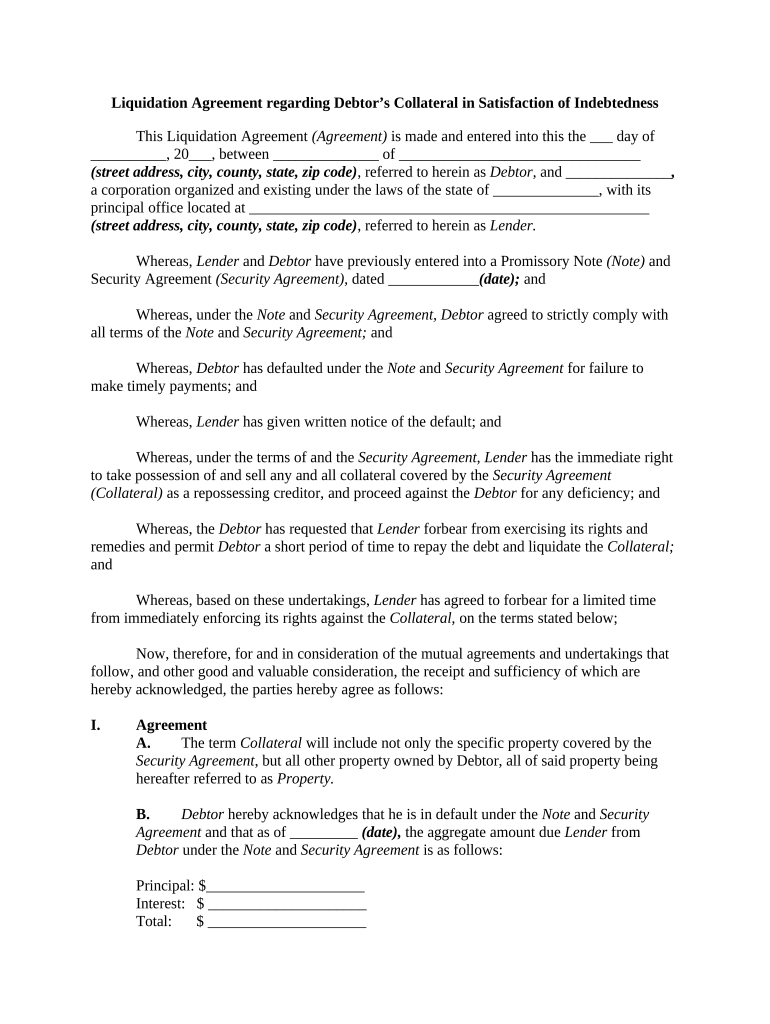
A well-drafted Liquidation Agreement reduces dispute risk, clarifies creditor priorities, preserves asset value through defined sale procedures, and documents distribution mechanics and timelines to support enforceability under applicable law.

Different parties may draft, approve, or sign a Liquidation Agreement depending on context, including company officers, secured creditors, appointed liquidators, trustees, or court-appointed representatives.
Identify the responsible signing authority and confirm any required corporate approvals, board resolutions, or court orders before execution to avoid invalidation.
A CRO acts on behalf of the debtor to negotiate asset sales, approve distributions, and represent the estate in creditor communications. The CRO must have written authorization (board resolution or court order) to bind the entity under the Liquidation Agreement.
An appointed liquidator or trustee administers the liquidation, collects and sells assets, reviews creditor claims, and prepares the final accounting. Their duties and liabilities are defined by statute, court order, or the agreement itself.
Define the parties, the reason for liquidation, effective date, and legal authority for the liquidation. Clear recitals limit later factual disputes and frame the agreement's intent and governance.
Name the liquidator or trustee and specify powers, limitations, compensation, reporting obligations, and removal procedures to ensure transparent administration of the estate.
Provide a detailed list or exhibit of assets to be liquidated or transferred, valuation approach, and any encumbrances to allow accurate creditor notices and sale planning.
Set the claims submission procedure, required supporting documentation, review timeline, and objection mechanisms so parties know how to assert and resolve claims.
Specify priority rules, payment sequence (secured creditors, priority claims, unsecured creditors, equity), and methods for distributing net proceeds or retained reserves.
Require detailed accounting, retention of sale records, tax reporting responsibilities, and a schedule for final accounting and termination of the liquidation process.
| Field | Configuration |
|---|---|
| Template | Create reusable template with locked sections |
| Conditional Fields | Show creditor exhibit fields only if applicable |
| Authentication | Use email + SMS or stronger signer ID |
| Audit Trail | Enable IP, timestamp, and certificate recording |
When choosing a platform for e-signing, confirm integration support (ERP/CRM), supported file formats, and authentication options that meet regulatory needs.
Platforms that capture detailed audit trails and integrate with storage systems simplify compliance and post-liquidation reporting.
Date when obligations and rights begin under the agreement.
Typical window is 30–90 days after notice; specify exact MM/DD/YYYY.
Specify scheduled dates or milestone-triggered distributions.
Set date for final report and approval of distributions.
Date after which remaining assets may be retained per policy.
Board resolution or court order authorizes the liquidation process.
Draft and circulate the Liquidation Agreement for review and approval.
Publish and send notices; accept and adjudicate creditor claims.
Sell assets, pay priorities, and distribute net proceeds.
| signNow | DocuSign | Adobe Sign | PandaDoc | HelloSign | |
|---|---|---|---|---|---|
| Starting Price | $8/user/mo | $15/user/mo | $14/user/mo | $19/user/mo | $15/user/mo |
| Free Trial | 7-day trial | Free trial available | Free trial available | Free trial available | Free trial available |
| Bulk Send | Yes | Yes | Yes | Yes | No |
| Audit Trail | Yes | Yes | Yes | Yes | Yes |
| HIPAA Compliant | Yes | Yes | Yes | No | No |
| Envelope Cap | No cap | 100 envelopes/user/year | Varies by plan | Varies | Varies |
A small corporation decides to dissolve after losses and drafts a Liquidation Agreement to sell inventory and equipment.
A corporate parent liquidates a non-core subsidiary and uses the agreement to transfer customer contracts and inventory to a buyer.