Petition Statement
Clear factual narrative of the protected person’s incapacity, daily limitations, incidents demonstrating incapacity, and the petitioner’s relationship and legal interest in seeking interdiction.
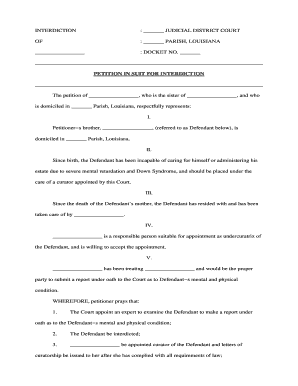
A well-prepared interdiction petition clarifies rights and responsibilities for the protected person and the proposed guardian, reduces delay in court review, and documents medical and factual evidence the judge needs to assess capacity.

Several parties may prepare or initiate an interdiction filing depending on family structure and public interest.
Selecting the correct filer and ensuring supporting documentation is attached helps the court evaluate the petition and schedule hearings efficiently.
Clerks accept and docket interdiction petitions, verify filing fees and signatures, and provide information on local hearing calendars and required forms for the specific parish.
An attorney drafts the petition, assembles medical affidavits and inventories, represents the petitioner at hearing, and prepares the proposed curator/guardian appointment documents for court approval.
Clear factual narrative of the protected person’s incapacity, daily limitations, incidents demonstrating incapacity, and the petitioner’s relationship and legal interest in seeking interdiction.
One or more physician or clinical evaluator affidavits describing cognitive or functional impairment, assessment dates, and examinations that support the need for court-ordered protection.
Name, contact information, qualifications, criminal background disclosures, and a statement of willingness to serve as guardian or curator for the court’s consideration.
Preliminary list of the alleged incapacitated person’s property, liabilities, income sources, and relevant account details to aid the court in deciding protective scopes.
Specific authorities sought (personal care, financial management, medical consent), with distinctions between limited, plenary, or emergency powers.
Draft orders the petitioner asks the judge to sign — temporary measures, visitation rules, and notice provisions for third parties holding assets.
| Field | Configuration |
|---|---|
| Authentication Method | Email link plus SMS code for signer verification |
| Signing Order | Sequential signing to preserve witness chronology |
| Notary Mode | Support in-person or remote online notarization when allowed |
| Audit Trail | Enable full timestamps, IPs, and download logs |
Local clerk calendars typically schedule initial hearings within 30 to 90 days
Courts prefer evaluations completed within the prior 30 to 90 days
Allow sufficient time to serve the protected person and interested parties before hearing
Judge may issue emergency temporary protections pending a full hearing
Parties commonly have post-judgment appeal periods set by local rules
Court accepts petition and assigns case number
Court may grant emergency restrictions or appoint a temporary curator
Parties present medical affidavits and inventories to the court
Judge evaluates evidence and issues a final interdiction order
Ensure your e-sign and e-filing platform supports notarization workflows, detailed audit trails, and secure document storage.
Confirm the chosen platform meets court rules for filed documents, supports your notarization method, and retains audit logs for the required retention period.
| signNow | DocuSign | Adobe Sign | PandaDoc | HelloSign | |
|---|---|---|---|---|---|
| Starting Price | $8/user/mo | $15/user/mo | $14/user/mo | $19/user/mo | $15/user/mo |
| Free Trial | 7-day free trial | Varies by vendor | Varies by vendor | Varies by vendor | Varies by vendor |
| Bulk Send | Yes | Yes | Yes | Yes | Yes |
| Audit Trail | Yes | Yes | Yes | Yes | Yes |
| HIPAA Compliant | Yes | Yes | Yes | No | No |
| Envelope Cap | No cap | 100 envelopes/user/year | Varies | Varies | Varies |
An elderly parent exhibiting progressive dementia requires full financial protection; petitioner files a petition with recent neurocognitive evaluations and a detailed asset inventory.
An adult with severe traumatic brain injury lacks decision-making capacity; family seeks limited personal care and medical-consent powers for a relative.