Establishing secure connection…Loading editor…Preparing document…

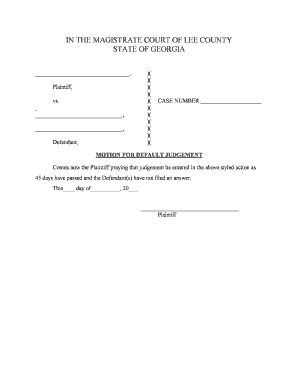
Georgia Motion for Default Judgment

This template is fully customizable. Edit the text, fill out the fields, and send it for signature. Give it a try!
Georgia Motion for Default Judgment

What the Georgia Motion for Default Judgment Is

A Georgia Motion for Default Judgment asks a court to enter judgment against a defendant who failed to appear, respond, or defend within the time required by law. In Georgia civil practice the motion typically follows a properly served complaint and a clerk s entry of default or proof that the defendant was served but has not answered. The motion must show facts establishing the defendant s default, the amount or relief requested, and support such as affidavits, accountings, or contract copies so the judge can determine damages and enter a final order.

Why this motion matters in Georgia cases

Filing a Motion for Default Judgment provides a streamlined route to a final court order when a party fails to respond. It preserves rights without requiring a full trial and enables recovery of damages, costs, and statutory interest where authorized.

Why this motion matters in Georgia cases

Who typically prepares and files this motion

Georgia plaintiffs, their attorneys, and collection agents prepare Motions for Default Judgment after a defendant fails to respond within the statutory period.

  • Plaintiff or plaintiff s counsel preparing proof of service and damages
  • Collections professionals assembling documentation for judgment enforcement
  • Small-business owners filing pro se when an opposing party does not answer

Step-by-step: preparing and filing the motion

Follow these steps in order to prepare a complete motion and reduce the chance of procedural rejection.

  • 01
    Confirm service and default: Verify proof of service and clerk s default entry
  • 02
    Calculate damages: Total principal, contractual interest, fees, and costs
  • 03
    Assemble exhibits: Attach contracts, invoices, affidavits, and service proof
  • 04
    File and serve: File with the clerk and serve the defendant per local rules

Core elements every professional motion includes

A clear, well-documented motion increases the likelihood the court will grant relief without additional hearings.

Complete caption

Accurate court identification, case number, and party names matching the complaint and docket entries.
Statement of default

Concise factual statement showing defendant was served and failed to answer within the time required by law.

Detailed damages

A breakdown of amounts due, including contract terms for interest, late fees, and any statutory penalties claimed.

Affidavit of facts

Sworn declaration from plaintiff or custodian verifying the amounts and service facts; signed and dated under oath.

Exhibit index

Numbered exhibits with document descriptions to allow the court to confirm support for the relief requested.

Proposed order

A draft order for the judge to sign that precisely implements the relief and includes enforcement directions.

Required information and key entries

Case Caption: Court name, case number
Plaintiff Identity: Full legal name
Defendant Identity: Full legal name
Service Details: Method and date
Relief Sought: Amounts or remedies
Supporting Evidence: Exhibits listed

Common pitfalls to avoid

  • Missing or inconsistent case caption that does not match the complaint
  • Failing to attach proof of service or clerk s default entry
  • Vague damages statements without documentary backup
  • Unsigned motions or missing attorney identification

Consequences of submitting an incorrect motion

Delay or denial: Court may strike or deny the motion
Fee exposure: May incur additional filing or defense costs
Judgment vulnerability: Errors can lead to successful set-aside motions
Sanctions risk: Frivolous claims may trigger sanctions
Time lost: Extra hearings and briefing required
Enforcement delays: Execution on judgment deferred

Where to file and how the process unfolds

This outlines routing: preparing the motion, filing with the clerk, serving the defendant, and obtaining a judge s order or clerk s final judgment where permitted.

  • Prepare motion: Draft motion and attach exhibits
  • File with clerk: Submit to the county civil clerk s office
  • Serve defendant: Provide notice of motion and any hearing
  • Obtain order: Judge signs order or clerk enters judgment

How to customize the motion for e-filing and e-signature

Set up an electronic workflow that captures signatures, attachments, and service proof consistent with Georgia rules and local e-filing requirements.

Field Configuration
Signature Type Typed or drawn signature allowed; include audit trail
Attachment Format PDF/A preferred for court filings
Service Proof Attach affidavit of service or e-filing receipt
Authentication Use email or two-factor for signer attribution

Electronic submission and signing considerations

Courts and clerks vary in accepted e-filing formats and signature authentication; confirm local rules before e-submitting.

  • File formats: PDF, PDF/A
  • Authentication: Email link or two-factor
  • Audit trail: IP, timestamp, signer data

Key timing rules and expectations

Timeliness centers on the service date and response period; Georgia civil practice requires attention to the date a defendant was served and any extensions or tolling events.

Service to answer:

Usually 30 days for in-state service

Clerk entry of default:

After answer deadline expires

Motion filing:

File promptly after default entry

Hearing scheduling:

Court sets hearing if needed

Post-judgment appeals:

Follow Georgia appeal deadlines

Milestones from complaint to judgment

A sequential view of the main stages can help track deadlines and necessary filings so the court can enter judgment efficiently.

01

Complaint Filed

Plaintiff files complaint initiating the action

02

Service Completed

Defendant is served per Georgia law

03

Answer Deadline

Statutory period for defendant to respond

04

Default & Motion

Clerk defaults then plaintiff files motion for judgment

Real examples of how motions are used

These short cases illustrate typical scenarios where a Motion for Default Judgment resolves claims without a contested trial.

Commercial Contract

A small supplier filed a complaint for unpaid invoices and served the defendant.

  • Defendant did not answer within the deadline.
  • The court entered a default judgment on submitted invoices, interest, and court costs after the plaintiff provided invoices, proof of service, and an affidavit of amounts due.

Consumer Debt

A creditor sued for a charged-off account and obtained a clerk s default.

  • Debtor failed to respond or appear.
  • The creditor obtained a default judgment supported by account statements and an affidavit from the account custodian, then proceeded to post-judgment enforcement steps.

Common eSignature providers compared for filing and signing court documents

Platforms vary by price, bulk capabilities, and compliance features; signNow is listed first for comparison purposes with representative plan or starting-price data.

signNow DocuSign Adobe Sign PandaDoc HelloSign
Starting Price $8/user/mo $15/user/mo $14/user/mo $19/user/mo $15/user/mo
Free Trial 7-day free trial Varies by vendor Varies by vendor Varies by vendor Varies by vendor
Bulk Send Yes Yes Yes Yes Yes
Audit Trail Yes Yes Yes Yes Yes
HIPAA Compliant Yes Yes Yes No No

Frequently asked questions about Georgia Motions for Default Judgment

Answers to common practical and procedural questions about preparing, filing, and enforcing a Motion for Default Judgment in Georgia.


Need help? Contact support

be ready to get more
Join over 28 million airSlate SignNow users