Establishing secure connection…Loading editor…Preparing document…

Maine Disclosure Hearing

This template is fully customizable. Edit the text, fill out the fields, and send it for signature. Give it a try!
Maine Disclosure Hearing

What a Maine Disclosure Hearing Covers

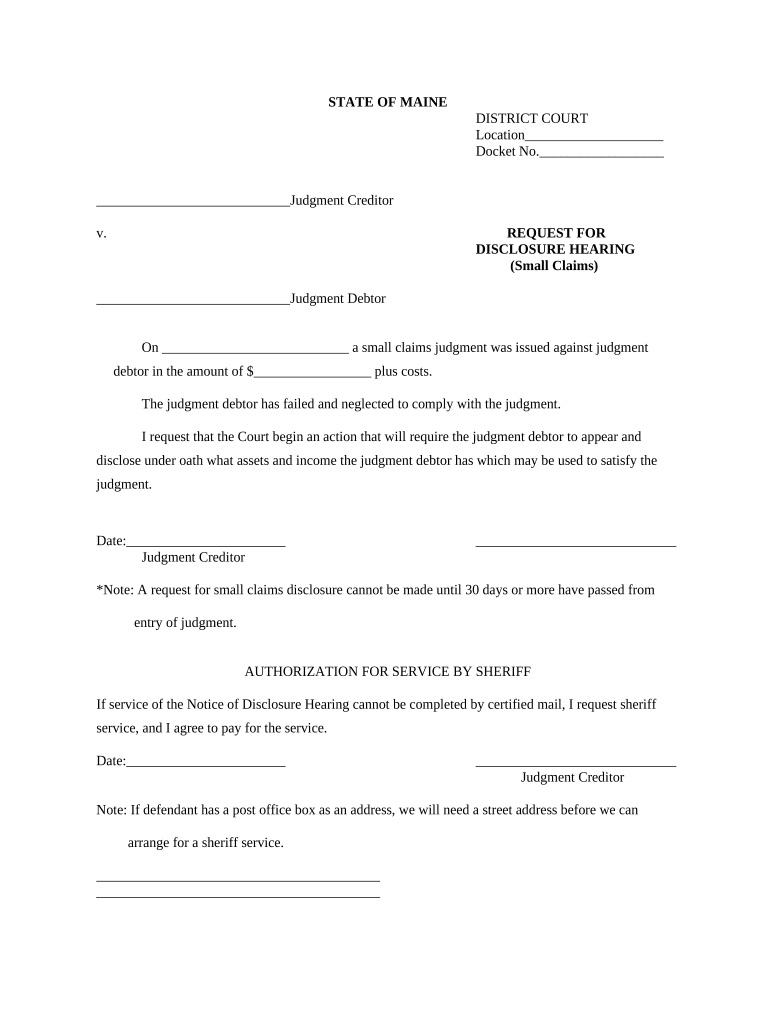
A Maine Disclosure Hearing is a court proceeding during which parties present and, where required, formally disclose documents, financial details, or factual statements to opposing parties and the judge before a resolution or order is issued. These hearings commonly appear in civil litigation, family law, probate, and contested administrative matters. The hearing ensures transparency, supports evidentiary rulings, and gives the court a clear record of what each side intends to rely on at trial or in settlement discussions. Local court rules and scheduling orders govern timing and required filing formats.

Why complete disclosures carefully

Accurate, timely disclosure reduces risk of sanctions, preserves evidence for appeal, and helps the court resolve factual disputes efficiently while protecting parties’ procedural rights.

Why complete disclosures carefully

Who typically participates in a Maine Disclosure Hearing

Typical participants and their roles are straightforward and procedural.

  • Litigants and their attorneys who prepare and present disclosure materials to comply with court orders and scheduling requirements.
  • Judges and court staff who review filings, enforce disclosure deadlines, and rule on admissibility or sanctions.
  • Third-party witnesses, forensic accountants, or trustees who supply exhibits, sworn statements, or expert reports for the record.

Key signer and participant roles

Litigant

A party to the case who must disclose requested documents and attest to their completeness. The litigant is responsible for certifying accuracy under penalty of perjury and for responding to discovery motions if disclosures are incomplete.

Attorney

Counsel prepares disclosure packages, files required affidavits or certificates with the court, and presents evidence at the hearing. Attorneys must follow local rules for formatting, service, and authentication of exhibits.

Core elements of a professional disclosure package

A complete disclosure package for a Maine Disclosure Hearing bundles required affidavits, numbered exhibits, service proof, an index, and any supporting certifications or expert reports in a format acceptable to the court.

Notice of Hearing

A clear notice stating date, time, location, and the matters to be addressed at the disclosure hearing; must follow the court’s scheduling order and service rules.
Affidavit of Disclosure

A signed affidavit summarizing what was produced, referencing exhibit numbers, and attesting under oath to the accuracy and completeness of the disclosure materials.

Indexed Exhibits

Numbered or tabbed exhibits with an index; each exhibit should be labeled, Bates-stamped where appropriate, and referenced in the affidavit or hearing brief.

Certificate of Service

A signed certificate showing how and when opposing counsel and relevant parties were served with disclosure materials, complying with Maine Rules of Civil Procedure.

Authentication

Documentation or testimony establishing chain of custody or authenticity for records, including notarizations, declarations under penalty of perjury, or business records foundations.

Hearing Brief

A concise statement for the court explaining contested disclosure points, legal authority relied on, and the specific relief or rulings requested at the hearing.

Step-by-step: preparing for the hearing

Follow a standard sequence to prepare, serve, and file disclosure materials so the hearing proceeds without procedural delay.

  • 01
    Gather Documents: Collect and paginate all requested records and organize them by exhibit number.
  • 02
    Prepare Affidavit: Draft an affidavit describing produced materials and sign under penalty of perjury.
  • 03
    Serve Opposing Parties: Serve the disclosure package per court rules and prepare a certificate of service.
  • 04
    File with Clerk: File the package with the court clerk and confirm receipt before the hearing date.

Typical e-submission workflow for disclosure materials

Build a simple digital workflow that tracks document preparation, signer authentication, and court filing to reduce manual errors.

Field Configuration
Document Format PDF/A for long-term preservation
Authentication Email + optional SMS verification
Signature Capture Date, typed name, and audit trail
Filing Method Upload to court e-filing portal or file in person

How electronic disclosure submission typically flows

An electronic workflow reduces handling time and creates an auditable trail useful at the hearing and for appeals.

  • Upload: Upload final PDFs and exhibits to your document system.
  • Assign Fields: Place signature, date, and initial fields where required.
  • Authenticate: Confirm signer identity using email, SMS, or stronger methods.
  • File/Serve: File with the court and serve opposing counsel; retain confirmations.

Technical considerations for e-signing and e-filing

Ensure the platform you use supports required file types, authentication, and audit trails for court submission.

  • File Formats: Accept PDF, DOCX, and searchable PDFs.
  • Authentication Options: Email links, SMS codes, and multi-factor methods.
  • Integration: Connectors for e-filing portals and cloud storage.

Common timing considerations before the hearing

Court orders or local rules set deadlines for serving and filing disclosures; confirm the precise timing with the scheduling order.

Exchange Deadline:

Often required 14–30 days before the hearing to allow review and objections.

File with Clerk:

File the disclosure package in accordance with local e-filing or in-person filing requirements.

Serve Proof:

Submit a certificate of service demonstrating timely delivery to all parties.

Objection Window:

Opposing parties commonly have a short period to object to undisclosed exhibits.

Continuances:

Request continuances promptly if material evidence appears after disclosure deadlines.

Key milestones leading to the hearing

Track these numbered milestones so you meet filing, service, and authentication obligations before the hearing.

01

Prepare Package

Assemble exhibits, affidavit, and index with consistent pagination.

02

Serve Parties

Deliver materials by the method required and prepare proof of service.

03

File With Court

File the complete package and obtain a filing receipt or confirmation.

04

Attend Hearing

Bring certified copies, originals for authentication, and witness readiness.

Common mistakes to avoid

  • Incomplete exhibit labeling that prevents the judge or opposing counsel from locating referenced material quickly.
  • Missing or incorrectly formatted docket number causing filings to be placed in the wrong case file.
  • Failure to produce a proper certificate of service or to serve all required parties timely.
  • Using unsecured or unsigned electronic files without a preserved audit trail for authenticity.

Penalties and legal risks for flawed disclosures

Sanctions: Monetary fines or case-specific penalties
Evidence Exclusion: Court may refuse late or undisclosed exhibits
Contempt: Possible contempt for willful disobedience
Perjury Exposure: False affidavits can trigger perjury charges
Delay Costs: Proceedings may be continued, increasing expense
Fee Shifting: Court may order payment of opposing counsel fees

Required data elements and formats

Case Caption: Exact caption
Docket Number: Court docket
Hearing Date: MM/DD/YYYY
Signer Identity: Full legal name
Certificate of Service: Service method
Exhibit Index: Numbered list

Real-world examples of efficient disclosure handling

These examples illustrate how documented workflows and clear disclosure packages reduced friction in comparable cases.

Martin Properties

The team consolidated lease and inspection records before a property dispute hearing to avoid delays.

  • The hearing proceeded without continuance.
  • Tim Martin reported that preparing a single, paginated package eliminated multiple follow-up requests and reduced hearing time.

Fertility Clinic

Clinic counsel prepared redacted patient records with privilege logs for a contested administrative review.

  • Counsel used structured indexes for quick reference.
  • John Butler noted that standardized indexes and clear affidavits minimized evidentiary objections and kept the administrative record focused.

How a Maine Disclosure Hearing differs from related documents

Compare the Maine Disclosure Hearing to common alternatives to understand when a formal hearing and court-level disclosure are required.

Criteria Maine Disclosure Hearing Seller Property Disclosure
Typical Purpose court adjudication transactional disclosure
Court Role judge-led hearing agent-provided form
Authentication affidavits/notary possible usually unsigned form
Filing Destination court docket buyer/seller records

Representative eSignature vendor comparison for document workflows

Compare basic pricing and capabilities relevant to executing and managing disclosure packages; signNow is listed first per platform data.

signNow DocuSign Adobe Sign PandaDoc HelloSign
Starting Price $8/user/mo $15/user/mo $14/user/mo $19/user/mo $15/user/mo
Free Trial 7-day free trial, no credit card Varies by vendor Varies by vendor Varies by vendor Varies by vendor
Bulk Send Yes (Premium plan) Yes Yes Yes Varies by plan
Audit Trail Yes Yes Yes Yes Yes
HIPAA Compliant Yes Yes Yes Varies Varies

Frequently asked questions about Maine Disclosure Hearings

Answers to common questions about signing, filing, and authenticating disclosure materials in Maine court proceedings.


Need help? Contact support

be ready to get more
Join over 28 million airSlate SignNow users