Scope of Services
Describe specific duties (maintenance, leasing, bookkeeping, vendor selection), frequency of reporting, and deliverables. Avoid vague terms; reference exhibits for detailed schedules and fee calculations.
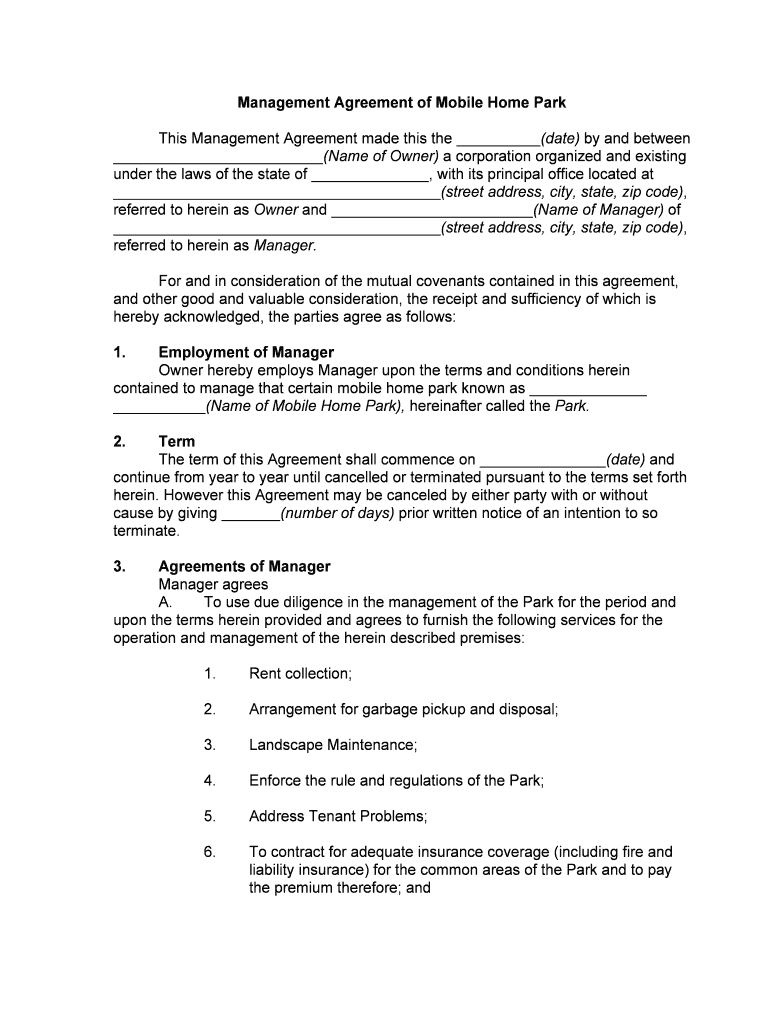
A well‑drafted Management Agreement clarifies authority, reduces disputes, and preserves legal remedies by documenting duties, limits on spending and contract signing authority, performance standards, and termination triggers. It also helps with regulatory compliance, insurance claims, and tax reporting.

Owners and managers across small business, real estate, and professional services commonly use Management Agreements to define responsibilities and compensation.
Agreements are also commonly reviewed by corporate counsel, accountants, and insurance advisers before execution to confirm scope, tax treatment, and risk allocation.
Owner or authorized representative who delegates management authority. This signer must have authority to bind the asset or business and should match the legal entity name used for tax and insurance documents; mismatched names can create enforceability issues and backup withholding or title problems.
Individual or company accepting management duties. The manager's signature should be by an officer or authorized agent, and the document should state whether subagents, contractors, or employees may act on the manager's behalf.
Describe specific duties (maintenance, leasing, bookkeeping, vendor selection), frequency of reporting, and deliverables. Avoid vague terms; reference exhibits for detailed schedules and fee calculations.
Spell out the manager's authority to enter contracts, approve vendors, disburse funds, or evict tenants. Include monetary limits requiring owner approval to limit inadvertent commitments.
Specify fees (flat, percentage of revenue, or performance fees), timing of payments, reimbursable expenses, and treatment of third‑party costs to prevent billing disputes.
State the effective date, fixed or renewable term, notice periods for nonrenewal, cure periods for breaches, and consequences of early termination, including final accounting and transition obligations.
Require appropriate insurance limits, name parties as additional insured if needed, and include mutual indemnities for negligence and breaches, with caps if negotiated.
Define accounting standards, frequency of financial reports, audit rights, electronic delivery formats, and retention periods for records and supporting documents.
| Field | Configuration |
|---|---|
| Authentication | Email link | SMS code | Knowledge‑based (if required) |
| Conditional Fields | Show fee or insurance fields only when relevant to the selected asset type |
| Audit Trail | Capture IP, timestamp, and action log for each signer |
| Integrations | Connect to CRM, accounting, or document storage (Salesforce, NetSuite, Box) |
Choose document formats and signer authentication to meet legal and industry requirements before sending for signature.
Maintain an audit trail and storage plan that satisfies ESIGN (15 U.S.C. §7001) and applicable industry rules; consider a BAA if the agreement contains protected health information.
Date the agreement becomes operative; use MM/DD/YYYY.
Commonly 30–90 days; check clause for exact period.
Often 10–30 days to remedy breaches before termination.
Due within a specified period after termination, typically 30–90 days.
Require proof of renewal before policy expiration dates each year.
| signNow | DocuSign | Adobe Sign | PandaDoc | HelloSign | |
|---|---|---|---|---|---|
| Starting Price | $8/user/mo | $15/user/mo | $14/user/mo | $19/user/mo | $15/user/mo |
| Free Trial | 7‑day free trial | Varies | Varies | Varies | Varies |
| Bulk Send | Yes | Yes | Yes | Yes | No |
| Audit Trail | Yes | Yes | Yes | Yes | Yes |
| HIPAA Compliant | Yes | Yes | Yes | No | No |
Optica implemented standardized management agreements across its portfolio to speed onboarding for new properties
Martin Properties shifted to online execution for agency management agreements