Establishing secure connection…Loading editor…Preparing document…

Florida Certificate of Compliance with Mandatory Disclosure

This template is fully customizable. Edit the text, fill out the fields, and send it for signature. Give it a try!
Florida Certificate of Compliance with Mandatory Disclosure

What the Florida Certificate of Compliance with Mandatory Disclosure Is

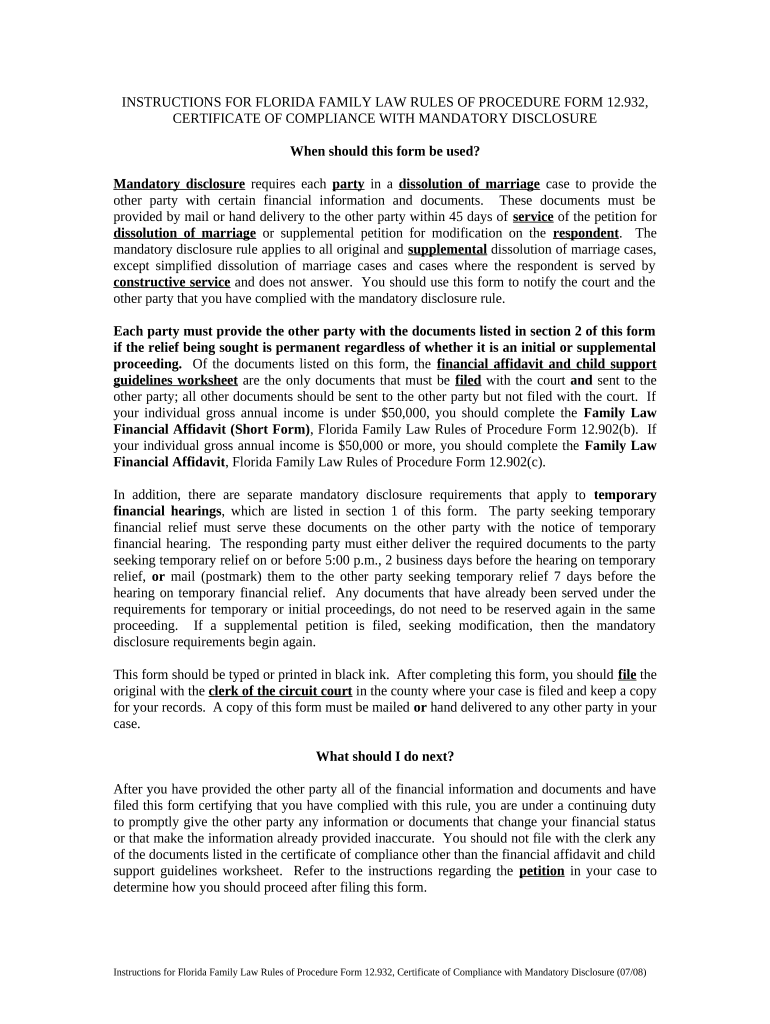
The Florida Certificate of Compliance with Mandatory Disclosure is a written attestation used in Florida real estate transactions to confirm that required seller disclosures have been completed and provided to prospective buyers. It summarizes statutorily required statements about property condition, known defects, and other material facts that Florida law or local ordinances require sellers to disclose. The certificate documents the seller’s representations, identifies the property and parties, and records the delivery date of the disclosures, forming part of the transaction record relied on by brokers, lenders, and closing agents.

Why this Certificate Matters in Florida Real Estate Deals

This certificate provides a clear, auditable record that mandatory disclosures were made, reducing closing delays and limiting post-closing disputes related to non-disclosure or misrepresentation.

Why this Certificate Matters in Florida Real Estate Deals

Who typically completes and relies on the certificate

The certificate is prepared by sellers and their agents, reviewed by buyers, and retained by closing agents as part of the transaction file.

  • Sellers and their attorneys — confirm full disclosure and sign the certificate before listing or contract acceptance.
  • Real estate brokers and agents — collect disclosures to meet agency duties and document compliance.
  • Title and closing agents — use the certificate to confirm documentation before issuing title commitments and closing.

Accurate completion helps all parties manage risk and supports lender and title requirements at settlement.

Primary signers and responsible parties

Seller — Owner

The property owner signs to attest to the accuracy of disclosures. The owner’s signature affirms knowledge of material defects and triggers the certificate’s legal effect in the transaction record.

Listing Agent — Broker

The listing agent documents delivery of disclosures to potential buyers and confirms that the seller provided the required information, creating an agent-level record of compliance.

Core parts of a professional Certificate of Compliance

A complete certificate combines identity, property identification, disclosure summary, dates, signatures, and retention instructions so it functions as a reliable legal and closing record.

Seller Identity

Full legal names of all sellers as they appear on title, including entity names for corporate or trust sellers; necessary for attribution and verification.
Property Details

Parcel ID, street address, and legal description or MLS number to tie the certificate explicitly to the subject property and closing file.

Disclosure List

A checklist or summary naming specific mandatory disclosures provided (e.g., property condition, lead-based paint, flood zone information), with delivery dates.

Delivery Dates

Date(s) when the disclosures were delivered to buyer or buyer’s agent; controls timing for rescission rights and deadlines.

Signatures

Seller and agent signature blocks with printed names and signature dates; signatures create attribution and intent to sign.

Retention Note

A brief instruction on how long the certificate should be kept in the transaction file and who is the custodian of the record.

Required information fields at a glance

Seller Name: Full legal name
Property Address: Street, city, ZIP
Parcel ID: County parcel number
Disclosure Items: List of disclosures
Signature Date: MM/DD/YYYY
Signer Role: Seller, agent, or attorney

Step-by-step: filling and finalizing the certificate

Follow these steps in order to ensure the certificate is complete and accepted by title and lenders.

  • 01
    Prepare disclosures: Gather all statutory and required property disclosures before populating the certificate.
  • 02
    Complete fields: Enter seller, property, and delivery date information accurately in each field.
  • 03
    Sign and date: Seller and agent sign electronically or on paper with date and printed names.
  • 04
    Retain copy: Provide copies to buyer, agent, and closing agent and store in the transaction file.

Configuring an online workflow for the certificate

Set up fields, authentication, and routing so the certificate fits your closing process and preserves an audit trail.

Field Configuration
Signature Field Require signer attribution and timestamp
Date Field Use MM/DD/YYYY validation
Routing Order Seller → Agent → Title/Buyer
Authentication Email link or SMS code for signer verification

Where the completed certificate goes in the closing process

Understand routing so the certificate is available to title, lender, and buyer when needed.

  • Seller to Agent: Seller signs and returns certificate to listing agent for verification.
  • Agent to Buyer: Agent provides copy to buyer or buyer’s agent for acknowledgement.
  • Agent to Title: Agent or seller uploads certificate to title/closing agent as part of the commitment package.
  • Closing File: Final signed certificate is retained in the transaction and delivered to lender if required.

Digital signing and eSubmission considerations

Choose an eSignature platform and settings that meet legal and lender expectations for attribution, retention, and security.

  • Integrations: Salesforce | NetSuite | Google Workspace | Microsoft 365 integrations help route and archive documents.
  • Formats: PDF and PDF/A output preserves signatures and is accepted by title companies.
  • Security: Use TLS and AES encryption in transit and at rest; require audit trails.

Timing and processing expectations

Key dates and timeframes help ensure the certificate supports closing schedules and lender requirements.

Disclosure Delivery:

Deliver disclosures before contract acceptance if required by agreement or local custom.

Signature Date:

Signature dates anchor when disclosures were made and affect rescission windows.

Title Review:

Allow at least 3–5 business days for title to accept and file the certificate into the commitment.

Lender Review:

Expect lenders to request copies during underwriting; provide promptly to avoid delays.

Archival:

Store the final certificate with the closing package immediately after settlement.

Common preparation mistakes to avoid

  • Using informal or partial seller names that do not match title records, causing delays in clearing title.
  • Entering delivery dates incorrectly or leaving date fields blank which can affect buyer rights and lender acceptance.
  • Failing to attach or list required companion disclosures such as lead-based paint notices or HOA documents.
  • Relying on unsigned or image-only signatures without an audit trail, raising questions about attribution and intent.

Risks and consequences of incorrect or missing certificates

Contract Delays: Closing postponement
Title Objections: Title or lender may require re-execution
Legal Claims: Potential for post-closing disclosure suits
Monetary Exposure: Damages, settlement costs
Escrow Issues: Escrow holdbacks or adjustments
Regulatory Review: Possible enforcement action for statutory noncompliance

Representative eSignature pricing and feature comparison

Compare starting prices and key features for common eSignature providers; signNow appears first per vendor listing rules.

signNow DocuSign Adobe Sign PandaDoc HelloSign
Starting Price $8/user/mo $15/user/mo $14/user/mo $19/user/mo $15/user/mo
Free Trial 7-day free trial Yes Yes Yes Yes
Bulk Send Yes (Business Premium) Yes Yes Yes No
Audit Trail Yes Yes Yes Yes Yes
HIPAA Compliant Yes (BAA) Yes Yes No No
Envelope Cap No cap 100 envelopes/user/year Varies by plan Varies by plan Varies by plan

Electronic signature versus digital (cryptographic) signature

Understanding the technical and legal differences helps decide whether a basic e-signature suffices or a PKI-backed digital signature is required.

Criteria Electronic Signature Digital Signature
Legal Definition broad electronic process pki-based cryptographic process
Technology varied (images, typed, click) x.509 certificate required
Non-repudiation audit trail evidence strong cryptographic non-repudiation
Common Use Cases contracts, disclosures high-assurance regulatory filings

Real-world examples of electronic certificates in practice

Two representative examples show how firms integrated electronic certificates into closing workflows.

Martin Properties

Martin Properties moved to fully online closing packets to speed deals and reduce in-person steps.

  • Team adopted mobile signing for on-site sellers.
  • The result was faster turnaround and consistent compliance tracking across listings, with signed certificates available to title within minutes of execution.

BIS

BIS selected a compliant eSignature solution to centralize transactional records.

  • The company enforced role-based routing for signatures.
  • Centralized audit trails and standardized certificates reduced post-closing inquiries and improved internal audit readiness for compliance reviews.

Downloading, exporting, and packaging the signed certificate

Ensure the signed certificate and supporting documents are exportable in accepted formats and packaged for title and lender review.

Export Formats

Provide signed files as PDF and PDF/A to preserve signature appearance and ensure long-term readability for title and lender archives.

Certified Copies

Create a certificate of completion or audit report that documents signer identity, timestamps, and IP addresses to support evidentiary needs.

Attachments

Bundle companion documents (lead-based paint disclosure, HOA documents, inspection reports) as a single package to reduce missing-document rejections at closing.

Audit Trail

Include a full audit trail with each exported file so lenders and title insurers can verify the signing sequence and authentication methods used.

Frequently asked questions about the certificate and eSigning

Answers to common questions about validity, signing methods, corrections, and practical execution in Florida real estate transactions.


Need help? Contact support

be ready to get more
Join over 28 million airSlate SignNow users